NCERT Solutions for Class 9 Science Chapter 13: Earth as a System: Energy, Matter, and Life by PW
 Mishika Gupta17 Nov, 2026

Earth functions through the interaction of different natural systems, including the atmosphere, hydrosphere, geosphere and biosphere. Understanding how energy and matter move between these systems can be challenging when you study their individual processes and connections. NCERT Solutions for Class 9 science Chapter 13 by PW provide clear answers to textbook questions to help you understand these concepts.
Practising the questions can help you connect scientific ideas with natural processes and understand how changes in one Earth system affect others. Use the solutions to review important concepts, work through different question types and strengthen your preparation for the Class 9 Science examination.
Check the CBSE Class 9 Syllabus 2026–27 to get complete details of the prescribed chapters and topics and plan your studies effectively.
NCERT Solutions for Class 9 Science Chapter 13
The chapter Earth as a System: Energy, Matter, and Life explains how different components of Earth interact and maintain environmental balance. The following solutions cover the activities, in-text questions, NCERT exercises and The Quest Continues section.
Practice with CBSE Class 9 Sample Papers to understand the exam pattern, test your knowledge, and improve your preparation for school exams.
Activity 13.1: Let Us Explore
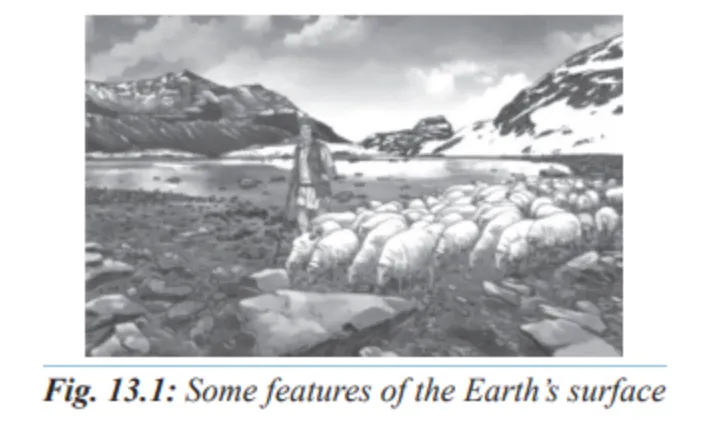
Q1. Observe the features of the Earth as shown in Fig. 13.1. Identify and circle one example representing each of the geosphere, hydrosphere, cryosphere, atmosphere, and biosphere.
Ans.
|
Sphere |
Example from Fig. |
|
Geosphere |
The rocky mountains and the soil/stones on the ground. |
|
Hydrosphere |
The water in the lake. |
|
Cryosphere |
The snow and ice capping the mountain peaks. |
|
Atmosphere |
The air and clouds in the sky above the landscape. |
|
Biosphere |
The sheep, the grass, and the shepherd. |
Q2. How does snow (cryosphere) eventually become part of the lake (hydrosphere)?
Ans. When the temperature rises or when summer begins, the snow on the mountains starts to melt. This melted snow turns into liquid water. Gravity pulls this water downhill in the form of small streams or runoff, which eventually flows into the basin to fill the lake. Thus, water moves from the cryosphere to the hydrosphere.
Q3. If there is less snowfall during winters for a few years, how would this affect the lake’s level and the grass available for the sheep?
Ans. If there is less snowfall, there will be less melted water flowing down the mountains in the spring. This will cause the lake level to drop. Because there is less water in the ground and the lake, the grass will not grow well (it might dry up). This means the sheep will have less food to eat, showing how a change in the cryosphere directly affects the biosphere.
Activity 13.2: Let Us Find Out
Q5. Complete Table 13.1 using information from authentic sources like websites and books.
Ans.
Table 13.1: Reflection of solar radiation by surfaces of materials
|
S. No. |
Materials |
Albedo |
|
1. |
Snow |
0.80–0.90 |
|
2. |
Ice |
0.50–0.70 |
|
3. |
Crushed rock |
0.25–0.30 |
|
4. |
Light-coloured soil |
0.35–0.45 |
|
5. |
Black soil |
0.10–0.15 |
|
6. |
Ocean water |
0.06–0.10 |
Snow and ice have a high albedo, so they reflect most incoming solar radiation and keep polar regions cold. In contrast, black soil and ocean water have a low albedo, absorb more solar radiation, and are therefore warmer.
Explore Class 9 Resources on PW for NCERT Solutions, chapter-wise notes, syllabus, and other essential study materials to make your learning easier.
NCERT Intext Questions
Think It Over
Q1. How does the warming of Arabian Sea water affect the southwest monsoon in India?
Ans. The warming of the Arabian Sea affects the southwest monsoon in the following ways:
-
Increased Moisture: Warmer sea waters increase evaporation, adding more moisture to monsoon winds.
-
Extreme Rainfall: Excess moisture can lead to heavy rainfall, cloudbursts, and flooding.
-
Cyclonic Interference: Higher sea temperatures may generate cyclones that can disrupt or delay the monsoon’s advance over India.
Q2. If a large forest is cleared, how can that affect the flow of a river in that area?
Ans. Yes, clearing a large forest can reduce rainfall and increase soil erosion, which may decrease the water flow in rivers and even cause floods or droughts.
Q3. What might happen to coastal cities in India if glaciers and polar ice keep melting faster?
Ans. If glaciers and polar ice keep melting faster, sea levels may rise and coastal cities in India could face flooding, land loss, and damage to property.
Q4. How would increasing carbon dioxide levels in the atmosphere affect the ocean plankton?
Ans. Increasing carbon dioxide levels can make oceans more acidic, which may harm ocean plankton and disturb the marine food chain.
Pause and Ponder
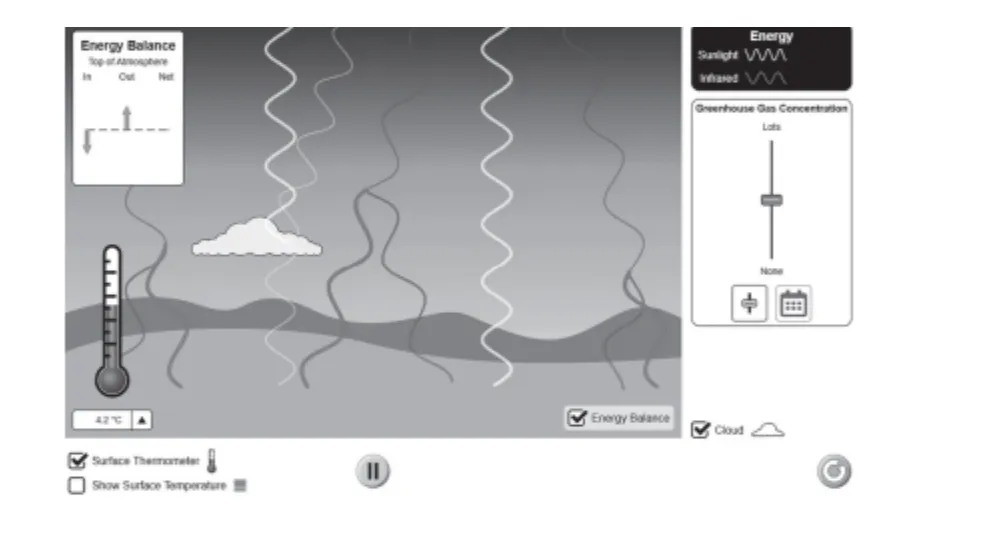
Q5. Visit the website given below and study the effect of the concentration of greenhouse gas on surface temperature.
Ans.
Effect of the concentration of greenhouse gas on surface temperature
-
Increasing greenhouse gas concentration increases Earth’s surface temperature.
-
Greenhouse gases absorb and trap outgoing infrared radiation from Earth’s surface.
-
At low greenhouse gas concentration, more heat escapes into space, so the surface remains cooler.
-
At high greenhouse gas concentration, more heat is trapped in the atmosphere, making the surface warmer.
More greenhouse gases – More heat trapped – Higher surface temperature.
Increased greenhouse gases strengthen the greenhouse effect and contribute to global warming.
Pause and Ponder
Q6. How does the cool mountain breeze benefit agriculture activity, particularly the crops and soil?
Ans. The cool mountain breeze helps maintain cool temperature and moisture in the soil, which supports healthy crop growth and prevents the soil from drying quickly.
Q7. What happens to the warm surface of water from the equator as it travels toward the poles? What impact does this movement have on the area?
Ans. Warm surface water from the equator moves toward the poles carrying heat energy. This warms nearby coastal areas, keeps some ports ice-free during winter, and helps regulate climate.
Pause and Ponder
Q8. The CO₂ dissolved in the ocean is disturbed when the global temperature increases. What will happen to marine life?
Ans. If global temperature increases, the balance of CO₂ dissolved in ocean water gets disturbed, making oceans more acidic. This harms marine organisms like plankton, corals, and shell-forming animals, disturbing the marine ecosystem and reducing marine biodiversity.
Pause and Ponder
Q9. What would happen to plants and animals on Earth if the biogeochemical cycles were disrupted and stopped? Explain by giving a few examples.
Ans. If biogeochemical cycles were disrupted or stopped, the exchange of nutrients between living organisms and the environment would stop, making life on Earth impossible. Plants and animals would not get essential substances needed for survival.
-
If the carbon cycle stopped, plants would not get CO₂ for photosynthesis, reducing food production.
-
If the oxygen cycle stopped, animals and humans would not get oxygen for respiration.
-
If the nitrogen cycle stopped, plants would not get usable nitrogen compounds to make proteins and grow properly.
-
If the water cycle stopped, rainfall would decrease, causing droughts and shortage of water for living organisms.
Thus, disruption of these cycles would disturb ecosystems, reduce biodiversity, and threaten life on Earth.
What If?
Q10. Photosynthesis stopped, what would happen on the Earth?
Ans.
-
Photosynthesis would stop, so plants could not synthesize food (glucose).
-
Atmospheric oxygen levels would decrease.
-
Carbon dioxide concentration would increase.
-
Food chains would collapse as producers die.
-
Most living organisms would eventually become extinct.
NCERT Exercise – Revise, Reflect, Refine
Q1. Choose the most appropriate option to describe the role of biogeochemical cycles in an ecosystem.
(i) To provide food directly to all organisms.
(ii) To recycle essential nutrients between biotic and abiotic components.
(iii) To create new elements for use by living things.
(iv) To remove pollutants and toxins from the organism.
Ans. (ii) To recycle essential nutrients between biotic and abiotic components.
Q2. Which of the following is primarily responsible for warming of the Earth?
(i) Solar radiation is immediately absorbed by carbon dioxide, which then releases it as heat.
(ii) The atmosphere’s tiny particles absorb incoming solar radiation, which directly heats the Earth.
(iii) The Earth’s surface absorbs solar radiation, which is then re-radiated and trapped by greenhouse gases.
(iv) The Earth’s environment is heated only by the solar radiation reflected by the clouds.
Ans. (iii) The Earth’s surface absorbs solar radiation, which is then re-radiated and trapped by greenhouse gases.
Q3. Explain how climate change affects the water cycle. Illustrate with examples.
Ans. Climate change affects the water cycle if the atmospheric temperature increases.
-
A warmer atmosphere holds more moisture, causing heavy rainfall and floods in some areas, while other regions face droughts.
-
Melting glaciers raise sea levels and threaten coastal cities.
-
Heavy rains also increase soil erosion and reduce groundwater recharge, affecting agriculture.
Thus, climate change disturbs the balance of the water cycle and affects the atmosphere, hydrosphere, geosphere, cryosphere, and biosphere.
Q4. Describe how albedo affects the Earth’s surface temperature and its climate.
Ans. Albedo, such as snow and ice, reflect most of the sunlight and remain cooler. Surfaces with low albedo, such as black soil and ocean water, absorb more solar radiation and become warmer.
Thus, albedo controls the amount of heat absorbed by the Earth’s surface and influences climate. Regions with high albedo remain colder, while regions with low albedo experience higher temperatures. Changes in albedo can also affect weather patterns and global climate.
Q6. You have witnessed weather phenomena, such as winds, storms, rainfall, etc. Which atmospheric layer is mainly responsible for such phenomena and what is the primary reason for its occurrence?
Ans. The troposphere is mainly responsible for weather phenomena such as winds, storms, clouds, and rainfall because almost all weather changes occur in this layer. It is heated from the Earth’s surface, so warm air rises and cool air sinks, creating winds and storms. The presence of water vapour and clouds in this layer also causes rainfall and other weather activities.
Q7. Explain the processes involved in the nitrogen cycle. How would life on Earth be affected if nitrogen were not cycled?
Ans. The nitrogen cycle involves the following processes:
-
Nitrogen fixation: Nitrogen-fixing bacteria convert atmospheric nitrogen into ammonia. Lightning also helps in nitrogen fixation.
-
Nitrification: Nitrifying bacteria (Nitrosomonas and Nitrobacter) convert ammonia into nitrites (NO₂⁻) and then into nitrates (NO₃⁻).
-
Assimilation: Plants absorb nitrates from the soil; animals get nitrogen by eating plants.
-
Ammonification: When organisms die, decomposers (bacteria/fungi) break down the organic matter, returning ammonia to the soil.
-
Denitrification: Bacteria like Pseudomonas convert nitrates back into N₂ gas, completing the cycle.
If nitrogen were not cycled, plants would not get usable nitrogen compounds to make proteins and grow. Animals would not get proteins through food, and life on Earth would gradually become impossible. Ecosystem balance would also be disturbed.
Q9. Explain with suitable diagram the path that carbon takes to go back to the atmosphere. You may start from plants using CO₂ from the atmosphere.
Ans. Plants absorb CO₂ from the atmosphere during photosynthesis and prepare food. Animals obtain carbon by eating plants or other animals. Through respiration, plants and animals release CO₂ back into the atmosphere.
When plants and animals die, decomposers break down the organic matter and release carbon dioxide. Some dead organisms get buried and form fossil fuels like coal and petroleum. Burning of fossil fuels also releases CO₂ into the atmosphere.
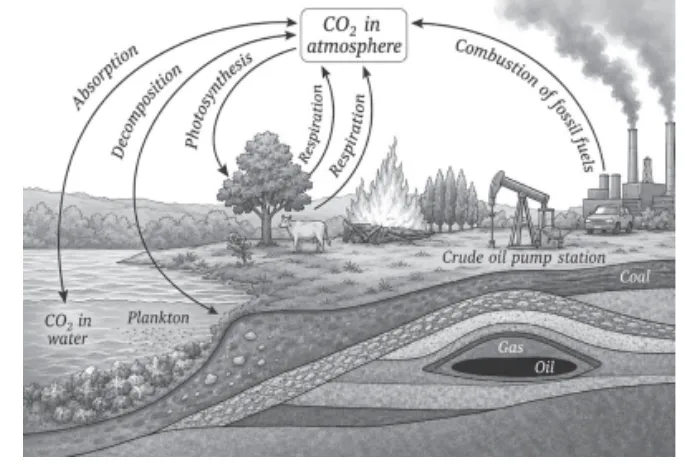
Thus, carbon continuously cycles between the atmosphere, living organisms, oceans, and Earth’s crust.
Ready to strengthen your Science preparation? Explore PW Class 9 Online Batches for focused learning and practice.
NCERT Solutions for Class 9 Science Chapter 13 PDF
You can use the PDF of NCERT Solutions for Class 9 Science Chapter 13 to access the answers in one place and revise the chapter's textbook questions.
NCERT Solutions for Class 9 Science Chapter 13
Study without using the internet
Why Choose NCERT Solutions for Class 9 Science Chapter 13 by PW?
NCERT Solutions for Class 9 Science Chapter 13 by Physics Wallah help you understand how Earth's natural systems interact. The answers cover activity-based questions, in-text exercises, textbook exercises and application-based questions.
-
Understand Earth's five spheres: Learn about the geosphere, hydrosphere, cryosphere, atmosphere and biosphere through examples such as mountains, lakes, snow, air and living organisms.
-
Learn the concept of albedo: Review how different surfaces reflect or absorb solar radiation and how this affects Earth's temperature.
-
Connect concepts with climate change: Understand the effects of rising temperatures, melting ice, greenhouse gases and changing rainfall patterns.
-
Revise biogeochemical cycles: Strengthen your understanding of the carbon, nitrogen, oxygen and water cycles through relevant questions and explanations.
-
Practise application-based questions: Relate scientific concepts to everyday activities, food production, human actions and environmental changes.
Looking to improve your Science problem-solving skills? Practise key concepts and strengthen your exam preparation with PW Class 9 Science resources.
Earth's natural systems work together through the continuous movement of energy and matter. Understanding their connections helps explain climate patterns, the water cycle, changes in biodiversity and the effects of human activities. Use NCERT Solutions for Class 9 Science Chapter 13 by PW to review the textbook questions and strengthen your understanding of how Earth supports life.
NCERT Solutions for Class 9 Science Chapter 13 FAQs
What are the five major spheres of Earth discussed in Chapter 13?
What is albedo in Class 9 Science Chapter 13?
Which topics are covered in NCERT Solutions for Class 9 Science Chapter 13?
What is the name of Class 9 Science Chapter 13?