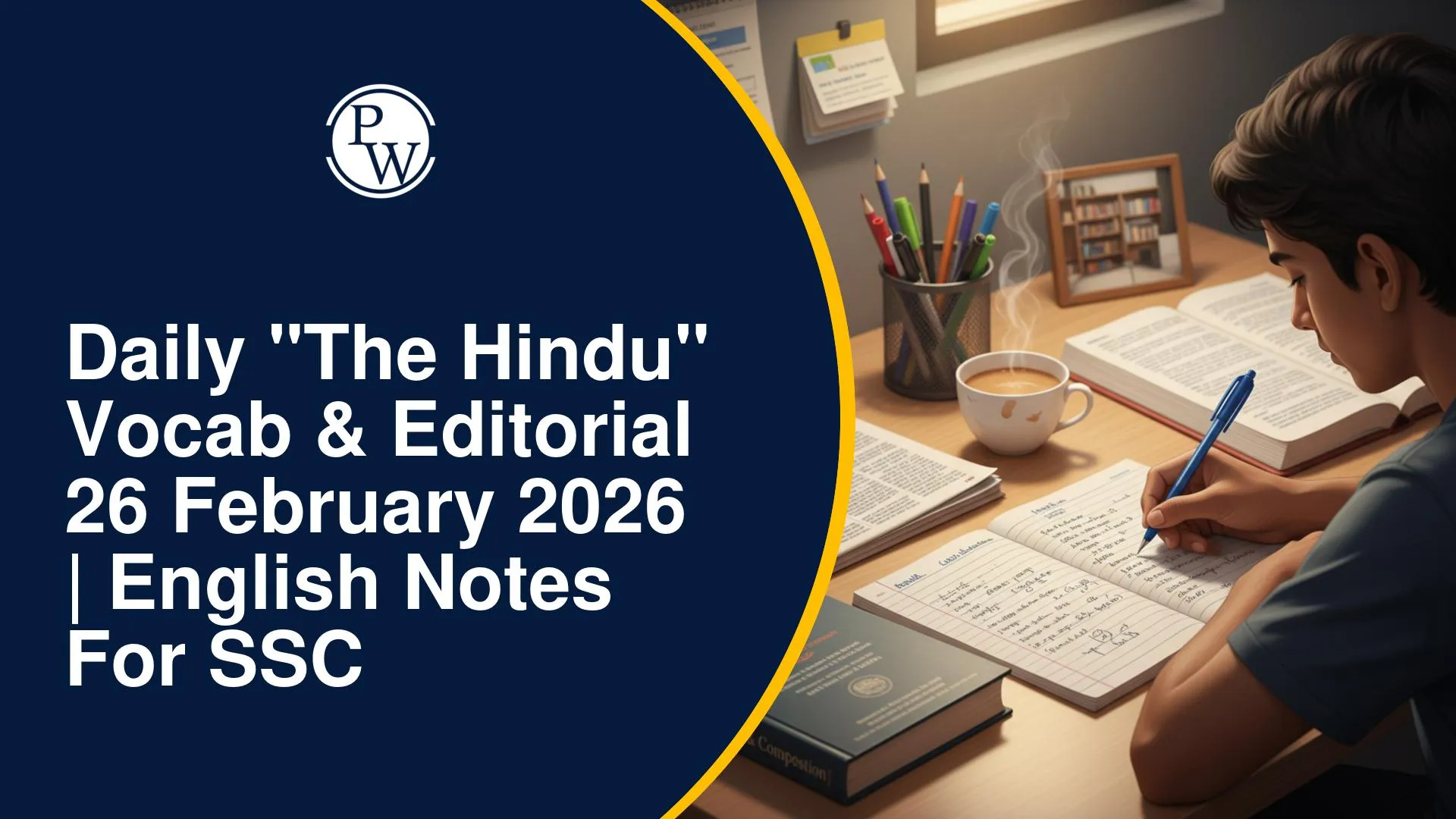
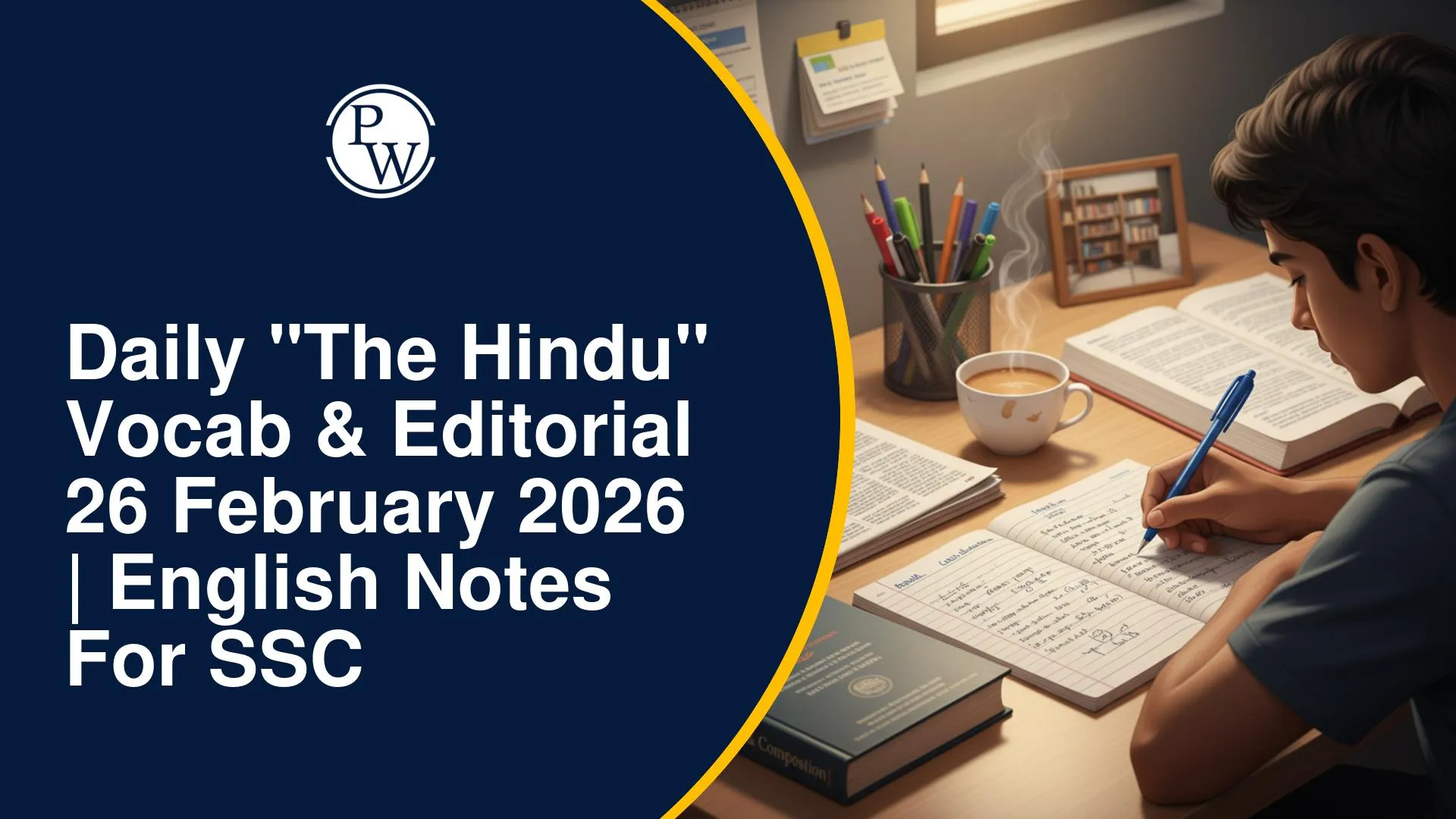
Daily "The Hindu" Vocab & Editorial 26 February 2026 | English Notes for SSC by Bhragu Sir

Preparing for SSC exams requires regular practice of vocabulary and grammar. Many questions in SSC exams are based on English comprehension, synonyms, antonyms, and the correct usage of words. A strong vocabulary helps students understand passages and solve questions with confidence.
The Daily The Hindu Vocabulary and Editorial session conducted by Staff Selection Commission exam mentor Bhragu Sir on 26 February 2026 focused on improving word knowledge through practical examples. This session was useful for beginners as well as students who have been practicing for a few weeks.
The main aim of this class was to help aspirants improve their understanding of English words in an easy and clear manner. The session also included grammar rules, idioms, and contextual reading practice. All the topics were explained using simple examples so that students could remember the meanings during the exam. This daily practice boosts confidence while attempting the English section in exams like SSC GD, SSC CGL, CHSL, RRB Group D, NTPC, ALP, and other government job exams.
Daily "The Hindu" Vocab & Editorial 26 February 2026 Video
In this video, Bhragu Sir explains important vocabulary words, idioms, and grammar rules through editorial-based reading. The session focuses on improving word usage in context. It also helps students understand sentence formation and exam-oriented comprehension.
Vocabulary Building Through Visual Learning
In this segment, words are introduced with picture-based examples. This method helps students understand meanings quickly. It also improves memory retention.
-
Sacred: Something holy or respected.
-
Perpetrated: To commit a harmful or illegal act.
-
Prosecute: To take legal action against someone.
-
Litigate: To settle a matter in court.
-
Concern: A feeling of worry or anxiety.
-
Washed his hands off: Refused to take responsibility.
-
Assemble: To gather together.
-
Retreat: To move back or withdraw.
-
Diverted: To mislead or distract.
-
Vigilantism: Law enforcement done by private individuals.
-
Infringed: To violate a rule or right.
-
Diffidence: Hesitation due to lack of confidence.
-
Spate: A sudden increase in something.
-
Recourse: A source of help in a difficult situation.
-
Distort: To twist facts.
-
Punitive: Related to punishment.
-
Dismay: A feeling of shock or distress.
Learning such words helps students solve vocabulary-based questions more easily in SSC exams.
Root Word Study: CRED
Root words are very useful for vocabulary development. One root word can help understand many related terms. In this session, focus is given to the root word “Cred”, which means belief or trust.
-
Credible: Believable or trustworthy.
-
Incredible: Not believable or very surprising.
-
Credence: Acceptance as true.
-
Credentials: Documents that prove qualification.
-
Credit: Recognition or trust given to someone.
-
Credulous: Someone who believes easily.
-
Discredit: To damage someone’s reputation.
-
Creed: A set of beliefs.
-
Accredit: To officially recognize.
Understanding root words helps students guess the meanings of unfamiliar words during exams.
Idioms and Phrases
Idioms are often used in SSC English questions. Knowing their meanings helps in sentence correction and comprehension.
-
To go wool gathering: To daydream or lose focus.
-
To make a pile: To collect a large amount of money.
-
To break the staff over someone: To punish someone strictly.
-
To declare someone illegally dead: To condemn someone without proof.
Such phrases improve understanding of the language used in passages.
Important Vocabulary for Editorial Reading
Editorials often include political and social vocabulary. Learning these words helps in reading comprehension.
Demagogue: A leader who gains support by appealing to emotions. Antonyms: Statesman, diplomat.
-
Double down: To continue strongly with a decision.
-
Fret: To feel anxious or tense.
-
Undaunted: Not discouraged.
-
Disdain: Feeling of disrespect. Antonyms: Respect, admiration.
-
Burgeoning: Growing rapidly. Antonyms: Declining, shrinking.
-
Allude: To suggest indirectly.
-
Heavy-handed: Using excessive force. Antonyms: Gentle, moderate.
-
Modus vivendi: A temporary peaceful agreement.
-
Touting: Publicly promoting something.
-
Swath: A large area or range.
These words are useful for understanding complex passages in SSC exams.
Grammar Rule for Exam Accuracy
Grammar rules are also discussed in the session. One important rule is:
After verbs like avoid, the next verb should be in the –ing form.
Example:
Correct: He avoided making mistakes.
Incorrect: He avoided make mistakes.
Reading Comprehension 26 February 2026
In his 2026 State of the Union address, U.S. President Donald Trump chose to double down on the politics of his conservative support base by touting his second administration’s achievements with regard to divisive, if not polarising issues relating to immigration, the cost of living, and foreign policy concerns including tariffs and the prospect of war in the context of Iran.
The speech itself comes at a fraught moment for the Trump White House, days after the U.S. Supreme Court struck down its use of the International Emergency Economic Powers Act to slam a broad swathe of trading partners, including India, with punitive tariffs.
An apparently undaunted Mr. Trump repeated his earlier remarks on social media hinting at disdain for the ruling, when he described it during the speech as “unfortunate” and argued, against evidence to the contrary regarding the burgeoning public debt, that the tariff revenues received by his government were “saving” the U.S.
Similarly, he neatly avoided alluding to the two Americans killed in ICE raids in Minneapolis or the agency’s other heavy-handed actions targeting “criminal aliens” and “drug lords”.
With regard to Iran, even though Washington has rapidly built up its force posture across West Asia following Teheran’s crackdown on protesters, Mr. Trump appeared to be holding out hope for a modus vivendi when he said, “My preference is to solve this problem through diplomacy. But... I will never allow the world’s number one sponsor of terror, which they are by far, to have a nuclear weapon.
Editorial Analysis: Contextual Learning
The session used recent political and social news to explain how vocabulary is applied.
-
Political Context: The word "Demagogue" was used to describe leaders who use emotions rather than logic.
-
Health Context: The term "Jab" was explained as a common word for a vaccination or injection, specifically regarding the HPV vaccine.
-
Legal Context: Terms like "Punitive" (relating to punishment) and "Litigate" (to go to court) were discussed to help with reading comprehension.
PW provides SSC exam content, including SSC Exams Updates, sample papers, mock tests, guidance sessions, and more. Also, enroll today in the SSC Online Batches for preparation.
Daily The Hindu Vocab & Editorial 26 February 2026 FAQs
What is the main focus of Daily "The Hindu" Vocab & Editorial sessions?
How does Bhragu Sir teach new words in the session?
Why is root word study important in SSC English preparation?
Which grammar rule was highlighted in the 26 February 2026 session?