







SSC CGL Reasoning Paper Folding & Cutting: Rules and Questions

Paper Folding and Cutting is a visual reasoning topic in which candidates are shown a sheet of paper folded one or more times before certain cuts are made. The paper is then unfolded, and candidates must identify the final pattern created by those cuts.
These questions assess spatial visualization, observation, and logical reasoning rather than mathematical calculations. Since the patterns follow the principles of symmetry and mirror reflection, understanding the folding sequence is more important than memorizing shortcuts.
With regular practice, Paper Folding and Cutting becomes one of the quicker and more scoring topics in the SSC CGL Reasoning section.
Why is Paper Folding and Cutting Important for SSC CGL?
Paper-folding and Cutting questions are frequently asked in SSC CGL and other SSC examinations, such as CHSL, CPO, and MTS. They require less calculation and can be solved quickly once the basic concepts are clear.
Some reasons why this topic is important include:
-
Frequently asked in SSC reasoning exams.
-
Helps improve spatial visualization and logical thinking.
-
Can be solved quickly with the right approach.
-
Offers good scoring opportunities with regular practice.
Rules to Solve Paper Folding and Cutting Questions
Before attempting questions, remember these basic rules:
-
Every fold creates a line of symmetry.
-
Every unfold reflects the existing cuts across that fold.
-
The original cut shape never changes after unfolding.
-
More folds generally result in more reflected cuts.
-
Follow the unfolding sequence in reverse order of folding.
-
Eliminate options that violate symmetry or show an incorrect number of cuts.
Illustrative Example: Paper Folding and Cutting Process
Consider a square piece of paper to understand the process:
-
First Fold: The paper is folded along a dotted line, reducing its size.
-
Second Fold: This smaller, folded shape is folded again along another dotted line, making it even smaller.
-
Cuts: Specific cuts are then applied to this final folded shape.
-
Unfolding: The paper is then unfolded in reverse order of folding.
When the paper is unfolded from the second fold, the original two cuts will reflect, resulting in four cuts (e.g., two circles become four circles). This reflection creates a mirror image of the cuts across the fold line. Therefore, options with an incorrect number of cuts or an improper arrangement will be wrong.
Paper Folding and Cutting Practice Questions and Solutions
Practising different types of paper folding and cutting questions is the best way to improve speed and accuracy for SSC CGL. The questions below demonstrate how folding patterns, symmetry, and the elimination method can be applied to solve exam-level problems effectively.
Practice Question 1 (SSC CGL Pre)
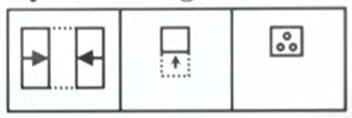
Options:
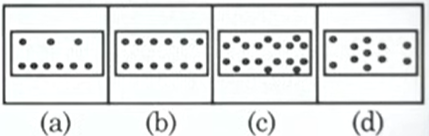
Answer: (d)
Explanation: The pattern shows that when two elements merge/converge, the resulting figure combines their features in a reduced/organised manner. The 4 dots in the question figure correspond to answer (d), which shows a similar small, organised arrangement of dots matching the pattern of condensation seen in the series.
Practice Question 2 (SSC CGL Pre 2011)
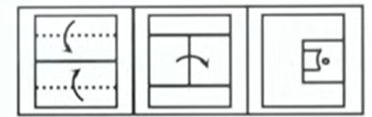
Options:
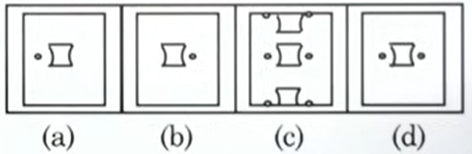
Answer: (b)
Explanation: The pattern shows that the figures progressively combine — curved lines form an hourglass/bowtie shape, and the dot (from figure 3's target element) appears on the right side. Option (b) correctly shows the hourglass shape with a single dot positioned on the right, matching the transformation pattern of the series.
Practice Question 3 (SSC CGL Pre 2011)
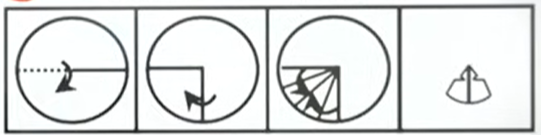
Options:
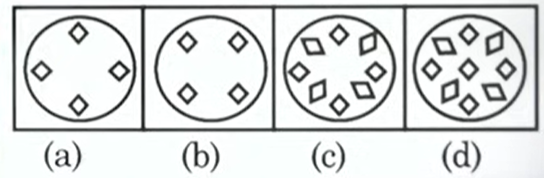
Answer: (d)
Explanation: The pattern shows progressive filling/increase in elements inside the circle — from a single arrow, to a quarter shape, to a fully shaded pattern. The fourth figure should show the maximum density of elements. Option (d) with the most diamonds densely packed throughout the circle best continues this pattern of increasing density.
Practice Question 4
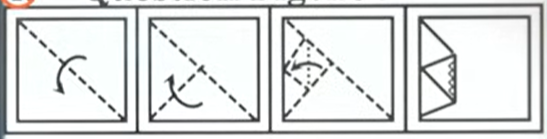
Options:
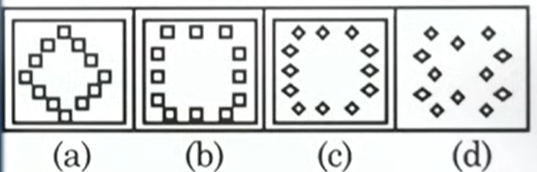
Answer: (b)
Explanation: The question figures show a square being progressively folded — the folding creates a layered rectangular shape. When unfolded, the crease pattern would produce a symmetric rectangular arrangement of elements along the border. Option (b) with small squares arranged in a neat rectangular border pattern best represents the result of this folding sequence.
Practice Question 5
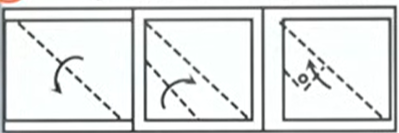
Options:
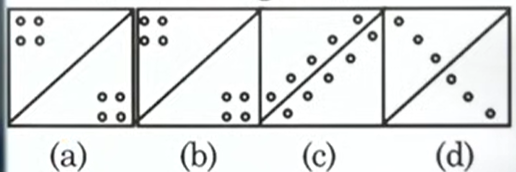
Answer: (a)
Explanation: The folding sequence shows the square being folded along the diagonal. The small circle/dot in figure 3 represents a hole punch. When folded and punched, then unfolded, the dots appear symmetrically on both sides of the diagonal. Option (a) shows equal symmetric distribution of dots on both triangular halves, correctly representing the unfolded result.
Practice Question 6 (SSC CPO SI & IB 2010/2011)
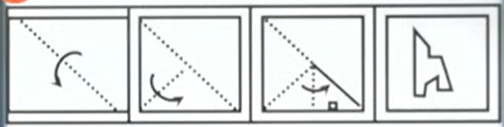
Options:
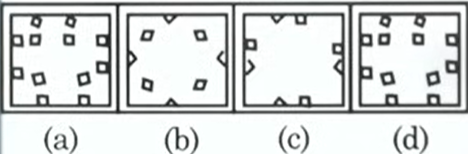
Answer: (b)
Explanation: The paper is folded diagonally twice and a square notch is cut from the corner. When unfolded, the cut creates symmetric notches/arrow shapes on all four sides and corner squares appear at each corner. Option (b) correctly shows both the inward arrow patterns from the notch cuts and the symmetric corner squares resulting from the two diagonal folds.
Paper Folding and Cutting FAQs
What is the primary objective of Paper Folding and Cutting questions?
Which method is most effective for solving these questions accurately?
How do cuts reflect during the unfolding process?







Get Free Counselling Today
and Clear up all your Doubts
 Live & recorded classes available at easeDashboard for progress trackingLakhs of practice questions

