







SSC CGL Reasoning Seating Arrangement: Concepts, Rules, Examples
 Aarti .29 Jun, 2026
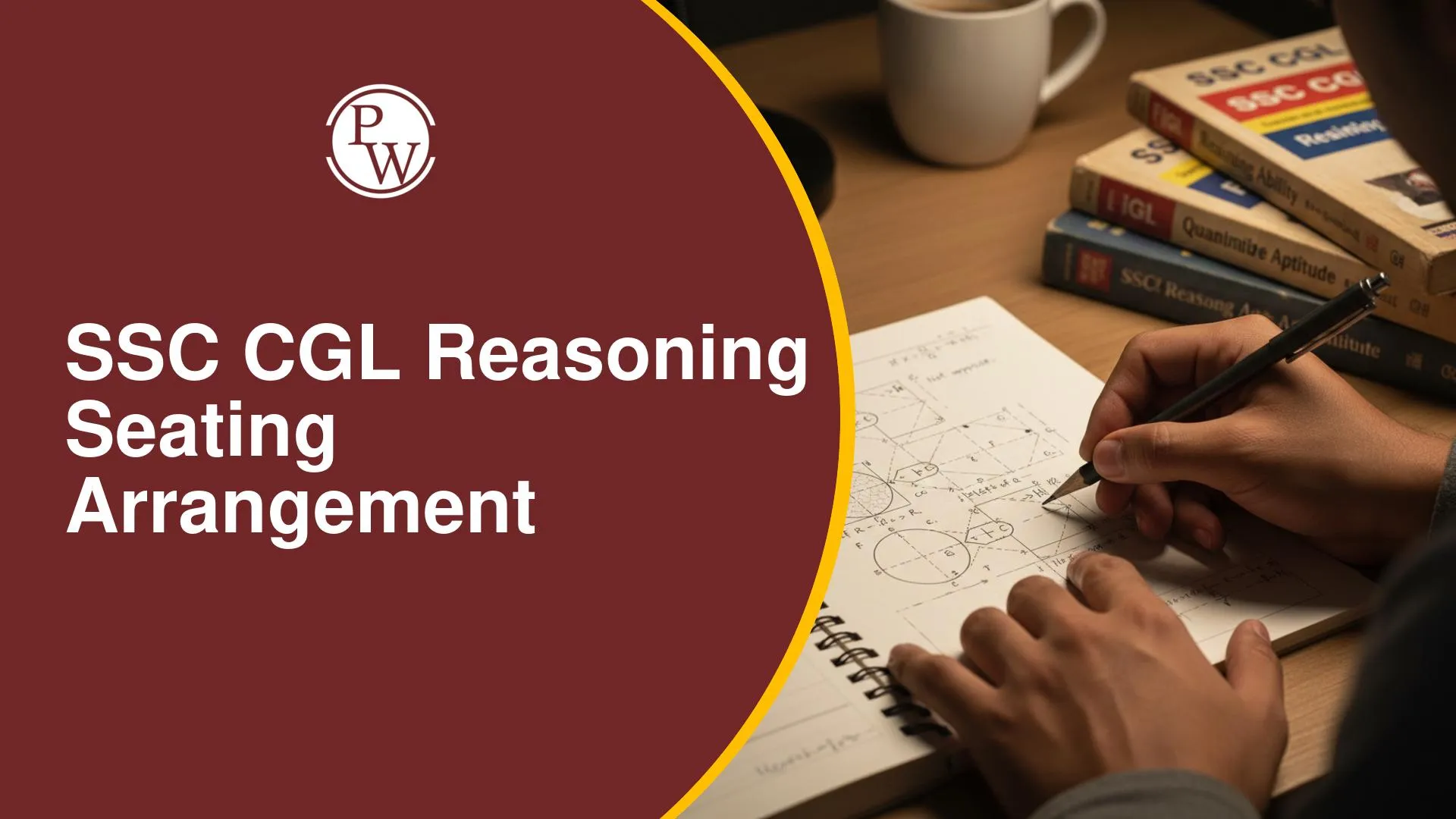
Seating Arrangement is one of the most important topics in SSC CGL Reasoning and appears regularly in the examination. These questions test a candidate’s ability to analyze information, understand relationships, and arrange people based on given conditions. While the concepts may seem simple, small mistakes in understanding directions, positions, or connectors can lead to incorrect answers.
Learning the basic rules and following a step-by-step approach can help candidates solve seating arrangement questions quickly and accurately in the exam.
Basic Concepts & Terminology in Setting Arrangement
Understanding the specific meanings of certain words is crucial for solving Setting Arrangement questions accurately.
Left & Right (Baen & Daen)
The interpretation of left and right depends entirely on the individual's facing direction.
-
Center-Facing Arrangement: When individuals face towards the center of an arrangement, their right and left directions correspond to your own right and left. For example, if a person E faces the center, their right is to your right.
-
Outward-Facing Arrangement: When individuals face away from the center, their right and left are opposite to your own right and left (and opposite to those facing the center). For instance, if person D faces outwards, their right is to your left from your perspective. This difference is critical; the right/left for outward-facing is the just opposite of inward-facing.
Immediate Neighbor (Nikattatam Parosi)
An immediate neighbor is a person sitting directly adjacent to a specified person. In most arrangements, a person has two immediate neighbors, one on each side, unless positioned at an end in a linear arrangement. For example, if A is positioned between H and B, then both H and B are immediate neighbors of A. This concept is usually straightforward.
Next To (Agala Sthan)
There can be some confusion with "Next To." However, "Next To" carries the same meaning as "Immediate Neighbor." It refers to someone directly adjacent.
|
Term |
Meaning |
|---|---|
|
Immediate Neighbor |
Adjacent position |
|
Next To |
Same as Immediate Neighbor |
Opposite vs. Facing (Vipreet vs. Sammukh)
The terms "opposite" and "facing" have distinct meanings. The meanings of Opposite and Facing are different.
-
Opposite (Vipreet): Refers to the person sitting directly across from another in an arrangement. Their faces might or might not be directed towards each other. For example, in an 8-person circular table, A and E might be opposite without looking at each other.
-
Facing (Sammukh): Implies that two individuals are looking directly at each other. Their faces must be directed towards one another. For two people to be "facing" each other, their mouths/faces must be towards each other. If one person looks inwards and another outwards, or both look outwards in the same direction, they are not facing each other.
|
Term |
Meaning |
|---|---|
|
Opposite |
Positionally across |
|
Facing |
Positionally across AND looking at each other |
Between (Beech Mein)
The term "Between" can have two interpretations, and a priority rule applies.
-
First Priority: Always give first priority to the person or persons sitting nearest or immediately between the two specified individuals.
-
Second Priority: If the arrangement does not work with the nearest option, then consider individuals further apart but still "between" in a broader sense. This is a crucial point for problem-solving.
Connectors: Who/That/Which and And/But/Also/While
These conjunctions are extremely important as they determine which person in a statement the subsequent clause refers to. This is the most important point for correctly interpreting conditions in Setting Arrangement problems.
-
Who / That / Which: Always refers to the second person (the object) mentioned in the preceding clause.
-
-
Example: "A is sitting second to the right of C, who is sitting second to the right of E." Here, "who" refers to C, not A. The statement means "C is sitting second to the right of E."
-
-
And / But / Also / While: Always refers to the first person (the subject) mentioned in the preceding clause.
-
-
Example: "A is sitting second to the right of C, and is sitting second to the right of E." Here, "and" refers to A, not C.
-
Step-by-Step Approach to Solve Seating Arrangement Questions
A structured approach is key to solving Setting Arrangement problems effectively:
-
Fixed Position First: Begin by placing an individual in the arrangement (e.g., a circular table). You can place the first person anywhere if no specific condition restricts their initial position.
-
Exact Information: Identify and use exact, 100% confirmed information to build the arrangement. Avoid assumptions.
-
Link Information: Connect subsequent pieces of information to the individuals already placed in the arrangement.
-
Iterative Process: If a piece of information cannot be immediately placed, skip it and move to the next. Return to it when more of the arrangement is filled, and conditions become clearer.
SSC CGL Seating Arrangement Examples
The following SSC CGL Seating Arrangement examples will help you understand how to apply key concepts and check different types of arrangement questions step by step.
Question 1:
Six students, Kabir, Messi, Ronaldo, Sharon, Raj, and Moosa are sitting around a circular table facing the centre. Moosa is sitting second to the left of Sharon. Kabir is sitting second to the left of Moosa. Ronaldo is sitting to the immediate left of Kabir. Raj is sitting to the immediate left of Moosa. Messi is an immediate neighbour to Sharon and Moosa. Who is sitting between Ronaldo and Messi?
Question 2:
8 friends A, B, C, D, E, F, G, and H are sitting around a circular table facing the centre. A is the immediate neighbour of B and C. H is the immediate neighbour of F and G. D is sitting to the immediate left of B. E is sitting to the immediate right of C. A and H are sitting opposite each other.
Who is sitting immediately to the right of B?
(a) A
(b) F
(c) H
(d) E
Question 3:
Anil, Bunty, Choubey, Dishant, and Eshan are five students sitting around a circular table facing the centre. Dishant sits to the immediate right of Anil. Choubey is not sitting next to Dishant or Anil. Eshan is sitting to the immediate right of Choubey.
Who is sitting to the immediate right of Dishant?
(a) Bunty
(b) Anil
(c) Choubey
(d) Eshan
Question 4:
Six people J, K, L, M, N and O are sitting around a circular table facing the centre. J sits second to the right of N. O is an immediate neighbour of M and J. K sits second to the left of L.
Who sits to the immediate right of O?
(a) K
(b) N
(c) M
(d) L
Question 5:
Six students are sitting around a circular table facing the centre. A sits to the immediate left of C. E sits third to the right of D. D is an immediate neighbour of C. B is an immediate neighbour of both E and F.
Who is the immediate neighbour of C and E?
(a) B
(b) A
(c) D
(d) F
Question 6
Kirti, Suman, Shubh, Kanak, Pari, Charu, Shlok and Shivi are sitting around a square table facing the centre of the table. Some of them are sitting at the corners, while some are sitting at the exact centre of the sides. Kirti sits third to the left of Shubh. Kirti sits at one of the corners. Kanak sits second to the right of Pari. Pari does not sit at any of the corners. Pari is not an immediate neighbour of Kirti. Suman is an immediate neighbour of Charu. Suman does not sit at any of the middle of the sides. Only three people sit between Suman and Shlok from either sides.
Who sits third to the left of Shlok?
(a) Shubh
(b) Suman
(c) Charu
(d) Shivi
SSC CGL Reasoning Seating Arrangement FAQs
What is the fundamental approach to solving Setting Arrangement problems?
How do "Left" and "Right" change based on facing direction in an arrangement?
What is the difference between "Opposite" and "Facing" in Setting Arrangement questions?
How do connector words like "who" and "and" affect interpretation in a sentence?
When can I place the first person in a circular arrangement problem?








Get Free Counselling Today
and Clear up all your Doubts
 Live & recorded classes available at easeDashboard for progress trackingLakhs of practice questions

