







SSC CGL Reasoning Syllogism: Rules, Venn Diagrams & Tips
 Aarti .1 Jul, 2026
SSC CGL Reasoning Syllogism is an important Logical Reasoning topic that usually carries 1–2 questions in the exam. It is based on statements, conclusions, and options, where candidates use logical deductions to determine whether the given conclusions follow from the statements. The Venn Diagram method is the most commonly used approach because it helps visualize relationships accurately.
The chapter covers four basic statement types-All, Some, No, and Some Not, along with their positive and negative outcomes. Key rules include: positive statements give positive conclusions, negative statements give negative conclusions, and 100% statements can lead to less-than-100% conclusions. Understanding Venn diagrams, reverse cases, and the “Can't Say” concept is essential for solving syllogism questions quickly and correctly in SSC CGL.
SSC CGL Reasoning - Core Components of Syllogism
In SSC CGL Reasoning, syllogism problems are built around three fundamental components:
-
Statement: This is the initial information provided, forming the basis for deduction.
-
Conclusion ( Result): These are the deductions or inferences drawn from the given statement(s).
-
Options: These are the choices provided to validate the conclusions, such as "first correct," "second correct," "both correct," "both incorrect," or "either/or."
To understand the process, imagine you are a judge. In Syllogism, you first plot a diagram based on the statement, then evaluate conclusions, and finally select the correct option.
Methods for Solving Syllogism in SSC CGL
Syllogism problems can be approached using various methods, including the 100-50 method or the Venn Diagram method. The Venn Diagram method is generally preferred for its higher accuracy in representing relationships and drawing conclusions.
Types of Conclusions
Conclusions in Syllogism are primarily categorized into two types:
-
Indefinite (Possibility): These conclusions involve situations where a confirmed result is not available. They often use terms like "possibility." For example, "There is a possibility that some A are B." These cases require specific rules and are often covered separately.
-
Definite: These conclusions yield a confirmed result that can be directly verified from the statements.
Elements (Statement Types) in Syllogism
There are four fundamental statement types in Syllogism, distinguished by the extent of information they provide:
-
100% All: Provides complete information about a relationship (e.g., "All A are B").
-
Less than 100% Some: Provides partial information about a relationship (e.g., "Some A are B").
-
100% No: Represents a complete denial of a relationship (e.g., "No A is B").
-
Some Not: Represents a partial denial of a relationship (e.g., "Some A are Not B").
These statements can be further categorized:
-
Positive Statements: "All" and "Some."
-
Negative Statements: "No" and "Some Not."
Golden Rules of Syllogism
To accurately draw conclusions, two golden rules are essential:
-
A 100% statement (All, No) can yield a Less than 100% conclusion (Some, Some Not).
-
Positive statements always lead to positive conclusions.
-
Negative statements always lead to negative conclusions.
-
For example, if "All A are B" is true, then "Some A are B" is also true.
-
In a positive statement, the second element implicitly contains "Some" when read in reverse. For instance, if "All A are B," it implies "Some B are A."
Venn Diagram Representations of Basic Statements
Understanding the visual representation of each statement type using Venn Diagrams is crucial for accurate problem-solving.
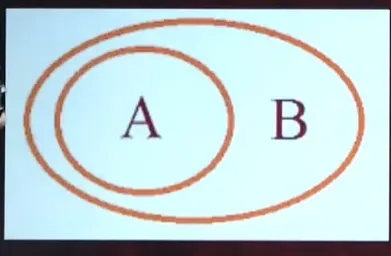
Case 1: All A are B
-
Diagram: Circle A is entirely contained within circle B.
-
Characteristics:
-
-
This is a positive statement.
-
It gives a positive result.
-
It is a 100% statement.
-
-
Inferences:
-
-
If "All A are B" is given, then "Some A are B" is also true (a 100% statement implies a Less than 100% conclusion).
-
"Some B are A" is true (the portion of B that contains A).
-
-
Incorrect Inferences:
-
-
"All B are A" is incorrect because the statement does not provide complete information about all of B.
-
Any negative conclusions (e.g., "No A is B," "Some A are Not B") are incorrect because a positive statement cannot yield a negative result.
-
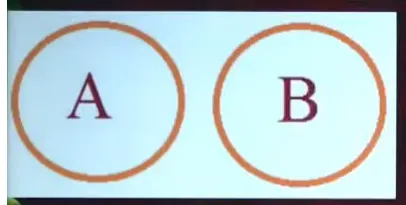
Case 2: No A is B
-
Diagram: Circle A and Circle B are completely separate, with no overlap.
-
Characteristics:
-
-
This is a negative statement.
-
It gives a negative result.
-
It is a 100% statement (100% separation).
-
-
Inferences:
-
-
Negative statements CANNOT give positive results. Therefore, any positive conclusion (e.g., "All A are B," "Some A are B") is incorrect.
-
The reverse is also true: If "No A is B," then "No B is A" is true.
-
Since it's a 100% statement, it also implies Less than 100% negative conclusions: "Some A are Not B" and "Some B are Not A" are true (Memory Tip: Imagine two rival villages separated by a river; if "No" relationship exists, complete separation means no part of one can be part of the other).
-
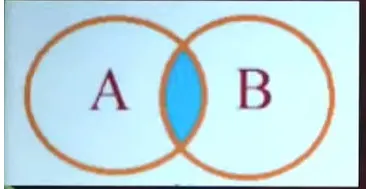
Case 3: Some A are B
-
Diagram: Circle A and Circle B are overlapping. The overlapping region represents "Some A are B."
-
Characteristics:
-
-
This is a positive statement.
-
It gives a positive result.
-
It is a Less than 100% statement (partial information).
-
-
Inferences:
-
-
Since it's a Less than 100% statement, 100% conclusions (All, No) are incorrect.
-
Positive statements yield positive results. Any definite negative conclusions (e.g., "No A is B," "Some A are Not B") are incorrect.
-
"Some A are B" is correct (given).
-
The reverse is also true: "Some B are A" is correct.
-
-
"Can't Say" Concept: The non-overlapping parts of A and B are indefinite. We cannot definitively conclude anything about these regions. For instance, conclusions like "Some A are Not B" or "Some B are Not A" are treated as "Can't Say" (incorrect in definite syllogism) because the statement provides insufficient information to confirm them.
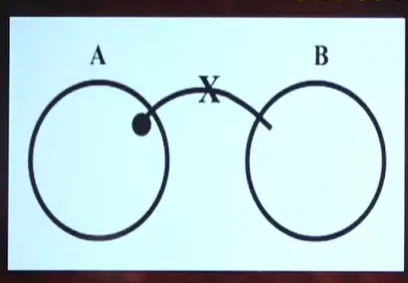
Case 4: Some A are Not B
-
Diagram: Circle A, with a portion clearly shown outside of Circle B.
-
Characteristics:
-
-
This is a negative statement.
-
It gives a negative result.
-
It is a Less than 100% statement (partial information).
-
-
Inferences:
-
-
Since it's a Less than 100% statement, 100% conclusions (All, No) are incorrect.
-
Negative statements yield negative results. Any positive conclusions (e.g., "All A are B," "Some A are B") are incorrect.
-
The statement "Some A are Not B" is correct by definition.
-
-
Crucial Point: Reverse is NOT possible in "Some Not" statements. If "Some A are Not B" is given, you CANNOT conclude "Some B are Not A." This statement only provides information about a part of A; it gives no information about B concerning A. The non-overlapping part of B remains a "Can't Say" region.
Summary of Reverse Possibilities
Understanding when a statement can be reversed is crucial for solving syllogism problems:
-
All A are B: Reverse is NOT "All B are A," but IS "Some B are A."
-
Some A are B: Reverse IS "Some B are A."
-
No A are B: Reverse IS "No B are A."
-
Some A are Not B: Reverse IS NOT "Some B are Not A."
SSC CGL Reasoning Syllogism FAQs
What are the core components of a Syllogism problem?
Which method is preferred for solving Syllogism problems, and why?
What is the difference between Definite and Indefinite (Possibility) conclusions?
Can a positive statement lead to a negative conclusion in definite Syllogism?
If the statement is "Some A are Not B," can we conclude "Some B are Not A"?








Get Free Counselling Today
and Clear up all your Doubts
 Live & recorded classes available at easeDashboard for progress trackingLakhs of practice questions

