






How Do Unlimited Practice Questions in the UPSI Nayi Bharti Foundation 2.0 Batch 2026–27 Support Preparation?
 Ekta Rakesh singh30 May, 2026
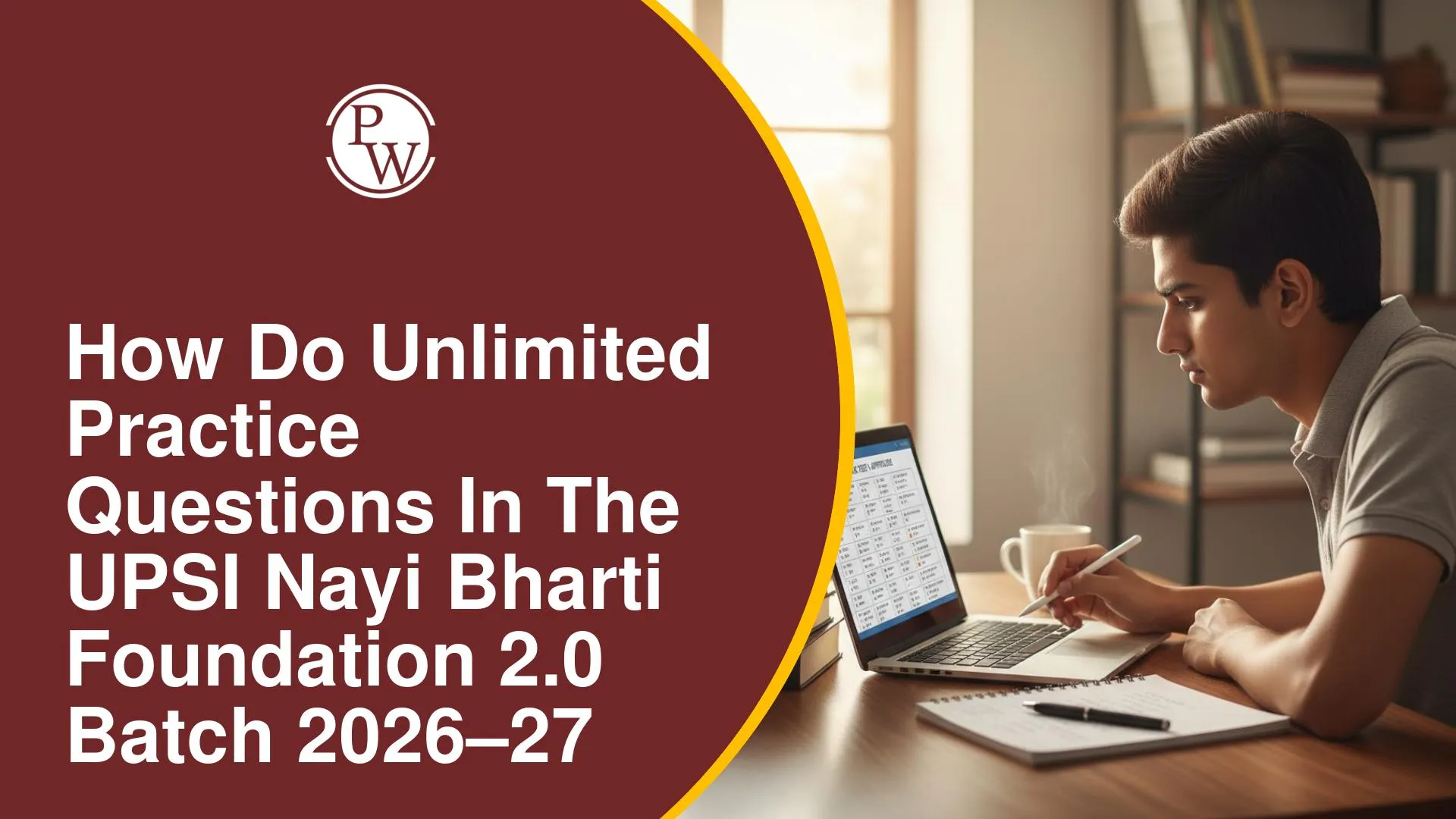
Preparing for the UPSI examination requires more than just understanding concepts from classes. Success depends on how effectively candidates can apply those concepts while solving questions under exam conditions. Many aspirants find that although a topic seems clear during lectures, answering different types of questions later becomes challenging. This gap between learning and application can affect confidence and performance.
To address this challenge, the UPSI Nayi Bharti Foundation 2.0 Batch 2026–27 includes unlimited practice questions that allow students to reinforce concepts through regular problem-solving. By providing continuous exposure to topic-wise and exam-oriented questions, this feature helps aspirants improve accuracy, strengthen weak areas, and develop the confidence needed for consistent UPSI preparation.
Why Just Studying Concepts Is Not Enough?
Most of you already know that when you complete a topic in class, it feels clear, but after a few days, you forget how to apply it to questions. This happens because:
-
You study the concept once, but do not apply it enough times
-
You see limited question types during preparation
-
You are not exposed to mixed or twisted questions early
-
Revision happens only by reading, not solving
Unlimited practice questions are included in this batch to directly handle the gap between “understanding” and “applying.”
How do Unlimited Practice Questions Work After Each Class?
In this batch, practice does not come randomly. It follows what you learn in class. After a topic is completed, you get questions linked to that concept. This means you are not solving unrelated or out-of-syllabus problems; you are immediately testing what you just learned.
For example:
-
After a Maths class on ratios, you solve different types of ratio-based questions
-
After Reasoning topics, you face variations that slightly change logic
-
After GK lessons, questions are framed in multiple ways to test recall
This immediate practice helps your mind connect the explanation with the application.
How Does It change the Way You Learn?
Unlimited practice is not about doing hundreds of questions in one go. It is about seeing the same idea in different forms until it feels familiar. Over time, this changes your learning pattern:
-
You stop memorizing steps blindly
-
You start recognizing question patterns
-
You understand where a concept can be twisted
-
You begin solving faster without overthinking
Instead of feeling “I know this topic,” you start feeling “I can solve this type of question anytime.”
How Does it Help When Questions Get Mixed?
One of the hardest parts of UPSI exams is not single-topic questions, but mixed ones. For example, a Maths question may combine percentages with simplification. A Reasoning question may mix directions with logic. This is where many of you slow down. Unlimited practice questions slowly train you for this stage by:
-
Exposing you to different variations of the same topic
-
Increasing difficulty gradually
-
Making you comfortable with mixed patterns
-
Reducing hesitation during solving
This is closer to how the actual exam behaves.
How Does It Help Revision Without Extra Pressure?
Revision does not always need separate time blocks. In this batch, revision happens through practice itself. When you solve unlimited questions:
-
You revisit old topics automatically
-
You repeat formulas and logic without memorizing again
-
You refresh concepts while solving, not just reading
-
You stay connected with earlier chapters
This reduces the feeling that “I forgot everything I studied last month.”
How Does it Help you Understand your Real Level?
Unlimited practice also works as a self-check tool. As you keep solving:
-
You notice which topics take more time
-
You see which mistakes repeat
-
You understand where confusion still exists
-
You can track improvement naturally
This helps you adjust your preparation instead of guessing whether you are ready or not.
What Students Should Understand Clearly?
Unlimited practice questions are not meant to be completed like a target list. They are meant to be used repeatedly until your thinking becomes faster and more stable. If used properly, they help you:
-
Reduce fear of new question patterns
-
Build speed through repetition
-
Stay consistent with revision
-
Improve accuracy step by step
But if ignored or used randomly, even a large question bank will not help much.
What You Should Do Next?
If you are preparing for UPSI 2026–27, focus less on “how many questions are there” and more on “how often you are practicing them.”
Try to:
-
Practice questions immediately after class
-
Revisit weak topics through repeated solving
-
Mix old and new topics regularly
-
Track mistakes and improve them slowly
This is where unlimited practice actually becomes useful.