110 Days Study Plan for BPSC Prelims 2026
 Priyanka Yadav10 Apr, 2026
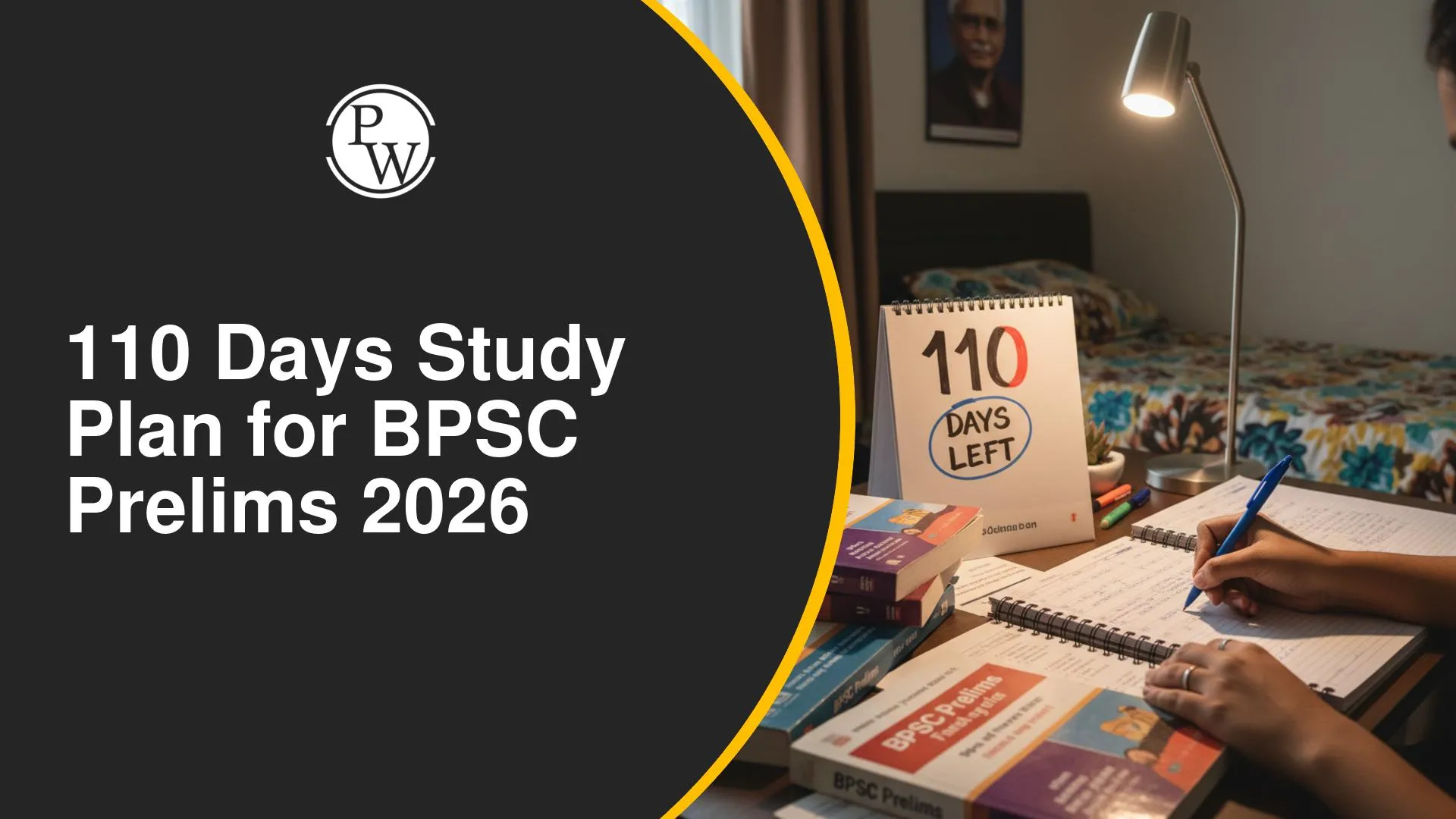
Preparing for BPSC Prelims 2026 in the last 100–110 days can feel overwhelming, but with the right strategy, this phase can become your strongest advantage. This period is not about starting from scratch but about refining what you already know, improving accuracy, and strengthening weak areas. Many aspirants struggle with balancing revision, practice, and current affairs, which often leads to confusion and burnout. A structured plan helps you stay focused, manage time effectively, and build confidence for the final exam.
BPSC Prelims 2026 Preparation
With the BPSC exam date set for July 26th, aspirants have approximately 100-110 days for their final preparation push. This period is crucial for giving a final touch through practice and consolidating knowledge. For students who have been continuously preparing, focusing on refining their strategy for optimal performance is important.
Strategic Time Management
The 100-110 days remaining are not a short duration. This time should be primarily dedicated to extensive practice and revision. For students with an incomplete syllabus, the initial two months (April-May) should focus on completing their syllabus alongside regular classes before shifting entirely to practice. It is essential to differentiate between reading a topic and effectively solving MCQs/questions on it, as the latter confirms true understanding.
Current Affairs Strategy for BPSC Prelims
Current Affairs (CA) demands regular study. For the upcoming exam, target coverage from the previous June up to the current month. In April, aim to complete March Current Affairs while simultaneously revising at least the last two months' Current Affairs. Continuous revision through your notes is key.
A common pitfall is abandoning monthly Current Affairs notes and effort when yearly magazines are released. Remember, the yearly magazine serves for compilation and final revision, after consistent monthly study and revision, not as a substitute for ongoing preparation.
Mock Tests, Subject Focus, and Daily Study Hours
Avoid abandoning your personal study routine solely to follow mock test schedules. A balanced approach is vital.
Daily Time Allocation (Until June)
-
Dedicate 3-4 hours daily to prepare for the specific syllabus of the upcoming weekly mock test (e.g., Modern History up to 1857 + 2 months of Current Affairs).
-
Use the remaining 5-6 hours daily for your core subjects and regular Current Affairs study.
-
Aim for at least 10 hours daily for the next 100 days.
Core Subjects for BPSC Prelims
Focus on these subjects until June: Science, History, Geography, Polity, and Bihar Special.
BPSC vs. UPSC Question Styles
Understanding the difference in question styles is crucial for targeted preparation:
|
BPSC vs. UPSC Question Styles |
||
|---|---|---|
|
Feature |
BPSC |
UPSC
|
|
Question Type |
Tends to ask factual questions |
Tends to ask analytical questions |
|
Example |
"What is the 1857 revolt?" |
"Why did the 1857 revolt happen?" |
July Strategy and Science Focus
In the crucial last month (July), prioritize Current Affairs and Science. Science is particularly important as 30 questions are typically asked from this section in Prelims, and it carries significant weight in the Mains examination. Aspirants cannot afford to neglect Science as it directly impacts selection. Combine your personal notes with NCERTs for Science, as questions are often directly sourced from them. Maintain a balanced approach, dedicating 3-5 hours to practice and the rest to main subjects. For Economics, focus primarily on PT (Prelims) aspects.
Enhancing Practice with AI Tools
Utilizing AI tools like ChatGPT can be a highly effective method for practicing questions:
-
Study: Thoroughly study a specific topic (e.g., 1857 Revolt, Light & Sound, monthly Current Affairs).
-
Generate Questions: Ask ChatGPT (or any AI tool) to generate 10-15 high-quality, statement-wise questions on that topic without answers.
-
Solve: Solve the generated questions independently.
-
Evaluate: Ask ChatGPT for the answers and evaluate your performance.
This method has significantly improved student performance, providing targeted practice.
Last Month Strategy and Effective Mock Test Analysis
For the period of July 1-23/24, focus on maximum study and revision. A common mistake is neglecting notes revision in favor of only practicing mock tests. The correct approach is to first read and revise your notes/copy, then attempt mock tests.
Effective Mock Test Analysis Method
This method is labor-intensive but highly fruitful for revision:
-
New Notebook: Obtain a new notebook dedicated solely to mock test analysis.
-
Subject Sections: Divide the notebook into dedicated sections for each core subject: History, Geography, Polity, Current Affairs, Science, Bihar Special (e.g., 15 pages per subject).
-
Record Learnings: While solving a mock test, if you encounter a question you cannot answer, or if you learn new information, immediately record it in the corresponding subject's section.
-
Bullet Points: Record these points as bullet points, not detailed explanations, for quick and efficient revision.
This compiled notebook becomes a personalized resource for quick revision of challenging or new information.
Strategy for Incomplete Syllabus
If your syllabus is incomplete, adopt a balanced and consistent approach:
-
Syllabus Completion: Dedicate the next two months (April-May) to complete your syllabus alongside regular classes.
-
Current Affairs: Maintain consistent Current Affairs practice.
-
Main Subjects: Continue studying your main subjects.
-
Revision: Incorporate continuous revision of one subject at a time.
This ensures comprehensive coverage and sustained progress towards success.
110 Days Study Plan for BPSC Prelims 2026 FAQs
What is the recommended daily study hour target for BPSC Prelims?
How should I approach Current Affairs preparation for BPSC Prelims?
Why is Science important for BPSC Prelims, and what resources should I use?
What is an effective method for analyzing mock tests for BPSC Prelims?