MPSC Rajyaseva Mains Answer Sheet Format 2026: Instructions, Rules & Writing Tips
 Aarti .6 Apr, 2026
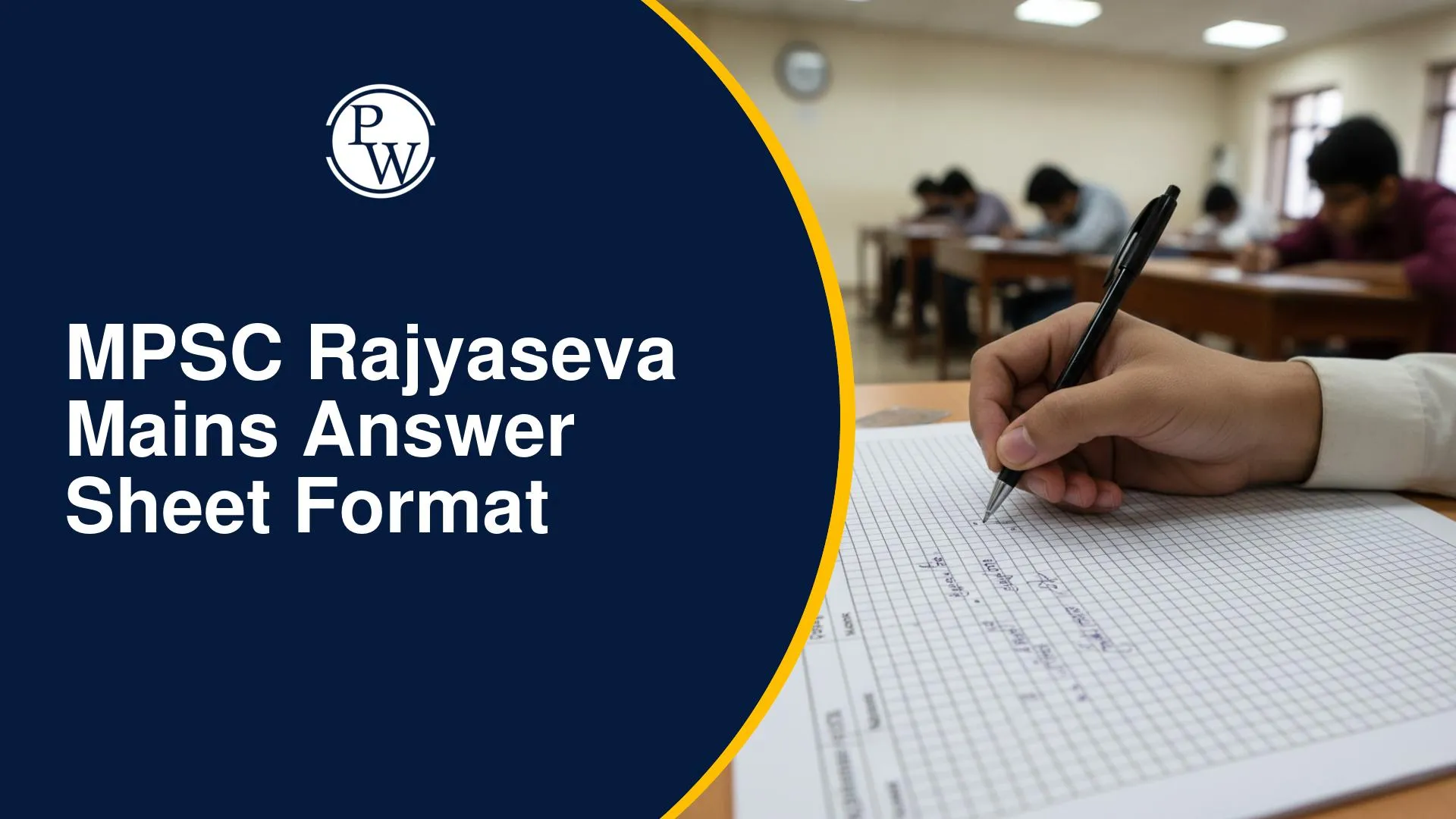
MPSC Rajyaseva 2025 Main Examination is scheduled from 29 March to 26 April, 2026. The Maharashtra Public Service Commission (MPSC) provides a specific answer booklet for its State Service Main Examination.
Understanding the MPSC Rajyaseva Mains answer sheet format and its critical instructions is important for all candidates. Following these guidelines helps you get evaluated properly and prevents disqualification; thus, it’s an important part of exam preparation.
MPSC Rajyaseva Mains Answer Sheet Format 2026: Overview
The MPSC Rajyaseva Mains Answer Sheet Format 2026 is designed to ensure uniform evaluation, transparency, and fairness in the examination process. Candidates appearing for the MPSC State Services Main Examination (scheduled from 29 March to 26 April 2026) must strictly follow the prescribed booklet format and instructions issued by the Maharashtra Public Service Commission (MPSC).
The answer booklet consists of a structured layout, including a front page for candidate details, followed by ruled pages for answer writing and designated space for rough work. Since the answer sheets are digitally scanned and evaluated, even minor errors—especially on the front page—can lead to complications in assessment or rejection.
Front Page Instructions: How to Fill MPSC Answer Booklet Correctly
The front page is the most sensitive part of your answer booklet, as it is scanned and processed digitally. Even small mistakes here can create problems during evaluation, so filling it carefully and correctly should be your priority before starting the paper.
-
Language: All required information on the front page must be written in English only.
-
Writing Instrument: Use an ink ballpoint pen.
-
Physical Handling: The answer booklet must not be folded.
-
Unauthorized Marks: Do not make any additional marks on the booklet.
-
Barcodes/QR Codes: Do not tamper with the barcode or QR code areas.
-
Required Information: Candidates must accurately fill in the Subject, Subject Code, and Exam Date.
How to Fill Exam Answer Booklet
This section focuses on confirming your identity and ensuring everything is properly recorded before evaluation. Both you and the supervisor play an important role here, so it’s essential to complete this part carefully and without errors.
Candidate Information:
-
Candidates must enter their seat number in English only.
-
Candidates must provide their signature.
-
A declaration stating, "I have complied with all rules of the Commission and have not committed nor will commit any malpractice," must be acknowledged and signed by the candidate.
Supervisor's Role:
-
The supervising officer must sign the booklet.
-
The supervisor's signature is to be made only after confirming that the candidate has accurately filled in all details and signed their declaration.
-
Office Use: A designated area exists for the answer booklet number for office use only.
Answer Writing Format in MPSC Mains: Structure & Presentation Rules
A clear and structured presentation makes it easier for examiners to read and award marks. Following the correct format helps you present your answers neatly and improves overall readability.
-
Question Numbering: Clearly write the Question Number and Sub-question Number on the left margin at the beginning of each answer in clean handwriting.
-
New Page for Each Question: Each question's answer must begin on a new page.
-
Concluding Line: After completing an answer, a horizontal line must be drawn to indicate its conclusion.
Rough Work Guidelines in MPSC Answer Sheet
Rough work is meant to help you think and solve problems during the exam, but it is not part of the evaluation. Using this space properly ensures you avoid confusion and keep your main answers clean and organized.
-
Candidates must not write their seat number or any other identifying marks on these pages.
-
No answers are to be written on rough work pages; they will not be evaluated.
-
All rough work must be struck out (cancelled) after use. Do not sign on these pages.
Important Rules & Prohibitions in MPSC Mains Exam
These are important rules that protect the fairness of the exam and your evaluation. Ignoring them, even unintentionally, can lead to serious consequences, so understanding and following them throughout the exam is essential.
Answer Booklet Verification:
-
Upon receiving, candidates must immediately check all pages and the binding for defects or damage.
-
If any defect is found, the booklet must be replaced immediately before starting to write.
-
Do not tear out any pages or parts.
-
Do not attach any additional pages.
-
Report issues like missing or damaged pages to the invigilator before the exam begins.
Prohibition of Identifying Marks:
-
Candidates must not write their name, seat number (except in designated areas), or any other unnecessary text anywhere else.
-
No signatures (other than the required one), symbols, or identifying marks that could reveal identity are permitted. This includes any coded signs or marks.
Sub-Question Sequence:
-
All sub-questions (e.g., a, b, c, d) of a main question must be attempted consecutively.
-
If answered out of sequence or on non-consecutive pages, those specific sub-questions will not be evaluated.
-
Multiple Answers for a Single Question:
-
Do not write answers to the same question more than once.
-
Duplicate answers will be cancelled.
-
Cancelling Answers/Parts of Answers:
-
To cancel an answer or part, clearly strike it out with a cross (X) and write "Cancelled by candidate" (रद्द केले) in bold letters next to it.
-
Do not sign near the cancelled portion.
Handling Blank Space/Pages:
-
Do not leave any blank space in the middle of an answer or consecutively.
-
If a page is inadvertently left blank, it must be struck out with a line.
-
If an entire page is accidentally left blank, write "Please turn over" (कृपया पृष्ठ उलटा) on it.
Writing Continuity:
-
Answers should be written continuously, without skipping pages.
-
Use a pen that does not bleed through to the next page.
-
No Supplementary Answer Sheets:
-
Candidates will only be provided with and must use only the main answer booklet.
-
No supplementary sheets will be issued or allowed.
-
Unauthorized Materials and Malpractice:
-
Do not write any unnecessary content on the question paper, admit card, or loose papers, as this is considered an attempt to copy/cheat.
-
Possession of unauthorized materials like subject-related papers, printed materials, diaries, or notebooks during the exam is strictly prohibited.
-
Violation leads to disciplinary action by the Commission, which can have severe consequences for the candidate's future.
MPSC Rajyaseva Mains Answer Sheet Format FAQs
What language is required for filling in information on the MPSC answer booklet's front page?
Can candidates use any pen to fill out the MPSC answer booklet?
What should a candidate do if they find a defect in the answer booklet?
Are supplementary answer sheets provided in the MPSC Main Examination?