

Jharkhand TET 2026 Latest News: Notification Cancelled, Delay & New Timeline Updates
Jharkhand TET 2026 notification has been cancelled due to a regional language dispute and procedural errors. Application process is halted, and a revised notification is expected after amendments, causing a delay of around 1 to 1.5 months in exam schedule.



Jharkhand TET 2026 Latest News: The Jharkhand Teacher Eligibility Test (JTET) 2026 Rules and notification are cancelled due to an unresolved linguistic dispute over regional languages (Bhojpuri, Angika, Magahi). This procedural error saw the notification issued prematurely before Cabinet approval. Future steps involve resolving the language issue and reviewing age limits, which will delay the exam process by 1-1.5 months.
Jharkhand Teacher Eligibility Test Introduction
The Jharkhand Teacher Eligibility Test (JTET) 2026 has recently faced significant developments, with its governing rules and previous notification now revoked. This crucial update impacts aspirants awaiting the examination, stemming primarily from unaddressed issues regarding regional languages. Understanding the reasons behind these changes, the procedural missteps, and the expected future actions is vital for all stakeholders.
Cancellation of JTET Rules and Notification
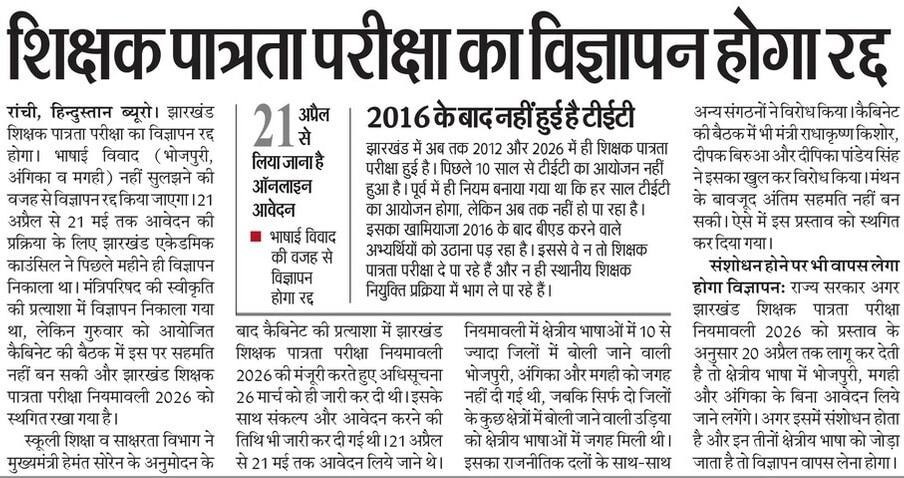
The Jharkhand Teacher Eligibility Test Rules (Niyamavali) 2026 have been cancelled. Consequently, the previously released notification for the JTET has also been revoked. This decision follows earlier indications regarding the Niyamavali's cancellation, which had already prompted concerns about application deadline extensions.
Primary Reason for Cancellation: Unresolved Linguistic Dispute
The primary cause for this cancellation is an unresolved linguistic dispute involving the inclusion of regional languages such as Bhojpuri, Angika, and Magahi. The Jharkhand Academic Council had previously advertised applications from April 21 to May 21, pending approval from the Council of Ministers. However, a recent Cabinet meeting failed to reach a consensus, directly leading to the suspension of the Jharkhand Teacher Eligibility Test Rules 2026.
Analysis of the Procedural Error
A major procedural mistake led to the current situation. The rules (Niyamavali) should have been approved by the Cabinet before releasing the exam notification. However, the notification was issued early, likely due to a court order, assuming approval would come later. This mistake caused the current problem.
Chronology of Events:
-
On March 26, the School Education and Literacy Department released the Jharkhand TET 2026 rules notification with the Chief Minister’s approval, expecting it to be approved later by the Cabinet. The application process was scheduled from April 21 to May 21.
-
However, the main issue was that some widely spoken regional languages—Bhojpuri, Angika, and Magahi—were not included in the rules, which led to objections.
Impact on Application Process and Future Options
Online applications, originally slated to begin on April 21, will now not be accepted. Administrative rules dictate that if amendments are made to the Niyamavali, the existing advertisement must be withdrawn, and a new one issued.
Dilemma Faced by the State Government:
-
Option 1: If the State Government implements the Jharkhand Teacher Eligibility Test Rules 2026 as originally proposed by April 20 (without the disputed regional languages), applications will proceed without the inclusion of Bhojpuri, Magahi, and Angika.
-
Option 2: If the Niyamavali is amended to include these three regional languages, the current advertisement will necessarily have to be withdrawn, requiring re-issuance of the notification.
Future Outlook and Anticipated Changes
The expected way forward involves modifications in two key areas:
-
Language Resolution: The upcoming Cabinet meeting is expected to approve the Niyamavali with the explicit inclusion of the disputed regional languages. Without resolving this linguistic dispute, Cabinet approval is unlikely.
-
Age Limit Review: Concerns exist regarding recent age limit changes. As per NCTE guidelines, the minimum age for eligibility should be 18 years. The Jharkhand government, Education Department, and JAC are advised to ensure the minimum age limit is set at 18 years to avoid future disputes.
Implementing all necessary changes concurrently is recommended to prevent further complications.
Revised Timeline for the JTET Process
A new notification will be issued after the required changes are made. This process is expected to take around 1.5 months.
Because of this, the application process and exam dates will also be delayed by about 1 to 1.5 months. If the exam was earlier expected in July, it is now likely to be held in August or September, depending on how quickly the authorities complete the process.
Jharkhand TET 2026 Latest News FAQs
Why were the Jharkhand TET 2026 rules and notification cancelled?
What was the procedural error highlighted in the cancellation?
Which regional languages caused the dispute?
How will the cancellation impact the JTET application process?
What is the estimated delay for the JTET process due to these changes?