







Mukta Singh CTET Feb 2026: Scored 113 Marks in Paper 2 Maths & Science with PW
Mukta Singh scored 113 marks in CTET February 2026 Paper 2 (Maths & Science) after a gap of nearly 23–24 years since completing her B.Ed. While managing a teaching job, family responsibilities, and a long daily commute, she prepared with PW’s online classes, revision support, handwritten notes, and previous-year questions.
 Neha Tanna7 Sept, 2026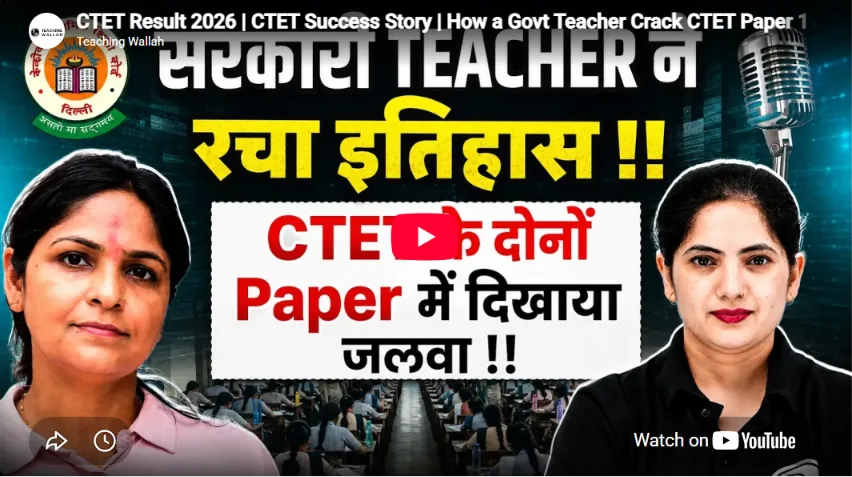
For Mukta Singh, clearing CTET in February 2026 meant returning to academic preparation after a gap of nearly 23–24 years while continuing her teaching job and managing family responsibilities. With around 16 years of teaching experience, she appeared for both CTET papers and scored 113 marks in Paper 2 (Maths & Science).
Her preparation involved PW’s online classes, recorded lectures, revision support, handwritten notes, and previous-year questions. The flexibility of online learning allowed her to continue preparing despite her work schedule and a daily commute of around 100 kilometres.
Mukta’s journey highlights how consistent preparation, self-made notes, detailed question analysis, and self-belief helped her return to exam preparation after a long academic gap.
Mukta Singh’s CTET Preparation Journey
Mukta Singh explained that the government's requirement to qualify for TET within two years created pressure for in-service teachers. Along with her school responsibilities, she also had family responsibilities.
She said:
“So, the government had given us only two years to complete it. So, completing it within these two years was a very big challenge for us. While being in service, we had all our responsibilities at school, and as you said, being a woman, we also had responsibilities at home. So, there was a lot of pressure to clear it within those two years.”
Another major challenge was the long gap since her B.Ed. She had completed her B.Ed. Around 2001.
“So, there was a very long gap. Whatever theories I had studied at that time during B.Ed. had completely washed out of my mind. Even for CDP, I had to think about what the full form of CDP was.”
Instead of allowing the gap to discourage her, Mukta decided to start her preparation from the basics.
“So, the level was completely different. That is why I had to start this preparation from the absolute basics, considering myself to be at zero.”
Mukta Singh’s CTET Preparation Strategy
Mukta had a demanding daily schedule. She travelled around 100 kilometres every day, spending approximately four hours travelling to and from school. Despite this, she managed to study whenever she could.
She focused heavily on handwritten notes because she believed they would help her during revision.
“The benefit of handwritten notes, ma’am, is that they are written by you. When you revise them and look at those things, you remember that, yes, I had studied this thing in this way.”
She also followed a detailed approach while solving previous-year questions. Instead of focusing only on the correct answer, she researched unfamiliar terms and understood all four options.
“I followed one more thing, ma’am. Whenever there was a question with four options, and I came across a new term in those four options that I had not studied before, I searched for that new term and found out what exactly it was.”
She added:
“I also tried to understand why an option was correct and why another option was wrong.”
This strategy helped her build conceptual understanding rather than simply memorising answers.
How PW Supported Mukta Singh’s CTET Preparation
Managing CTET preparation alongside a full-time teaching job made flexible learning important for Mukta. Since she could not always attend classes at fixed times, recorded lectures allowed her to continue studying according to her schedule.
Talking about her experience with PW, she said:
“No, ma’am, PW was very useful for me. In the beginning, I did not have knowledge about where to start, how to prepare, or what to do.”
She initially searched YouTube for suitable coaching options and also received a recommendation for PW from her family.
“Naturally, ma’am, first we searched on YouTube itself for which coaching was the best. Then I also got the suggestion of PW from my family.”
The availability of recorded classes was particularly helpful because she could not always attend classes at the scheduled time due to school.
“So, I chose PW, and because I also had to go to school, I had to manage school as well. I felt that if I joined a PW CTET batch, at least if I could not watch it at school, I could come back in the evening and watch it later.”
Mukta also used the available lectures to prepare her handwritten notes.
“I could not always watch the entire class because of the shortage of time, but PW supported me a lot.”
She combined the coaching content with other resources and continued making her own notes.
“I watched the videos that were available, made notes from them, and also watched YouTube and made my notes.”
The revision batch was another part of her preparation that she found useful.
“I got a lot of support from PW. Later, when the revision batch was conducted, I tried my best to attend the revision batch as much as possible so that I could check where I stood in my preparation.”
She concluded:
“All these things supported me a lot.”
Mukta Singh’s Advice to CTET Aspirants
Mukta believes that confidence and determination are essential for CTET preparation. Her primary advice to future aspirants is to believe in themselves and develop strong determination towards their goal.
“I would definitely like to give this tip to all the children who are coming ahead: believe in yourself and develop a passion for anything you want to achieve.”
For CTET aspirants, she particularly recommends preparing handwritten notes.
“For CTET, I would definitely give one important tip: make your handwritten notes. They help you a lot at the last moment.”
She further explained:
“When you do this, you will yourself feel that your handwritten notes are very, very important.”
Mukta Singh’s CTET February 2026 journey shows that professional responsibilities, a long academic gap, and limited preparation time do not have to become barriers to success. After nearly 23–24 years since her B.Ed., she prepared alongside her teaching job and daily travel and scored 113 marks in CTET Paper 2 (Maths & Science).
Her experience highlights the value of online learning, recorded classes, revision support, handwritten notes, and detailed question analysis. Most importantly, her journey reinforces the importance of believing in yourself and continuing to work towards your goal despite challenges.




Get Free Counselling Today
and Clear up all your Doubts
 Live & recorded classes available at easeDashboard for progress trackingLakhs of practice questions

