







Super TET CDP Syllabus 2026: Topic-Wise Syllabus, Exam Pattern, Preparation Tips
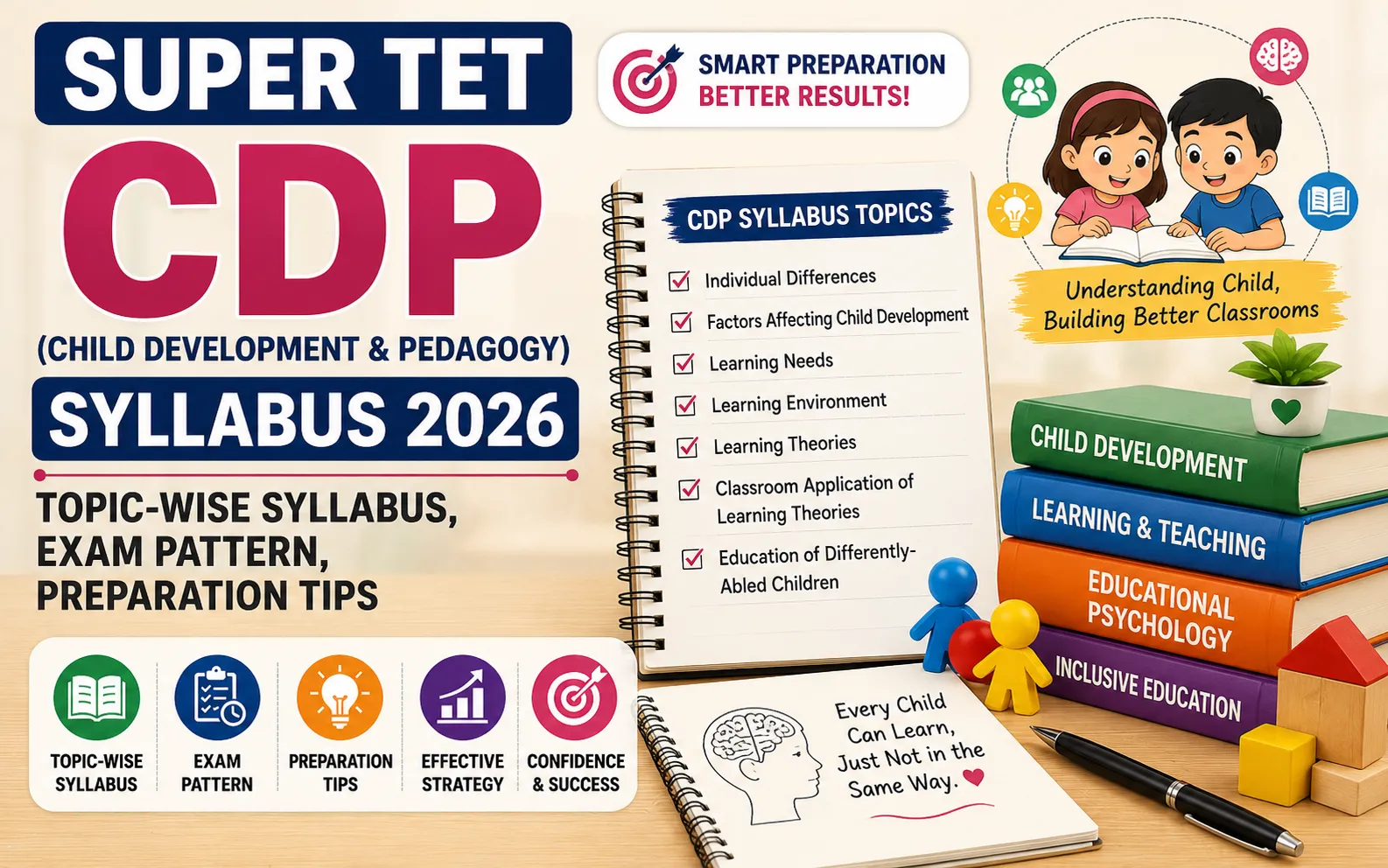
Super TET CDP Syllabus 2026 covers Individual Differences, Child Development, Learning Needs, Learning Environment, Learning Theories, Classroom Applications, and Education of Differently-Abled Children. Check the exam pattern and preparation tips.
 Abhishek Kumar29 Jul, 2026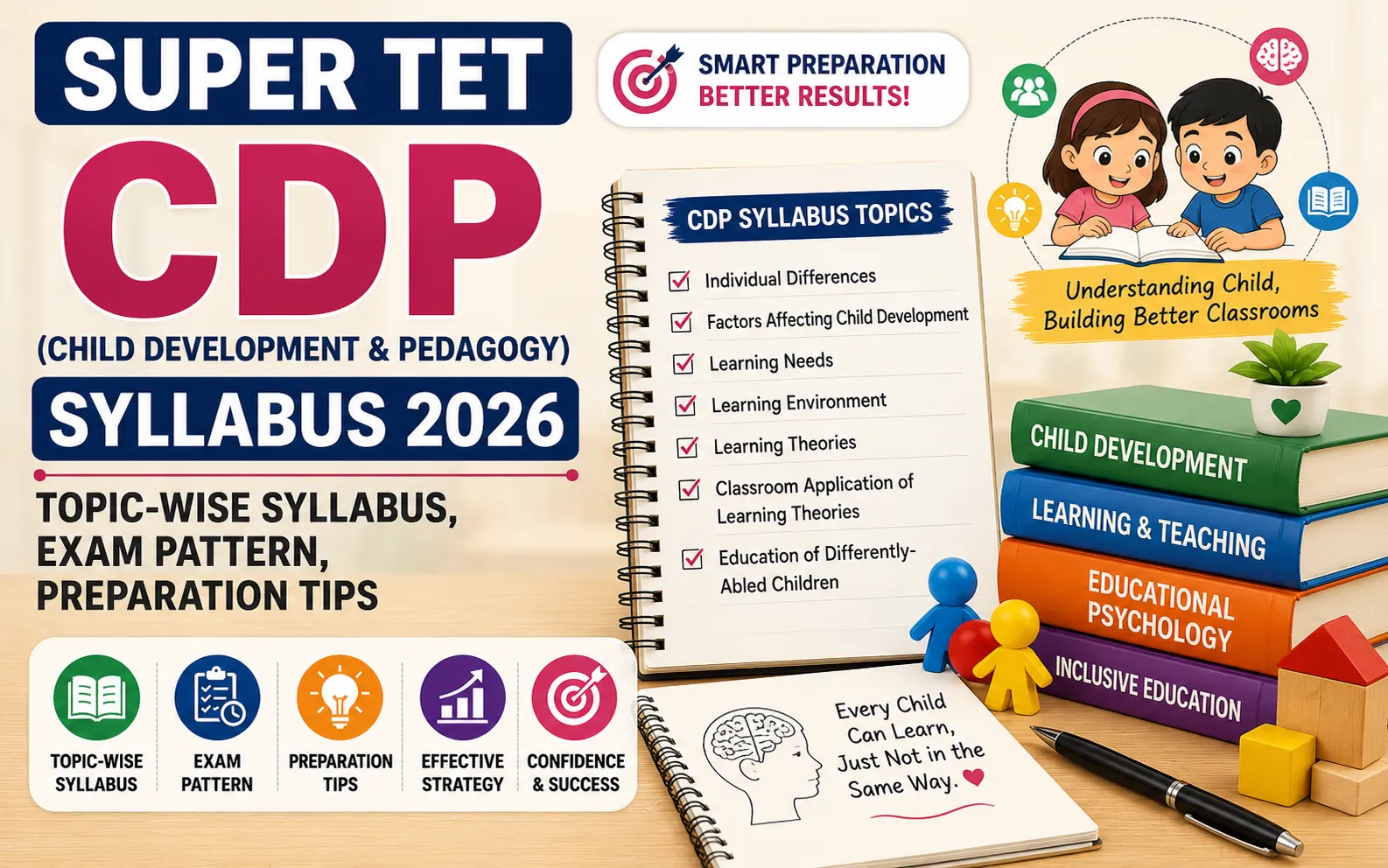
The Super TET CDP Syllabus 2026 is an important resource for candidates preparing for the Super TET examination. CDP, commonly referred to as Child Development and Pedagogy, is an important area for understanding children's development, learning needs, individual differences, and the application of learning theories in the classroom.
In the revised Super TET Syllabus, this section is listed as Child Psychology (Bal Manovigyan) and consists of 10 questions carrying 10 marks. The syllabus includes topics such as Individual Differences, Factors Affecting Child Development, Learning Needs and Environment, Learning Theories and Classroom Application, and Education of Differently-Abled Children.
Candidates should understand the complete CDP syllabus before beginning their preparation. A clear understanding of the topics can help aspirants build conceptual clarity, identify important areas, and develop an effective preparation strategy.
This article provides the Super TET CDP Syllabus 2026, topic-wise syllabus, important topics, exam pattern, preparation strategy, and preparation tips to help candidates prepare effectively for the Child Psychology section.
Super TET CDP Syllabus 2026: Overview
Candidates can check the key details related to the Super TET CDP section below:
| Particulars | Details |
|---|---|
| Exam Name | Super TET 2026 |
| Subject | Child Psychology (CDP) |
| Number of Questions | 10 |
| Total Marks | 10 |
| Question Type | Multiple Choice Questions (MCQs) |
| Exam Mode | Offline |
| Total Questions in Exam | 150 |
| Total Marks in Exam | 150 |
| Exam Duration | 2 Hours 30 Minutes |
| Negative Marking | No Negative Marking |
| Syllabus Level | Up to D.El.Ed Curriculum Level |
The Child Psychology section carries 10 questions for 10 marks in the revised Super TET exam pattern. The section focuses on understanding child development, learning processes, individual differences, classroom learning environments, and the education of children with different learning needs.
Super TET CDP Syllabus 2026: Topic-Wise Syllabus
The Super TET CDP syllabus covers important concepts related to child development, psychology, learning, and inclusive education. The major topics to prepare are given below:
| Super TET CDP Topics | Topics to Prepare |
|---|---|
| Individual Differences | Meaning of individual differences, differences among learners, factors responsible for individual differences |
| Factors Affecting Child Development | Biological, psychological, social, family, and environmental factors affecting child development |
| Learning Needs | Different learning needs of children and factors influencing learning |
| Learning Environment | Role of classroom environment, family, school, peers, and social surroundings in learning |
| Learning Theories | Major theories of learning and their basic principles |
| Classroom Application of Learning Theories | Application of learning theories and principles in classroom teaching |
| Education of Differently-Abled Children | Understanding diverse learning needs and approaches for educating differently-abled children |
Candidates should focus on understanding the concepts behind each topic rather than memorising isolated definitions. CDP questions often require candidates to apply psychological and educational concepts to classroom situations.
Super TET CDP Important Topics 2026
Although candidates should prepare the complete prescribed syllabus, special attention should be given to the following areas:
-
Individual Differences
-
Factors Affecting Child Development
-
Child Development and Learning
-
Learning Needs of Children
-
Learning Environment
-
Learning Theories
-
Application of Learning Theories in the Classroom
-
Education of Differently-Abled Children
-
Inclusive and Child-Centred Learning Approaches
Candidates should focus on understanding how children learn and develop and how teachers can create suitable learning environments for diverse learners.
Aspirants should also practise application-based questions to understand how theoretical concepts can be applied in real classroom situations.
Super TET CDP Exam Pattern 2026
Understanding the CDP exam pattern is important for planning preparation. According to the latest revised Super TET exam pattern available on the PW syllabus page, Child Psychology consists of 10 questions carrying 10 marks.
| Subject | Number of Questions | Total Marks |
| Child Psychology (CDP) | 10 | 10 |
The complete Super TET examination consists of 150 objective-type questions carrying 150 marks. The examination is conducted in offline mode and has a duration of 2 hours 30 minutes. Each correct answer carries one mark, and there is no negative marking according to the current exam pattern.
The complete subject-wise weightage is as follows:
| Subject | Questions | Marks |
|---|---|---|
| Language (Hindi, Sanskrit & English) | 40 | 40 |
| Mathematics | 20 | 20 |
| Science | 10 | 10 |
| Environment & Social Studies | 10 | 10 |
| Teaching Aptitude | 10 | 10 |
| Child Psychology | 10 | 10 |
| General Knowledge & Current Affairs | 30 | 30 |
| Logical Reasoning | 5 | 5 |
| Information Technology (ICT) | 5 | 5 |
| Life Skills, Management & Attitude | 10 | 10 |
| Total | 150 | 150 |
Super TET CDP Syllabus Level 2026
The current PW Super TET syllabus categorises Child Psychology as a professional subject and states that professional subjects are covered up to the D.El.Ed curriculum level. Candidates should therefore focus on fundamental concepts related to child development, learning, psychology, and educational practices relevant to teacher education.
Aspirants should focus on understanding the relationship between child development and learning. They should also learn how different factors influence children's development and how teachers can adapt classroom practices to meet diverse learning needs.
Super TET CDP Preparation Tips 2026
Candidates should follow a structured preparation strategy to cover the CDP syllabus effectively. The following tips can help aspirants prepare for the Child Psychology section.
1. Understand the Complete CDP Syllabus: Start your preparation by reading the complete Super TET CDP syllabus. Divide the topics into different categories, such as child development, individual differences, learning, learning theories, classroom applications, and inclusive education. Creating a topic-wise checklist can help you track your progress and ensure that all major areas are covered.
2. Build Strong Conceptual Understanding: CDP is primarily a conceptual subject. Candidates should focus on understanding the meaning and application of psychological and educational concepts rather than relying only on memorisation. Try to understand how children develop, learn, and respond to different classroom environments.
3. Focus on Individual Differences: Children differ in their abilities, interests, learning styles, backgrounds, and developmental needs. Candidates should understand the factors responsible for these differences and how teachers can address them effectively. Practice questions that involve classroom situations and diverse learners.
4. Understand Factors Affecting Child Development: Study the different factors that can influence child development, including biological, psychological, family, social, and environmental factors. Try to understand how these factors interact with one another and influence children's learning and development.
5. Study Learning Theories: Learning theories are an important part of CDP preparation. Candidates should understand the basic principles of major learning theories and their relevance to classroom teaching. Instead of memorising only the names of theories, focus on understanding their key concepts and practical applications.
6. Focus on Classroom Application: Candidates should practise applying psychological and learning concepts to classroom situations. Understand how teachers can use appropriate strategies to support children's learning and development. Application-based practice can help aspirants approach scenario-based questions more effectively.
7. Understand Learning Needs and Environment: Study how the classroom, school, family, peers, and broader social environment can influence learning. Candidates should understand the characteristics of a positive learning environment and the role of teachers in supporting children's learning needs.
8. Prepare Differently-Abled Education Topics: Candidates should understand the educational needs of differently-abled children and the importance of providing suitable learning opportunities. Focus on inclusive approaches and classroom practices that support diverse learners.
9. Solve Previous Year Questions: Previous year question papers can help candidates understand the nature of questions asked in the examination and identify topics that require additional preparation. Candidates should solve available Super TET previous year questions and analyse their mistakes after each practice session.
10. Attempt Mock Tests: Once the syllabus has been completed, candidates should attempt CDP practice tests and full-length Super TET mock tests. Mock tests can help aspirants evaluate their preparation, improve time management, and identify weak areas.
11. Revise Regularly: Regular revision is essential for retaining important concepts, theories, and educational principles. Candidates should revise difficult topics multiple times and maintain a dedicated revision schedule.
Super TET CDP Preparation Strategy
Candidates can follow the preparation strategy given below to cover the CDP syllabus systematically:
| Preparation Stage | Strategy |
|---|---|
| Step 1 | Read the complete Super TET CDP syllabus |
| Step 2 | Divide topics into Child Development, Learning, Psychology, and Inclusive Education |
| Step 3 | Build strong conceptual understanding |
| Step 4 | Study important learning theories and their classroom applications |
| Step 5 | Practise topic-wise CDP questions |
| Step 6 | Solve previous year questions |
| Step 7 | Attempt CDP mock tests |
| Step 8 | Analyse mistakes and identify weak topics |
| Step 9 | Revise the complete syllabus regularly |
Candidates should maintain a balance between conceptual learning and question practice. Since CDP carries 10 marks, aspirants should prepare the section thoroughly while also allocating sufficient time to higher-weightage sections of the Super TET examination.
How to Improve CDP Preparation for Super TET?
Candidates can improve their CDP preparation by following these simple practices:
-
Read the complete syllabus before starting preparation.
-
Focus on understanding child development and learning processes.
-
Study individual differences among children.
-
Understand the factors affecting child development.
-
Learn major learning theories and their classroom applications.
-
Practise application-based and classroom-situation questions.
-
Understand different learning needs and learning environments.
-
Study inclusive education and the education of differently-abled children.
-
Solve previous year questions and analyse mistakes.
-
Attempt regular mock tests.
-
Revise important concepts and theories frequently.
Candidates should focus on applying concepts to practical classroom situations. This approach can help improve conceptual clarity and accuracy while solving CDP questions.
Super TET CDP Syllabus 2026 FAQs
How many questions are asked from CDP in Super TET?
What are the important topics in Super TET CDP?
What is the syllabus level of CDP in Super TET?
Are previous year questions useful for Super TET CDP preparation?





Get Free Counselling Today
and Clear up all your Doubts
 Live & recorded classes available at easeDashboard for progress trackingLakhs of practice questions

