







Super TET Maths Syllabus 2026: Topic-Wise Syllabus, Exam Pattern, Preparation Tips
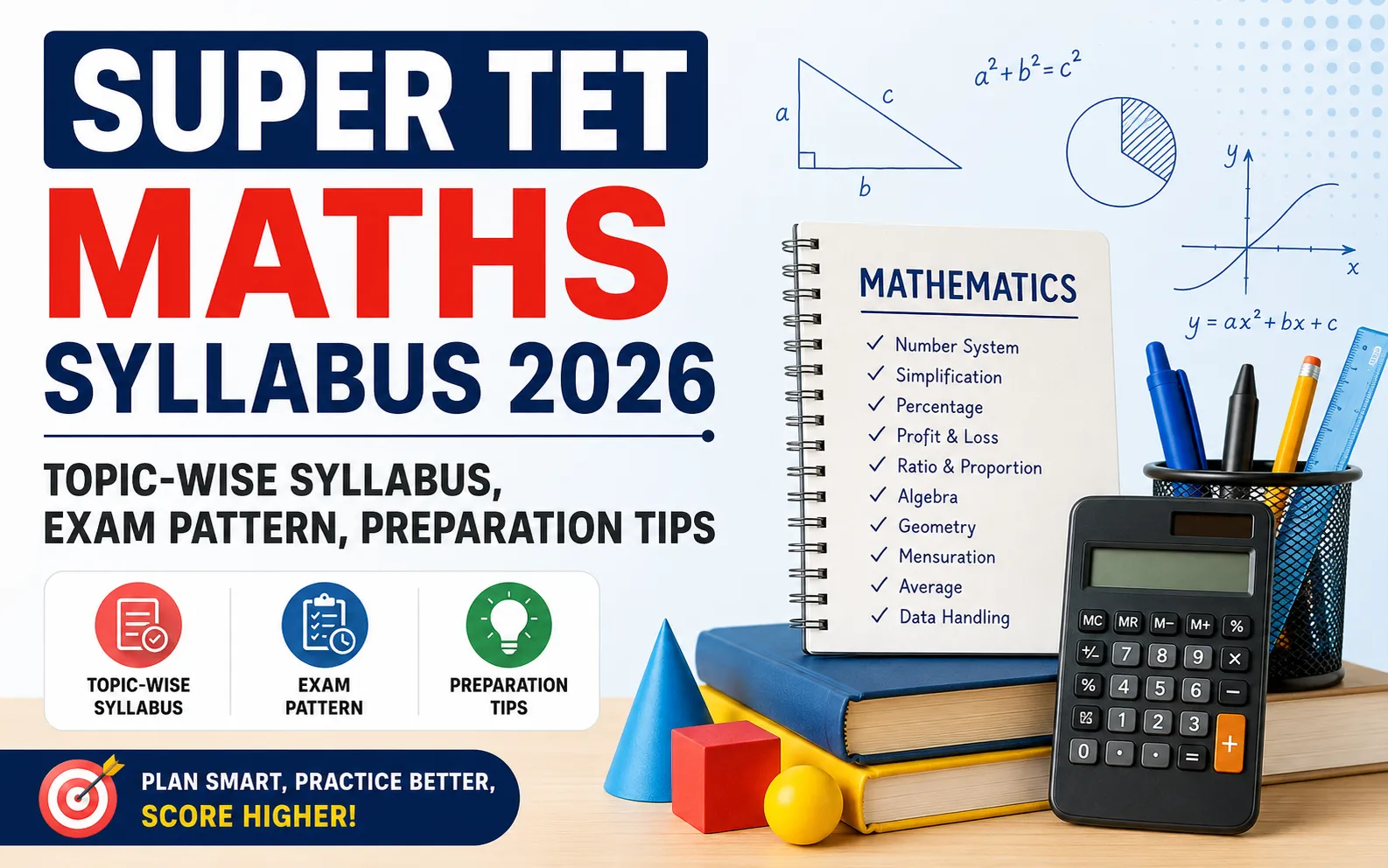
Super TET Maths Syllabus 2026 covers Number System, Simplification, Percentage, Profit & Loss, Algebra, Geometry, Mensuration, Average, and Data Handling. Check the exam pattern and follow effective preparation tips with regular practice, revision, PYQs, and mock tests.
 Abhishek Kumar28 Jul, 2026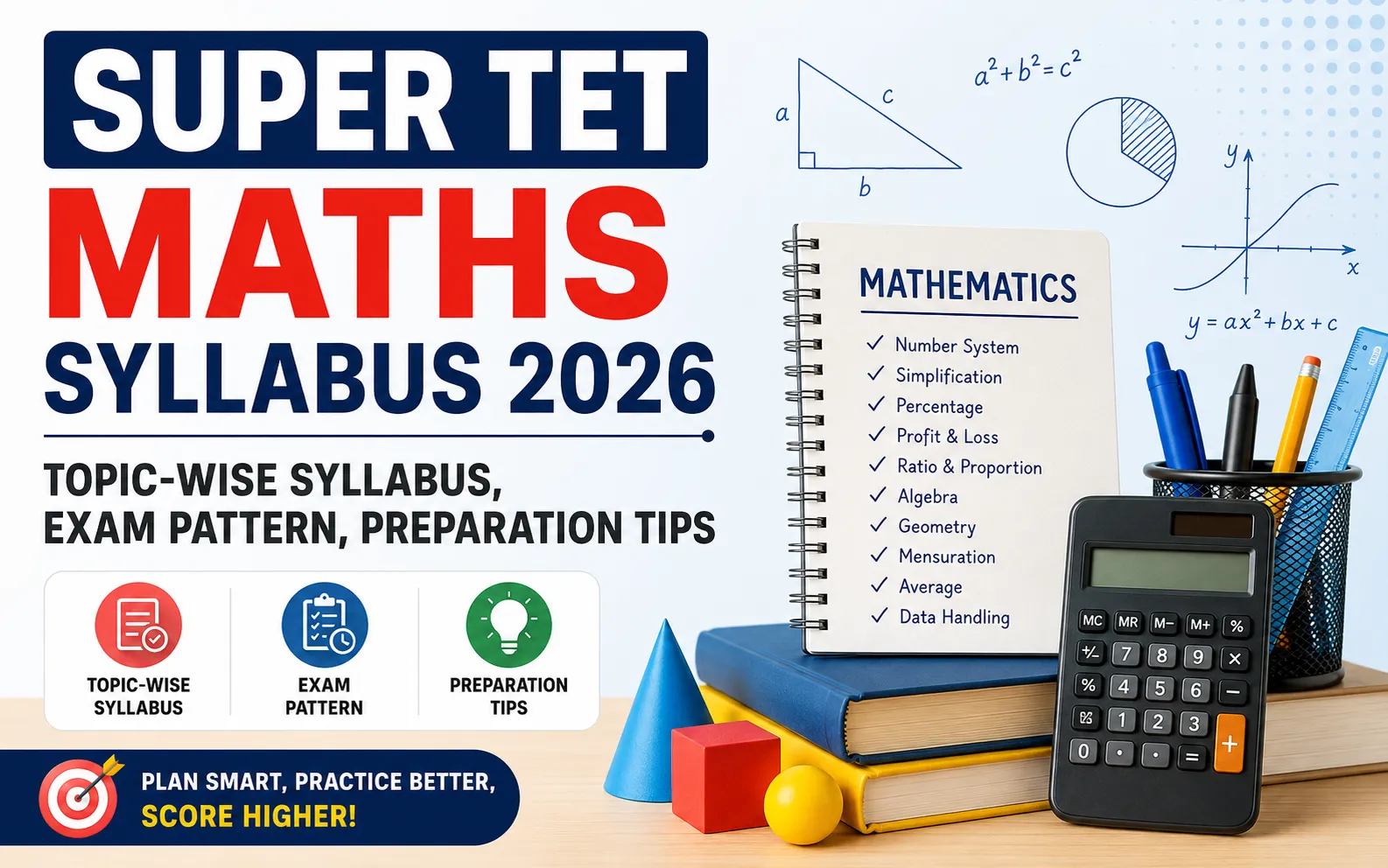
The Super TET Maths Syllabus 2026 is an important resource for candidates preparing for the Super TET examination. Mathematics is one of the key sections of the exam and tests candidates on fundamental concepts, numerical ability, and their understanding of basic mathematical principles.
As per the Super TET Syllabus 2026, the Mathematics section consists of 20 questions carrying 20 marks. The syllabus covers important topics such as Number System, Simplification, Fractions and Decimals, Percentage, Profit and Loss, Simple Interest, Ratio and Proportion, Basic Algebra, Geometry, Mensuration, Average, and Data Handling.
Candidates should understand the complete topic-wise syllabus before beginning their preparation. A clear understanding of the syllabus helps aspirants plan their study schedule, identify important topics, practise questions effectively, and revise the concepts systematically.
This article provides the complete Super TET Maths Syllabus 2026, topic-wise syllabus, exam pattern, important topics, and preparation tips for the Mathematics section.
Super TET Maths Syllabus 2026: Overview
| Particulars | Details |
|---|---|
| Exam Name | Super TET 2026 |
| Subject | Mathematics |
| Number of Questions | 20 |
| Total Marks | 20 |
| Question Type | Multiple Choice Questions (MCQs) |
| Mode of Examination | Offline |
| Marks per Correct Answer | 1 Mark |
| Negative Marking | No |
| Mathematics Weightage | 20 Marks |
Candidates can check the key details of the Super TET Mathematics syllabus and exam section below:
The Mathematics section carries 20 questions for 20 marks in the Super TET examination. Candidates should prepare all topics included in the prescribed syllabus and regularly practise numerical questions to improve their speed and accuracy.
Super TET Maths Syllabus 2026: Topic-Wise Syllabus
| Super TET Maths Topics | Topics to Prepare |
|---|---|
| Number System | Basic concepts of numbers and number operations |
| Simplification | Basic arithmetic operations and simplification |
| Fractions and Decimals | Fractions, decimals, conversions, and calculations |
| Percentage | Percentage calculations and applications |
| Profit and Loss | Cost price, selling price, profit, loss, and related problems |
| Simple Interest | Principal, rate, time, and simple interest calculations |
| Ratio and Proportion | Ratios, proportions, and numerical applications |
| Basic Algebra | Basic algebraic expressions and elementary equations |
| Geometry | Basic geometric concepts, lines, angles, and shapes |
| Mensuration | Perimeter, area, and measurement of basic figures |
| Average | Calculation and application of averages |
| Data Handling | Tables, data interpretation, and related questions |
The Super TET Mathematics syllabus includes topics from basic arithmetic, algebra, geometry, mensuration, and data handling. The topic-wise syllabus is given below:
Candidates should prepare each topic systematically and practise questions after completing the concepts. Topics involving calculations should be revised regularly to improve speed and accuracy.
Super TET Maths Important Topics 2026
While all topics mentioned in the syllabus are important, candidates should pay special attention to the following areas during their preparation:
-
Number System
-
Simplification
-
Fractions and Decimals
-
Percentage
-
Profit and Loss
-
Simple Interest
-
Ratio and Proportion
-
Basic Algebra
-
Geometry
-
Mensuration
-
Average
-
Data Handling
Candidates should begin with basic concepts and gradually move towards application-based and mixed questions. Regular practice can help aspirants identify common question patterns and improve their problem-solving skills.
Super TET Maths Exam Pattern 2026
Understanding the Super TET Maths exam pattern is important for effective preparation. According to the current Super TET Syllabus 2026, Mathematics consists of 20 questions carrying a total of 20 marks.
| Subject | Number of Questions | Total Marks |
|---|---|---|
| Mathematics | 20 | 20 |
The complete Super TET examination consists of 150 objective-type questions carrying 150 marks. Candidates should check the latest official notification and the main Super TET syllabus page for the complete examination structure and subject-wise weightage.
Super TET Maths Preparation Tips 2026
Candidates should follow a structured preparation strategy to cover the Mathematics syllabus effectively. The following tips can help aspirants prepare for the Super TET Maths section.
1. Understand the Topic-Wise Syllabus: Before starting preparation, go through the complete Super TET Maths syllabus. Make a list of all topics and divide them into smaller sections based on your preparation level.
This will help you track your progress and ensure that no important topic is left uncovered.
2. Strengthen Your Basic Concepts: Mathematics preparation should begin with a clear understanding of fundamental concepts. Revise basic arithmetic operations and strengthen your understanding of numbers, fractions, decimals, percentages, ratios, and other core topics.
Once your basics are clear, move towards more application-based questions.
3. Create a Formula Revision Sheet: Prepare a separate list of important formulas while studying. Include formulas related to:
-
Percentage
-
Profit and Loss
-
Simple Interest
-
Average
-
Geometry
-
Mensuration
-
Ratio and Proportion
Revise these formulas regularly to improve recall during the examination.
4. Practise Questions Topic-Wise: After completing each topic, solve practice questions based on that particular concept. Topic-wise practice helps candidates understand how concepts are applied in different types of questions.
For example, after completing Percentage, practise questions based on percentage increase, decrease, and its application in other numerical problems.
5. Solve Super TET Previous Year Questions: Previous year question papers are an important part of exam preparation. Solving them can help candidates understand the types of questions asked in the examination and identify topics that require additional practice.
Candidates should analyse their performance after solving each paper and work on recurring mistakes.
6. Practise with a Time Limit: Candidates should regularly solve Mathematics questions within a fixed time limit. Timed practice helps improve calculation speed and allows aspirants to manage their time effectively during the actual examination.
7. Take Mock Tests Regularly: After completing the syllabus, candidates should attempt full-length mock tests and subject-wise Mathematics tests. Mock tests can help aspirants evaluate their preparation and identify weak areas.
After every mock test, analyse:
-
Questions answered incorrectly
-
Questions left unanswered
-
Time taken to solve questions
-
Topics where mistakes occurred
-
Calculation errors
Use this analysis to improve your preparation strategy.
8. Revise Regularly: Regular revision is essential for retaining mathematical formulas and concepts. Candidates should keep sufficient time for revision in their study plan and revisit difficult topics multiple times.
Super TET Maths Preparation Strategy
| Preparation Stage | Strategy |
|---|---|
| Step 1 | Read the complete Super TET Maths syllabus |
| Step 2 | Identify strong and weak topics |
| Step 3 | Build basic concepts |
| Step 4 | Prepare important formulas |
| Step 5 | Practise topic-wise questions |
| Step 6 | Solve previous year question papers |
| Step 7 | Attempt Mathematics mock tests |
| Step 8 | Analyse mistakes and improve weak areas |
| Step 9 | Revise the complete syllabus |
Candidates can follow the preparation plan given below to cover the Mathematics syllabus in a structured manner:
Candidates should focus on consistency rather than trying to complete the entire syllabus in a short period. A balanced study plan covering concepts, practice, revision, and mock tests can help improve overall preparation.
How to Improve Speed and Accuracy in Super TET Maths?
Speed and accuracy are important when preparing for a competitive examination. Candidates can improve their performance by following these practices:
-
Practise basic calculations regularly.
-
Learn important formulas and revise them frequently.
-
Solve questions using a timer.
-
Avoid spending too much time on a single question.
-
Analyse mistakes after completing practice sets.
-
Maintain a notebook for frequently made errors.
-
Revise difficult topics at regular intervals.
-
Practice questions from previous year papers and mock tests.
Candidates should aim to reduce calculation errors while maintaining a consistent solving speed.
Super TET Maths Syllabus 2026 FAQs
How many questions are asked from Mathematics in Super TET?
What are the important topics in Super TET Maths?
Is Mathematics difficult in the Super TET exam?
Is there negative marking in Super TET?





Get Free Counselling Today
and Clear up all your Doubts
 Live & recorded classes available at easeDashboard for progress trackingLakhs of practice questions

