







Super TET Social Studies Syllabus 2026: Topic-Wise Syllabus, Exam Pattern, Preparation Tips
Super TET Social Studies Syllabus 2026 covers Indian Geography, Freedom Struggle, Constitution & Governance, Economy, Cultural Heritage, Environmental Conservation, Natural Resources, and Disaster Management. Check the exam pattern and preparation tips.
 Abhishek Kumar29 Jul, 2026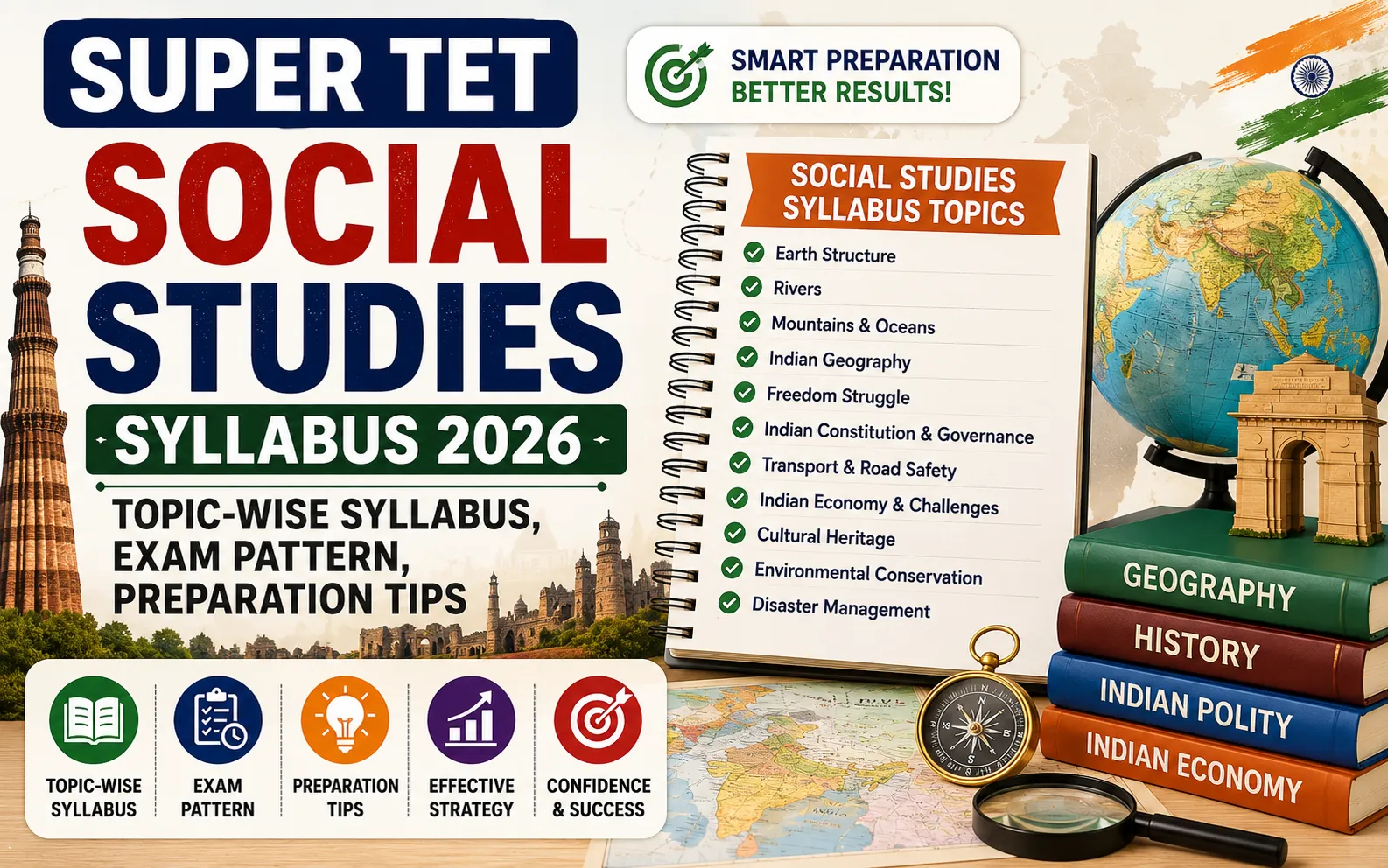
The Super TET Social Studies Syllabus 2026 is an important resource for candidates preparing for the Super TET examination. Social Studies is included under the Environment & Social Studies section and covers important concepts related to Geography, History, Indian Constitution and Governance, Indian Economy, Culture, Environment, and Disaster Management.
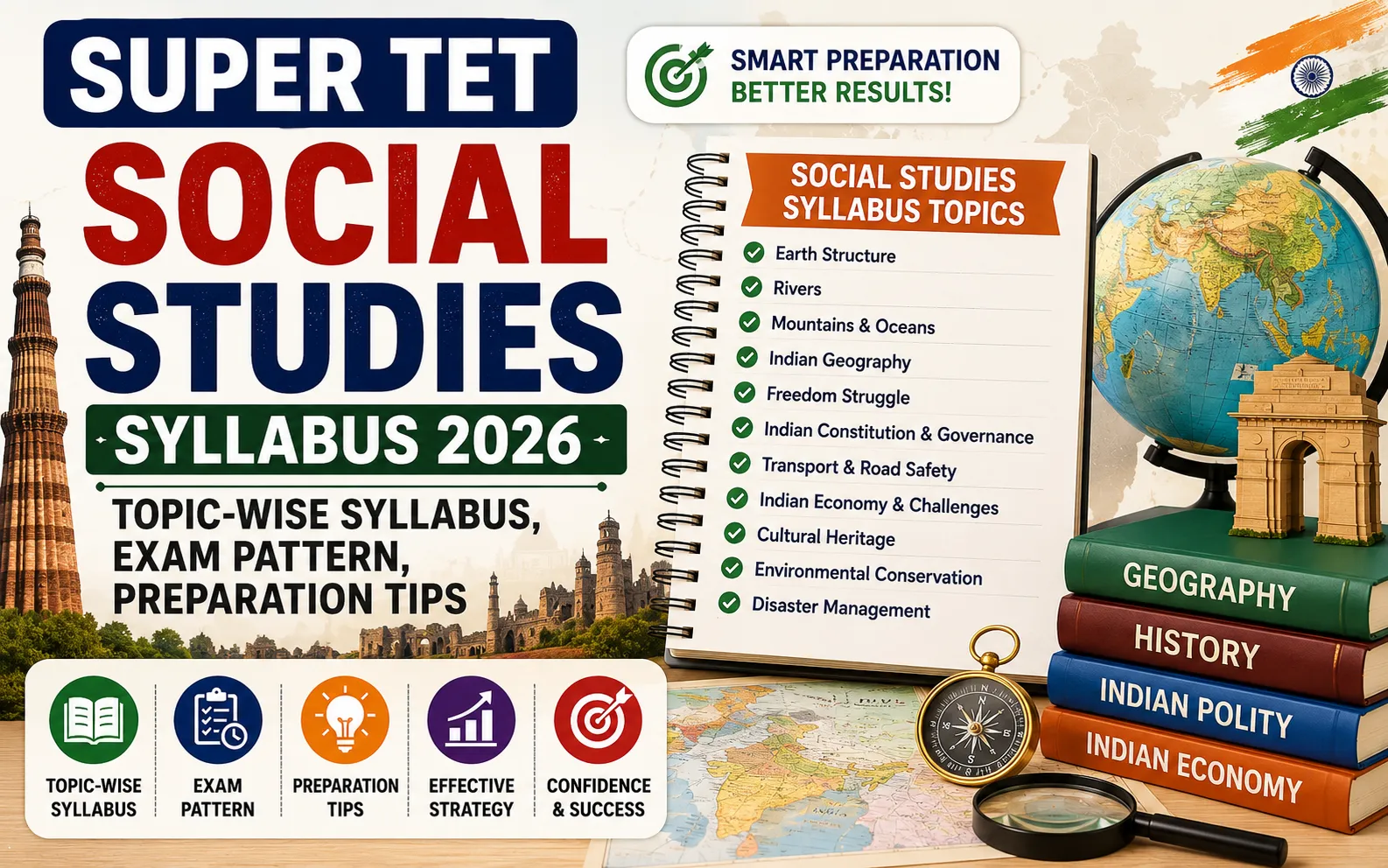
According to the latest revised Super TET Syllabus 2026, the Environment & Social Studies section consists of 10 questions carrying 10 marks. The syllabus includes topics such as Earth Structure, Rivers, Mountains and Oceans, Indian Geography, Freedom Struggle, Indian Constitution and Governance, Transport and Road Safety, Indian Economy and Challenges, Cultural Heritage, Environmental Conservation, and Disaster Management.
Candidates should understand the complete Social Studies syllabus before starting their preparation. Knowing the topic-wise syllabus can help aspirants create an effective study plan, identify important areas, and focus on conceptual understanding, factual revision, and regular question practice.
This article provides the Super TET Social Studies Syllabus 2026, topic-wise syllabus, important topics, exam pattern, preparation strategy, and preparation tips to help candidates prepare effectively for the Environment & Social Studies section.
Super TET Social Studies Syllabus 2026: Overview
Candidates can check the key details related to the Super TET Social Studies section below:
| Particulars | Details |
|---|---|
| Exam Name | Super TET 2026 |
| Subject | Environment & Social Studies |
| Social Studies Section | Included under Environment & Social Studies |
| Number of Questions | 10 |
| Total Marks | 10 |
| Question Type | Multiple Choice Questions (MCQs) |
| Exam Mode | Offline |
| Total Questions in Exam | 150 |
| Total Marks in Exam | 150 |
| Exam Duration | 2 Hours 30 Minutes |
| Negative Marking | No Negative Marking |
| Syllabus Level | Academic subjects up to Class 12 level |
The Environment & Social Studies section carries 10 questions for 10 marks in the revised Super TET exam pattern. Candidates should cover all the topics prescribed in the syllabus and focus on understanding important concepts as well as revising factual information.
Super TET Social Studies Syllabus 2026: Topic-Wise Syllabus
The Super TET Social Studies syllabus covers important areas from Geography, History, Indian Polity, Economy, Culture, Environment, and Disaster Management. The major topics to prepare are given below:
| Super TET Social Studies Topics | Topics to Prepare |
|---|---|
| Earth Structure | Basic structure of the Earth and related geographical concepts |
| Rivers | Major rivers and their geographical importance |
| Mountains | Major mountain ranges and their significance |
| Oceans | Major oceans and basic geographical concepts |
| Indian Geography | Physical features, geographical regions, climate, resources, and important geographical facts |
| Freedom Struggle | Important events, movements, leaders, and developments related to India's freedom struggle |
| Indian Constitution | Fundamental concepts and key features of the Indian Constitution |
| Indian Governance | Government structure, democracy, administration, and governance |
| Transport | Major modes and importance of transportation |
| Road Safety | Basic road safety rules and awareness |
| Indian Economy | Basic concepts of the Indian economy and major economic challenges |
| Cultural Heritage | Indian culture, traditions, heritage, and important cultural aspects |
| Environmental Conservation | Environmental protection, conservation, sustainability, and natural resources |
| Disaster Management | Types of disasters, preparedness, prevention, mitigation, and management |
Candidates should prepare these topics systematically and connect related concepts wherever possible. For example, while studying Indian Geography, candidates can revise geographical features, rivers, mountains, natural resources, and environmental issues together.
Super TET Social Studies Important Topics 2026
Although candidates should prepare the complete prescribed syllabus, special attention should be given to the following areas:
-
Earth Structure
-
Rivers
-
Mountains and Oceans
-
Indian Geography
-
Freedom Struggle
-
Indian Constitution
-
Indian Governance
-
Transport and Road Safety
-
Indian Economy and Major Challenges
-
Indian Cultural Heritage
-
Environmental Conservation
-
Natural Resources
-
Disaster Management
Candidates should focus on both conceptual and factual preparation. Geography requires an understanding of locations and physical features, while History and Culture require regular revision of important events, personalities, and developments.
Similarly, candidates should understand the basic framework of the Indian Constitution and Governance instead of relying solely on factual memorisation.
Super TET Social Studies Exam Pattern 2026
Understanding the Social Studies exam pattern is important for planning preparation. According to the latest revised Super TET exam pattern available on the PW syllabus page, Environment & Social Studies consists of 10 questions carrying 10 marks.
| Subject | Number of Questions | Total Marks |
|---|---|---|
| Environment & Social Studies | 10 | 10 |
The complete Super TET examination consists of 150 objective-type questions carrying 150 marks. The examination is conducted in offline mode and has a duration of 2 hours 30 minutes. Each correct answer carries one mark, and there is no negative marking according to the current exam pattern.
The complete subject-wise weightage is as follows:
| Subject | Questions | Marks |
|---|---|---|
| Language (Hindi, Sanskrit & English) | 40 | 40 |
| Mathematics | 20 | 20 |
| Science | 10 | 10 |
| Environment & Social Studies | 10 | 10 |
| Teaching Aptitude | 10 | 10 |
| Child Psychology | 10 | 10 |
| General Knowledge & Current Affairs | 30 | 30 |
| Logical Reasoning | 5 | 5 |
| Information Technology (ICT) | 5 | 5 |
| Life Skills, Management & Attitude | 10 | 10 |
| Total | 150 | 150 |
Super TET Social Studies Syllabus Level 2026
The current PW Super TET syllabus states that academic subjects, including Environment and Social Studies, are covered up to the Class 12 level. Candidates should therefore build their preparation around fundamental concepts while also reviewing relevant topics included in the prescribed syllabus.
Aspirants should focus on the core concepts and important facts relevant to the syllabus rather than studying every topic in excessive depth. The preparation should include conceptual learning, factual revision, map-based understanding where relevant, and regular practice of objective questions.
Super TET Social Studies Preparation Tips 2026
Candidates should follow a structured preparation strategy to cover the Social Studies syllabus effectively. The following tips can help aspirants prepare for the section.
1. Understand the Complete Syllabus: Start your preparation by reading the complete Super TET Social Studies syllabus. Divide the topics into different categories, such as Geography, History, Polity, Economy, Culture, Environment, and Disaster Management.
Creating a topic-wise checklist can help you track your progress and ensure that all important areas are covered.
2. Divide the Syllabus into Subject Areas: Social Studies covers multiple disciplines. Instead of studying all topics together, divide your preparation into separate sections:
-
Geography
-
History and Freedom Struggle
-
Indian Constitution and Governance
-
Indian Economy
-
Culture and Heritage
-
Environment
-
Disaster Management
This approach can make the syllabus more manageable and help you maintain a balanced preparation schedule.
3. Focus on Indian Geography: Revise important geographical concepts related to India, including physical features, rivers, mountains, oceans, geographical regions, natural resources, and environmental aspects. Wherever possible, use maps to improve your understanding of locations and geographical features.
4. Prepare the Freedom Struggle Chronologically: While studying the Indian Freedom Struggle, try to arrange important events and movements in chronological order. Make short notes covering important leaders, movements, organisations, and major events. A timeline-based approach can make it easier to remember the sequence of historical developments.
5. Understand the Constitution and Governance: Candidates should focus on understanding the basic structure and key concepts of the Indian Constitution and governance system. Prepare concise notes on important constitutional concepts and revise them regularly. Understanding the relationship between different aspects of governance can be more useful than memorising isolated facts.
6. Revise Indian Economy and Challenges: Focus on the basic concepts of the Indian economy and important economic challenges mentioned in the syllabus. Candidates should understand key terms and concepts and revise them regularly.
7. Study Culture and Heritage: Revise important aspects of Indian cultural heritage, traditions, and related topics. Create short notes for important facts and revise them periodically to improve retention.
8. Focus on Environmental Conservation: Candidates should understand the importance of environmental conservation, natural resources, sustainability, and related environmental challenges. Try to connect environmental concepts with real-life examples and current developments wherever relevant.
9. Prepare Disaster Management Topics: Study the basic concepts of disaster management, including types of disasters, preparedness, prevention, mitigation, response, and recovery. Understanding the disaster management cycle can help candidates organise these concepts effectively.
10. Solve Previous Year Questions: Previous year question papers can help candidates understand the nature of questions asked in the examination and identify areas that require additional preparation. Candidates should solve available Super TET previous year questions and analyse their mistakes after each practice session.
11. Attempt Mock Tests: Once the syllabus has been completed, candidates should attempt Social Studies practice tests and full-length Super TET mock tests. Mock tests can help aspirants evaluate their preparation, improve time management, and identify weak topics.
12. Revise Regularly: Regular revision is essential for retaining historical facts, geographical information, constitutional concepts, and other important topics. Candidates should maintain a dedicated revision schedule and revisit difficult topics multiple times before the examination.
Super TET Social Studies Preparation Strategy
Candidates can follow the preparation strategy given below to cover the Social Studies syllabus systematically:
| Preparation Stage | Strategy |
|---|---|
| Step 1 | Read the complete Super TET Social Studies syllabus |
| Step 2 | Divide topics into Geography, History, Polity, Economy, Culture, Environment, and Disaster Management |
| Step 3 | Build conceptual understanding of each subject area |
| Step 4 | Prepare short notes for important facts and concepts |
| Step 5 | Use maps and timelines wherever relevant |
| Step 6 | Practise topic-wise Social Studies questions |
| Step 7 | Solve previous year questions |
| Step 8 | Attempt Social Studies and full-length mock tests |
| Step 9 | Analyse mistakes and identify weak topics |
| Step 10 | Revise the complete syllabus regularly |
Candidates should maintain a balance between conceptual learning and factual revision. Since the section carries 10 marks, aspirants should prepare it thoroughly while also allocating sufficient time to higher-weightage sections of the Super TET examination.
How to Improve Social Studies Preparation for Super TET?
Candidates can improve their Social Studies preparation by following these simple practices:
-
Read the complete syllabus before beginning preparation.
-
Divide the syllabus into Geography, History, Polity, Economy, Culture, Environment, and Disaster Management.
-
Use maps to understand geographical locations and physical features.
-
Create timelines for important historical events and movements.
-
Prepare short notes for important constitutional and economic concepts.
-
Revise important facts regularly.
-
Practice objective questions after completing each topic.
-
Solve previous year questions and analyse mistakes.
-
Attempt regular mock tests.
-
Maintain a separate list of difficult topics and revise them frequently.
-
Keep sufficient time for final revision before the examination.
Candidates should focus on understanding concepts while maintaining regular factual revision. Consistent practice can help improve accuracy and confidence in the examination.
Super TET Social Studies Syllabus 2026 FAQs
How many questions are asked from Social Studies in Super TET?
What is the syllabus level of Social Studies in Super TET?
Are previous year questions useful for Super TET Social Studies preparation?
Is there negative marking in Super TET Social Studies?





Get Free Counselling Today
and Clear up all your Doubts
 Live & recorded classes available at easeDashboard for progress trackingLakhs of practice questions

