







UGC NET Environmental Science Unit 3 PYQs, Important Questions
UGC NET Environmental Science Unit 3 PYQs help candidates revise important topics of Ecology and Environmental Biology, ecological succession, biodiversity, population ecology, biogeochemical cycles, bioremediation, biofuels, and conservation biology. Regular PYQ practice improves conceptual clarity, analytical skills, and exam performance in UGC NET Environmental Science.
 Aarti .22 Jun, 2026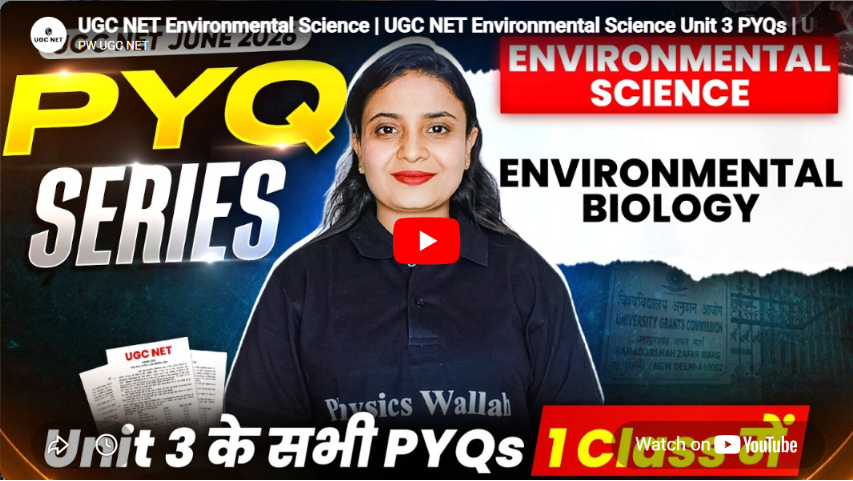
UGC NET Environmental Science Unit 3 focuses on Ecology, Ecosystems, Biodiversity, Population Ecology, Ecological Processes, and Environmental Biology. This unit contributes a significant number of conceptual and application-based questions in the examination.
Questions are frequently asked about ecological succession, ecosystem productivity, biodiversity hotspots, population growth models, nutrient cycles, ecological pyramids, bioremediation, environmental risk assessment, and conservation biology.
Since many questions involve assertion-reasoning, matching, and sequence-based formats, practicing Previous Year Questions (PYQs) is essential for scoring well.
What Does the UGC NET Environmental Science Unit 3 PYQ Session Cover?
This UGC NET Environmental Science Unit 3 session focuses on important concepts repeatedly asked in previous examinations. Key areas covered include:
-
Wilson Cycle and Plate Tectonics
-
Ecosystem Structure and Function
-
Ecological Pyramids
-
Ecological Succession
-
Population Ecology
-
Biodiversity and Conservation
-
Biodiversity Hotspots
-
Biogeochemical Cycles
-
Biofuels and Bioremediation
-
Environmental Risk Assessment
-
Wetlands and Coral Reef Ecosystems
-
National Parks and Wildlife Conservation
-
Ecological Productivity and Energy Flow
-
Environmental Conventions and Agreements
Important PYQs for UGC NET Environmental Science Unit 3
These important Previous Year Questions cover concepts that are frequently asked in UGC NET Environmental Science examinations.
Q1. Match List I and List II.
| List-I (Stage of Wilson Cycle) | List-II (Example of stage) |
| (a) Embryonic | (i) Red Sea |
| (b) Juvenile | (ii) Pacific Ocean |
| (c) Mature | (iii) East African rift |
| (d) Declining | (iv) Atlantic Ocean |
Choose the correct answer from the options given:
-
(A) (a)-(iii) (b)-(iv) (c)-(i) (d)-(ii)
-
(B) (a)-(i) (b)-(ii) (c)-(iii) (d)-(iv)
-
(C) (a)-(iii) (b)-(i) (c)-(iv) (d)-(ii)
-
(D) (a)-(i) (b)-(iii) (c)-(iv) (d)-(ii)
Q2. Match List I and List II.
| List-I (Characteristic) | List-II (Biomes) |
| (a) Tropical grasslands with scattered trees, loamy sand soils | (i) Tundra |
| (b) Tropical humid, tall trees, nutrient-poor and acidic soils | (ii) Desert |
| (c) Polar, low temperature, treeless, permafrost | (iii) Savanna |
| (d) Sub-tropical, evaporation more than precipitation, sparse vegetation | (iv) Tropical rainforest |
Choose the correct answer from the options given below:
-
(A) (a)-(iii) (b)-(iv) (c)-(ii) (d)-(i)
-
(B) (a)-(iv) (b)-(ii) (c)-(i) (d)-(iii)
-
(C) (a)-(iv) (b)-(iii) (c)-(ii) (d)-(i)
-
(D) (a)-(iii) (b)-(iv) (c)-(i) (d)-(ii)
Q3. Identify the correct statements:
-
A. Wetland ecosystems store and purify water.
-
B. Coral reefs, rich in calcareous materials, have very low productivity.
-
C. Chaparral ecosystems show excellent resilience stability.
-
D. Arctic ecosystems have small food chains.
-
E. Nutrient deficient estuarine ecosystems have low species diversity.
Choose the correct answer from the options given below:
-
(A) B, C and E only
-
(B) A, B and C only
-
(C) A, C and D only
-
(D) A, B, C and D only
Q4. Arrange the following geological/paleoclimate events from oldest to youngest:
-
A. Setting up of Monsoon climate on the Indian subcontinent
-
B. Appearance of Homo Sapiens
-
C. Appearance of free oxygen on the earth
-
D. Last Glacial Maximum
-
E. Deposition of Gondwana coals
Choose the correct answer from the options given below:
-
(A) C, E, A, D, B
-
(B) E, C, D, A, B
-
(C) D, C, E, B, A
-
(D) D, C, A, B, E
Q5. Consider the following statements about parasites.
-
A. Hemiparasite extract water and minerals nutrients from host.
-
B. Hemiparasite have green leaves and can photosynthesize.
-
C. Hemiparasite do not rely exclusively on the host for carbohydrates.
-
D. Corn smut fungus is an example of ectoparasite.
-
E. Ectoparasite does not have ease of dispersal in environment.
Choose the correct answer from the options given below:
-
(A) A, B and D only
-
(B) A, C and D only
-
(C) A, B, C and D only
-
(D) A, B, C, D and E
Q6. Which of the following is NOT true for ecological succession?
-
(A) Primary succession involves colonization of habitats devoid of life.
-
(B) In primary succession, colonizing species deal with more stressful conditions compared to species colonizing in secondary succession.
-
(C) Secondary succession involves re-establishment of a community.
-
(D) Colonizing species face less competition for resources in secondary succession compared to primary succession.
Q7. A toxic substance is present at 10mg/l (=10 ppm) level in water. Arrange the following subjects (A, B, C, D and E) in decreasing order of their daily dose in (mgkg⁻¹ day⁻¹) of this substance.
-
A. Subject taking 2 liters of water per day and have body weight of 50 kg.
-
B. Subject taking 2 liters of water per day and have body weight of 70 kg.
-
C. Subject taking 1 liter of water per day and have body weight of 10 kg.
-
D. Subject taking 5 liters of water per day and have body weight of 100 kg.
-
E. Subject taking 1 liter of water per day and have body weight of 70 kg.
Choose the correct answer from the options given below:
-
(A) D, B, A, E, C
-
(B) C, D, A, B, E
-
(C) D, E, B, A, C
-
(D) D, B, E, C, A
Q8. Which one of the following statements is correct?
-
(A) Birds are unitary organisms, while trees are modular organisms.
-
(B) Birds are modular organisms, while trees are unitary organisms.
-
(C) Birds and trees both are unitary organisms.
-
(D) Birds and trees both are modular organisms.
Q9. Match the following ecological concepts with the scientists associated with them.
| List-I (Concept) | List-II (Scientist) |
| (a) Ecosystem | (i) Norman Myers |
| (b) Ecosystem Services | (ii) H.T. Odum / Costanza |
| (c) Alpha, Beta, Gamma Diversity | (iii) H. Whittaker |
| (d) Biodiversity Hotspot | (iv) A.G. Tansley |
Choose the correct answer from the options given below:
-
(A) (a)-(iv) (b)-(ii) (c)-(iii) (d)-(i)
-
(B) (a)-(ii) (b)-(i) (c)-(iv) (d)-(iii)
-
(C) (a)-(iii) (b)-(iv) (c)-(ii) (d)-(i)
-
(D) (a)-(i) (b)-(iii) (c)-(iv) (d)-(ii)
Q10. Consider the following Assertion and Reason.
Assertion (A): Ecotones generally have higher species diversity and population density.
Reason (R): Ecotones provide opportunities for migration, invasion, and interspecific interactions.
Choose the correct answer from the options given below:
-
(A) Both A and R are true, and R is the correct explanation of A.
-
(B) Both A and R are true, but R is not the correct explanation of A.
-
(C) A is true, but R is false.
-
(D) A is false, but R is true.
Preparation Tips for UGC NET Environmental Science Unit 3
Ecology and Environmental Biology form one of the most important scoring areas in UGC NET Environmental Science. Candidates can improve their preparation by focusing on the following points:
-
Revise ecosystem structure, function, and energy flow concepts thoroughly.
-
Learn ecological succession stages and differences between primary and secondary succession.
-
Practice questions on ecological pyramids, productivity, and trophic levels.
-
Prepare biodiversity hotspots, endangered species categories, and conservation concepts.
-
Revise nitrogen, carbon, sulphur, and phosphorus cycles regularly.
-
Study population growth models, survivorship curves, and population dynamics.
-
Focus on bioremediation, biodegradation, biomagnification, and biofuels.
-
Learn important environmental conventions such as Ramsar, CITES, Bonn, and Basel.
-
Practice assertion-reasoning and match-the-following questions frequently.
-
Solve PYQs regularly to identify repeated concepts and improve accuracy.
Consistent revision and PYQ practice can significantly improve performance in Unit 3 and strengthen overall UGC NET Environmental Science preparation.
UGC NET Environmental Science Unit 3 PYQs FAQs
Which topics are most important in UGC NET Environmental Science Unit 3?
Why should candidates practice UGC NET Environmental Science Unit 3 PYQs?
How can I prepare effectively for UGC NET Environmental Science Unit 3?







Get Free Counselling Today
and Clear up all your Doubts
 Live & recorded classes available at easeDashboard for progress trackingLakhs of practice questions

