







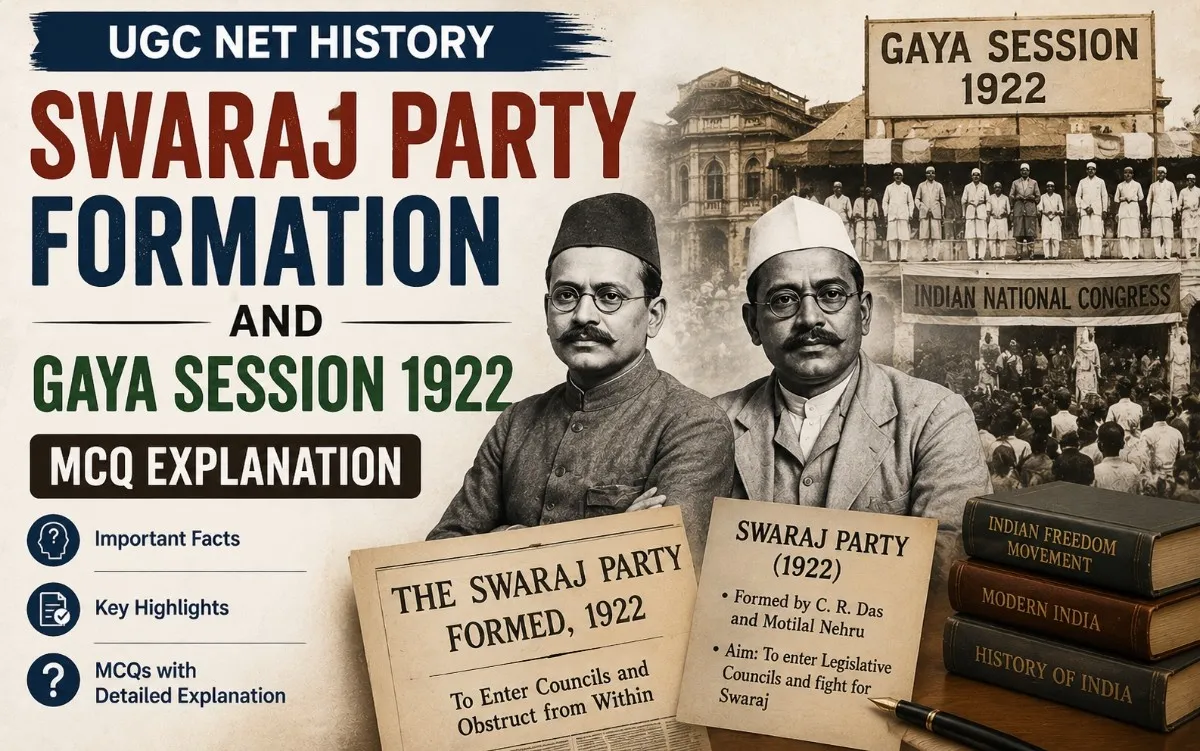
UGC NET History: Swaraj Party Formation and Gaya Session 1922 MCQ Explanation
The Swaraj Party was formed after ideological differences emerged within the Congress following the suspension of the Non-Cooperation Movement in 1922. Led by C.R. Das and Motilal Nehru, the party advocated council entry and became an important topic for UGC NET History preparation.
 Abhishek Kumar29 May, 2026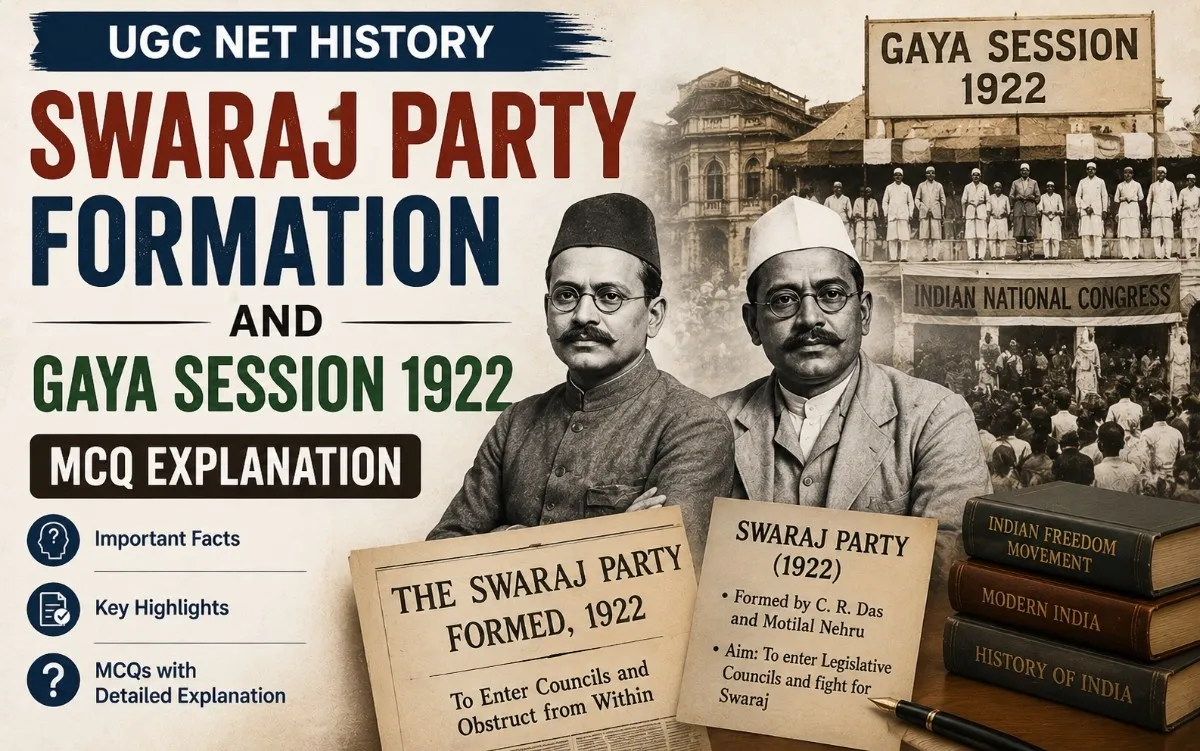
Which Congress session saw the formation of the Swaraj Party?
(A) Belgaum session, 1924
(B) Gaya session, 1922
(C) Calcutta session, 1928
(D) Lahore session, 1929
Answer: (B) Gaya Session, 1922
Explanation
The Swaraj Party emerged in the backdrop of the suspension of the Non-Cooperation Movement by Mahatma Gandhi in 1922 after the Chauri Chaura incident.
This decision created major differences within the Indian National Congress. One group believed that the boycott of legislative councils should continue, while another group wanted to enter the councils and oppose British policies from within the system.
The leaders who supported continuing the boycott were known as the “No-Changers.” Important leaders in this group included:
-
Rajendra Prasad
-
Vallabhbhai Patel
-
C. Rajagopalachari
The second group, called the “Pro-Changers,” believed in contesting elections and obstructing colonial governance through legislative councils. Major leaders included:
-
Chittaranjan (C.R.) Das
-
Motilal Nehru
-
Srinivasa Iyengar
During the Gaya Session of the Congress held in December 1922, C.R. Das, who was the Congress President, proposed entering the legislative councils with the objective of “ending or mending” them from within.
However, the proposal was rejected by the Congress leadership. As a result, C.R. Das and Motilal Nehru separated from the Congress organization and formed the Swaraj Party.
Conclusion
The correct answer is (B) Gaya Session, 1922. The formation of the Swaraj Party reflected ideological differences within the Congress after the withdrawal of the Non-Cooperation Movement. Under leaders like C.R. Das and Motilal Nehru, the party adopted the strategy of entering legislative councils to challenge British rule from within.
What Was the Swaraj Party?
The Swaraj Party was established in 1923 by C.R. Das and Motilal Nehru entered legislative councils and challenged British policies from inside the colonial political system.
The party aimed to:
-
Oppose British policies in legislative councils
-
Expose the limitations of colonial reforms
-
Demand greater self-governance for Indians
-
Continue the nationalist struggle through constitutional methods
The Swarajists became highly influential in Indian politics during the 1920s and played an important role in keeping the nationalist movement active during a relatively inactive phase of mass movements.
Important Facts for UGC NET Exam
| Topic | Key Detail |
| Formation of Swaraj Party | 1923 |
| Congress Session Associated | Gaya Session, 1922 |
| Founder Leaders | C.R. Das and Motilal Nehru |
| Background Event | Suspension of Non-Cooperation Movement |
| Reason for Formation | Entry into legislative councils |
| Group Supporting Council Entry | Pro-Changers |
| Group Opposing Council Entry | No-Changers |
| Famous Objective | “Ending or Mending” the Councils |
UGC NET History: Swaraj Party Formation and Gaya Session 1922 FAQs
Who founded the Swaraj Party?
Why was the Swaraj Party formed?
What was the difference between Pro-Changers and No-Changers?
Which Congress session is linked with the Swaraj Party?
Why is the Swaraj Party important for UGC NET?






Get Free Counselling Today
and Clear up all your Doubts
 Live & recorded classes available at easeDashboard for progress trackingLakhs of practice questions

