








UGC NET June 2026 Geography Success Story: How Ripan Secured 99.10 Percentile and JRF with PW
Ripan secured 99.10 percentile, 238 marks, and JRF in UGC NET June 2026 Geography. After improving his Paper 1 performance, he combined NCERTs, subject books, PYQs, MCQs, tests, and self-study with PW guidance to strengthen his preparation.

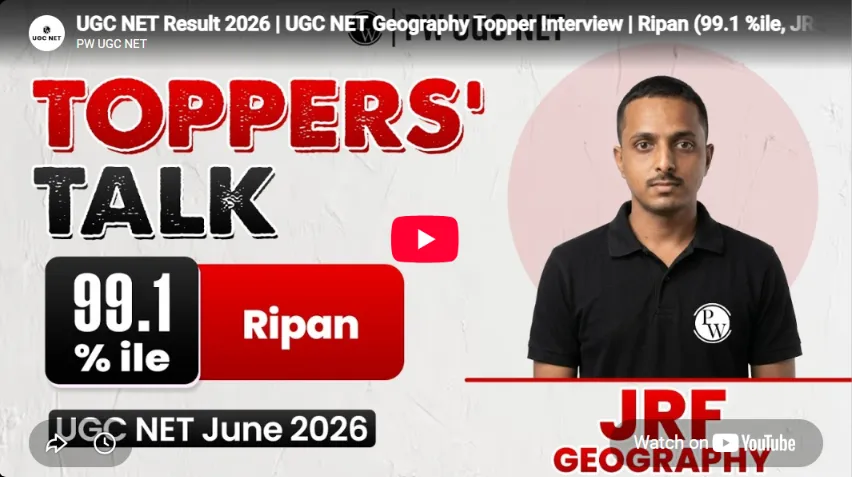
UGC NET preparation requires you to build subject knowledge while also improving your performance across both papers. Ripan’s journey in UGC NET June 2026 Geography reflects this balance. He scored 238 marks, secured the 99.10 percentile, and qualified for JRF.
During his interview with Physics Wallah, Ripan spoke about the preparation choices that supported his performance. He discussed the importance of NCERTs and basic books, explained how his Paper 1 performance improved from his previous attempt, and shared why simply solving PYQs is not enough. He also explained how he approached difficult concepts during self-study.
His experience offers a closer look at how he prepared for the examination and what he believes aspirants should focus on when preparing for UGC NET JRF.
Ripan’s Preparation Started With Strong Basics
Ripan’s UGC NET journey was built around a clear focus on books and conceptual understanding. Before preparing for UGC NET, he had already studied NCERT books from Classes 9 to 12 during his college days while preparing for UPSC. This gave him a foundation in Geography.
When asked about the high cutoff, Ripan said he expected it to rise but did not expect it to go so high.
"Ji sir dekhiye high cutoff maine to expect kiya lekin itna high jayega itna expectation nahi tha. Matlab high cutoff kitna hi ja sakta hai 200 unreserved ke liye matlab 200 304 236 itna ja sakta hai lekin bahut badhiya chala gaya cutoff to ye surprising bhi tha matlab mere liye aur hum logon ko sabhi ke liye."
Ripan scored 238 marks and secured 99.10 percentile in the June 2026 examination. The result also brought him the JRF qualification.
For his basic preparation, he continued to rely on books rather than treating lectures as the only source of learning.
"Matlab kitab hi ek cheez hai jo matlab padh ke koi matlab exam clear kar sakta hai matlab to usmein sir basic kitab to ho hi gaya jaise ki NCERT ke se class 9 se class 12 tak ka kitab wo main matlab mera college during college day maine kar liya tha mera matlab tab UPSC ka bhi tayari kar raha tha to uske chalte matlab NCERT to must hai."
This foundation helped him approach Geography with a focus on understanding the subject. His preparation later expanded to include practice and testing.
Ripan Improved Paper 1 Before the June 2026 Exam
Ripan divided his strategy into two parts: Paper 1 and Paper 2. He specifically highlighted the improvement in his Paper 1 performance compared with his previous attempt.
"To Paper 1 mein main agar dekho mera last matlab pichhle matlab attempt mein mera 25 se 30 tak hi sahi ho rahe the aur is baar mera Paper 1 mein 43 correct hue. Theek hai sir to Paper 1 obviously game changer hai aur uske saath matlab Geography to hai hi."
The increase in correct answers showed Ripan that Paper 1 could have a significant role in the overall result. Instead of concentrating only on Geography, he worked on improving his performance in Paper 1 as well.
This became an important part of his preparation strategy. His experience shows why both papers need attention when preparing for UGC NET.
How PW Became Part of Ripan’s Preparation Approach
Ripan’s preparation was not limited to studying books on his own. He also highlighted the need for proper guidance while preparing for UGC NET JRF. In his interview with Physics Wallah, he explained that self-study works best when it is supported by the right direction.
"Kitaabein padhna, notes banana, PYQs lagana is baar to PYQs bahut zyada zaroori tha aur MCQs lagana, test series dena ye sab bahut zaroori hota hai. Self-study karna bahut zaroori hota hai. Ek guidelines ki zaroorat hoti hai."
For Ripan, guidance was one part of a wider preparation process. He focused on self-study but also understood the value of having a clear direction. His approach brought together books, notes, PYQs, MCQs, test series, and guidance instead of depending on only one resource.
Ripan Used PYQs to Check Concept-Level Understanding
One of the important points from Ripan’s preparation was his approach towards previous year questions. He did not consider a PYQ complete just because he knew the correct answer.
He explained this with an example of a question involving capitals.
"Aur sir matlab aur ek cheez ki PYQ log PYQ solve karte hain jaise ki for example koi ek sawal diya hua hai ki what is the capital of India matlab itna matlab aayega nahi matlab for example to udhar diya hua hai Delhi, Thimphu, Dhaka ka theek hai aur log kya karenge India ka rajdhani New Delhi pata hai log sochega haan mujhe aata hai ye agle sawal pe chalta lekin Thimphu kiska capital hai wo pata nahi hai lekin log chale jaate hain aage aise PYQ solve karne se nahi chalega."
For him, solving a PYQ meant understanding the complete concept behind the question. If an option was unfamiliar, he believed it should also be studied instead of simply moving to the next question.
This approach made PYQs a learning tool as well as a practice resource. It helped him identify gaps in his knowledge and revisit topics that needed more attention.
Ripan Focused on Understanding Difficult Concepts
Ripan also suggested changing the way difficult concepts are studied. Instead of trying to memorise a complex topic without understanding it, he focused on breaking it down into simpler terms.
He referred to topics such as Physical Geography, Statistics, and Research Methodology while explaining this approach.
"Agar koi concept nahi samajh mein aa raha hai to main ChatGPT hai. Main bol raha hoon ki main class 5 mein padhta hoon. Mujhe samajh dijiye. Physical Geography ka agar koi Statistics ka Research Methodology ka koi matlab complex sawal hai aise matlab karna hoga."
The focus was on reaching a basic level of understanding first. Once the concept became clear, it could then be connected with more advanced questions.
This approach also supported his PYQ strategy. Rather than memorising answers, he tried to understand the concepts that appeared through questions.
Ripan’s Advice: Give Four to Six Months to Focused Preparation
Ripan also shared his thoughts for students preparing for the next UGC NET cycle. He highlighted the importance of giving adequate time to preparation, especially for students targeting JRF.
"To uske liye aapko dena hi hoga time chaar mahina chhe mahina to yahi sir."
His message was simple. Aspirants need to give consistent time to preparation instead of expecting results through short-term study.
Ripan’s UGC NET June 2026 journey shows how identifying a weakness can change the direction of preparation. After recognising the need to improve Paper 1, he strengthened his overall approach through basic books, self-study, PYQs, MCQs, tests and structured guidance. His 238 marks, 99.10 percentile and JRF qualification reflect that improvement.
For future UGC NET aspirants, his experience offers a realistic lesson: strong subject knowledge matters, but regular self-assessment is equally important. Identifying where marks are being lost, improving those areas and staying consistent can make preparation more effective.


Have questions about your prep?
Our experts can answer all your questions




 Live & recorded classes available at easeDashboard for progress trackingLakhs of practice questions

