








UGC NET Political Science Unit 7 PYQs, Important Questions
UGC NET Political Science Unit 7 PYQs help candidates revise important topics such as constitutional amendments, tenure rankings of political dignitaries, parliamentary committees, state-wise legislative strength, and judiciary frameworks. Regular PYQ practice improves conceptual understanding, analytical skills, and exam performance for the UGC NET examination.
 Aarti .10 Jun, 2026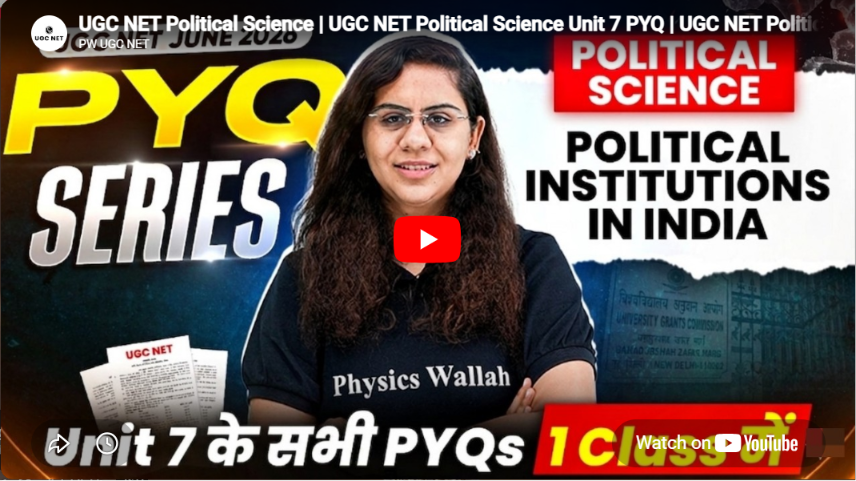
UGC NET Political Science Unit 7 covers core political institutions of India that frequently appear in the examination. Questions are commonly asked regarding historical constitutional enactments, the composition of federal bodies, state representation in parliament, the chronology of commissions, and constitutional articles.
Many candidates find this unit challenging because it demands precision with dates, chronological rankings, and analytical interpretations of institutional designs.
Practicing Previous Year Questions (PYQs) can help candidates identify recurring patterns, strengthen conceptual clarity, and improve accuracy in solving match-the-following, sequencing, and multiple-option questions.
What Does the UGC NET Political Science Unit 7 PYQ Session Cover
This UGC NET Political Science Unit 7 session focuses on vital aspects of Indian governance and institutional mechanisms that have been repeatedly found in previous cycles. Key areas covered include:
-
Major structural Constitutional Amendments and their social outcomes.
-
Chronological sequencing of constitutional functionaries (Attorney Generals, Chief Election Commissioners, etc.).
-
Distribution of Lok Sabha and Rajya Sabha seats across various Indian states.
-
Evolution of federalism and schools of thought among political thinkers.
-
Structural design and procedures of parliamentary bills and committees.
-
Framework, jurisdiction, and historical timeline of the Indian Judiciary.
Important PYQs for UGC NET Political Science Unit 7
These selected Previous Year Questions cover the important topics of Unit 7 that are frequently asked in the UGC NET Political Science examination.
Q1. Which of the following Constitutional Amendments empower women in India?
A. 69th
B. 73rd
C. 74th
D. 104th
E. 106th
Choose the correct answer from the options given below:
(A) A, C, D Only
(B) A, B, C, D Only
(C) C, D, E Only
(D) B, C, E Only
Q2. Arrange the correct sequence of Attorney Generals of India in the descending order of their tenure:
A. Ashok K. Desai
B. K. Parasaran
C. Niren De
D. L.N. Sinha
E. S.V. Gupte
Choose the correct answer from the options given below:
(A) A, B, D, E, C
(B) A, B, C, D, E
(C) C, E, B, D, A
(D) B, C, A, E, D
Q3. Match the LIST-I with LIST-II.
| LIST-I (States) | LIST-II (Number of Seats in Rajya Sabha and Lok Sabha) |
| A. West Bengal | I. 12 and 28 |
| B. Tamil Nadu | II. 10 and 21 |
| C. Odisha | III. 16 and 42 |
| D. Karnataka | IV. 18 and 39 |
Choose the correct answer from the options given below:
(A) A-I, B-II, C-III, D-IV
(B) A-II, B-III, C-I, D-IV
(C) A-III, B-IV, C-II, D-I
(D) A-I, B-IV, C-III, D-II
Q4. Arrange the following Chief Election Commissioners of India in ascending order as per their tenure-
A. M.S. Gill
B. T.S. Krishnamurthy
C. T.Swaminathan
D. R.V.S. Peri Sastri
E. S.L. Shakdhar
Choose the correct answer from the options given below:
(A) C, E, D, B, A
(B) E, C, A, B, D
(C) D, B, A, C, E
(D) C, E, D, A, B
Q5. Who is the final authority to determine a Bill as 'Money Bill'?
(A) Attorney General of India
(B) Chairman of the Law Commission of India
(C) Speaker of the Lok Sabha
(D) Chairman of the Rajya Sabha
Q6. Match the LIST-I with LIST-II.
| States List I | Number of Lok Sabha Seats List II |
| A. Assam | I. 28 |
| B. Karnataka | II. 14 |
| C. Odisha | III. 7 |
| D. Delhi | IV. 21 |
Choose the correct answer from the options given below:
(A) A-IV, B-III, C-I, D-II
(B) A-I, B-II, C-III, D-IV
(C) A-II, B-I, C-IV, D-III
(D) A-III, B-IV, C-II, D-I
Q7. Choose the sequence of articles mentioned in the Constitution of India in chronological order -
A. Abolition of Untouchability
B. Prohibition of employment of Children in Factories
C. Promotion of Co-operative Societies
D. Separation of Judiciary from Executive
E. Equal Justice and Free Legal Aid
Choose the correct answer from the options given below:
(A) A, B, E, C, D
(B) A, B, C, D, E
(C) B, A, D, E, C
(D) B, D, A, C, E
Q8. Match the LIST-I with LIST-II.
| Lok Sabha List I | Tenure List II |
| A. Rabi Ray | I. January 1985 – December 1989 |
| B. Dr. Bal Ram Jakhar | II. December 1989 – July 1991 |
| C. Shivraj Patil | III. July 1991 – May 1996 |
| D. Meira Kumar | IV. June 2009 – June 2014 |
Choose the correct answer from the options given below:
(A) A-I, B-II, C-IV, D-III
(B) A-III, B-IV, C-II, D-I
(C) A-IV, B-III, C-I, D-II
(D) A-II, B-I, C-III, D-IV
Q9. Choose the correct names of those who occupied the office of Comptroller and Auditor General(s) of India:-
A. V. Narhari Rao
B. Ranjan Gogoi
C. Vinod Rai
D. J M Lyngdoh
E. Girish Chandra Murmu
Choose the correct answer from the options given below:
(A) A, C, D Only
(C) A, C, E Only
(Note: Options listed as per original layout sequence)
Q10. Match List I with List II:
| List- I (Ideas) | List- II (Thinkers) |
| (A) Extremely Federal | (I) Morris Jones |
| (B) Quasi Federal | (II) Granville Austin |
| (C) Bargaining Federal | (III) K.C. Wheare |
| (D) Cooperative Federal | (IV) Paul Appleby |
Choose the correct option given below:
(A) A-I, B-III, C-II, D-IV
(B) A-IV, B-III, C-II, D-I
(C) A-I, B-IV, C-II, D-III
(D) A-IV, B-III, C-I, D-II
Preparation Tips for UGC NET Political Science Unit 7
Political Science Unit 7 includes many important concepts, facts, and constitutional topics. Candidates can improve their preparation and score better by following these simple study tips:
-
Create Master Indexes: Regularly catalog the sequential charts of high offices like the Chief Election Commissioners, Speakers of the Lok Sabha, CAGs, and Attorneys-General along with historical milestone periods (such as the 1975 Emergency or 1991 Economic Reforms).
-
Memorize Federal Demographics: Keep an updated state-wise checklist for representation counts in both the Lok Sabha and Rajya Sabha, as matching matrices on legislative seats are highly favored evaluation tools.
-
Track Structural Core Articles: Dedicate focused revision blocks to Part III, Part IV, and institutional structures spanning Articles 74 through 243, paying attention to specific constitutional subsections.
-
Link Thinkers with Structural Definitions: Learn how foreign and domestic analytical experts define Indian governance patterns (e.g., Morris Jones on bargaining structures vs. Granville Austin on cooperative networks).
-
Practice Cross-Referencing: Solve Previous Year Questions daily to train your mind to implement elimination parameters successfully on comprehensive assertion-reasoning matrices.
UGC NET Political Science Unit 7 Important PYQs FAQs
What are the most important topics in UGC NET Political Science Unit 7 PYQs?
How do PYQs help in Unit 7 preparation?
What type of questions are asked from Unit 7?


Have questions about your prep?
Our experts can answer all your questions


 Live & recorded classes available at easeDashboard for progress trackingLakhs of practice questions

