







Classical Music in India: Hindustani, Carnatic Music & UPSC PYQs
Classical Music in India is one of the world's oldest musical traditions and a cornerstone of Indian cultural heritage. It evolved into Hindustani and Carnatic music, based on the concepts of Raga and Tala, and remains significant for understanding India's artistic, spiritual, and cultural legacy, as well as UPSC Art and Culture preparation.
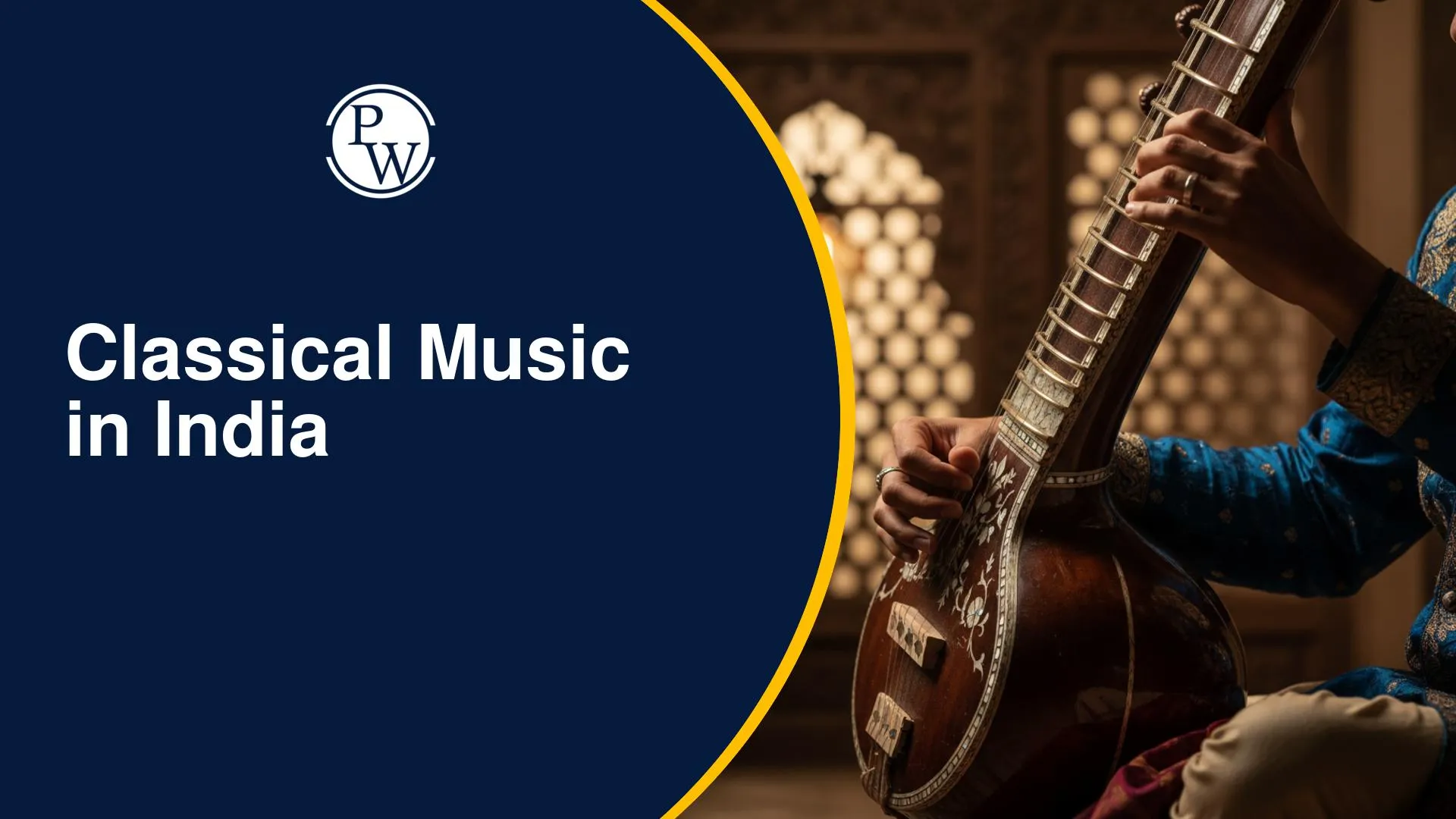
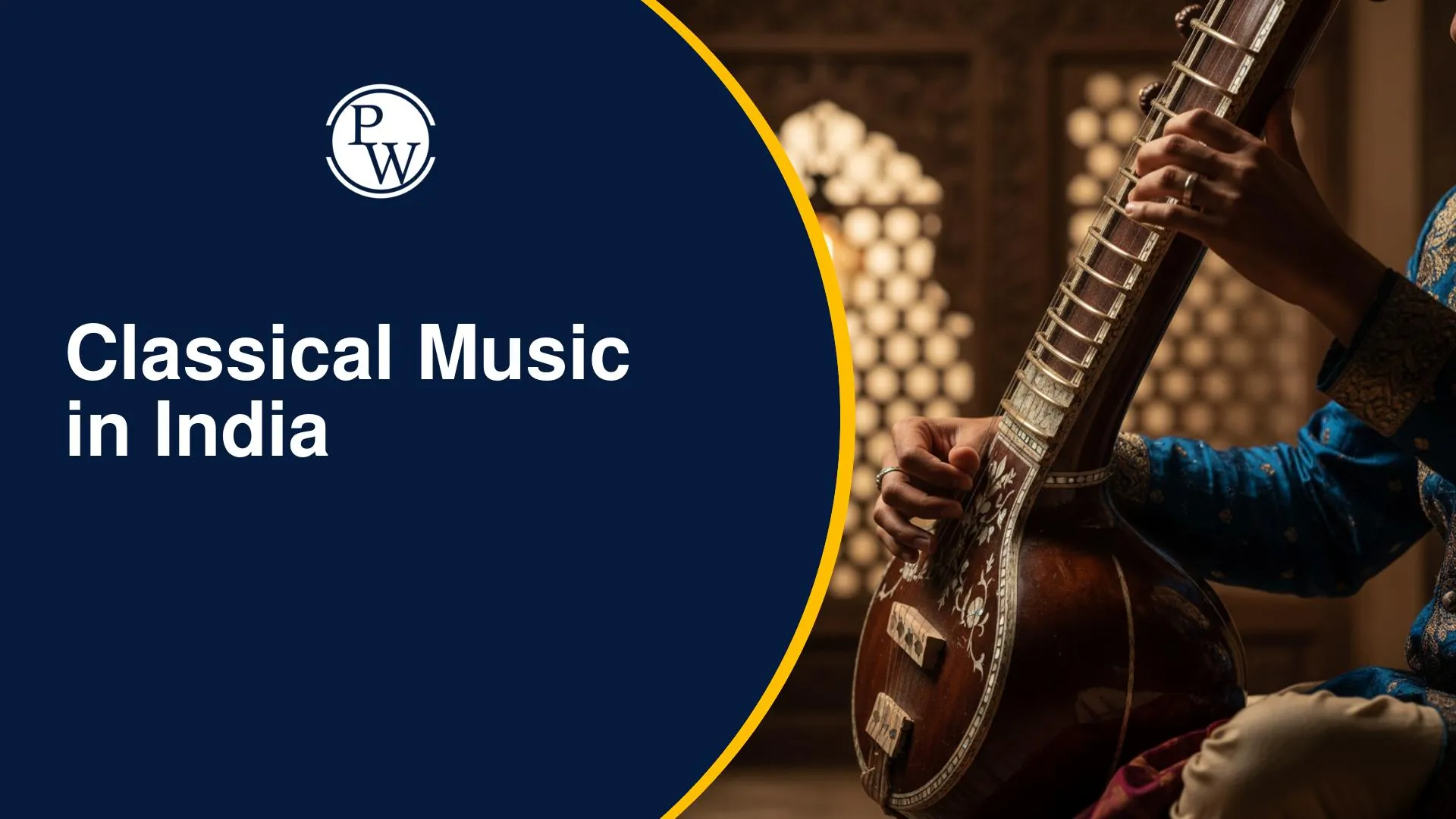
Classical Music in India represents one of the oldest and most sophisticated musical traditions in the world. Developed over centuries through the contributions of sages, scholars, saints, composers, and performers, it occupies a central place in India's cultural heritage. Rooted in spirituality and artistic expression, Indian classical music seeks to evoke emotions (Bhava) through melody, rhythm, and improvisation.
Indian Classical Music gradually evolved into two major traditions—Hindustani Classical Music in North India and Carnatic Music in South India. Both systems share common foundations such as Raga and Tala, yet differ in style, performance techniques, and historical influences.
This topic of ‘Classical Music in India’ is important from the perspective of the UPSC IAS Examination, particularly under General Studies Paper I (Indian Heritage and Culture), Art and Culture, and UPSC Prelims.
Historical Development of Indian Classical Music
Indian Classical Music is one of the world's oldest surviving musical traditions, with its roots tracing back to the Vedic period. Over centuries, it evolved through contributions from ancient scriptures, musicologists, saints, royal patrons, and legendary composers. The development of Indian music can broadly be divided into the Ancient, Medieval, and Modern periods.
The Sama Veda laid the foundation of musical concepts, while treatises such as the Natyashastra and Sangita Ratnakara systematized music theory. During the medieval period, Indian classical music gradually branched into Hindustani and Carnatic traditions. The Bhakti Movement further enriched musical forms through devotional compositions in regional languages. The 18th and 19th centuries witnessed the golden age of Indian classical music with the emergence of the Carnatic Musical Trinity and the growth of major Hindustani gharanas. Today, Indian classical music enjoys global recognition while preserving its rich cultural and spiritual heritage.
|
Period / Timeline |
Major Developments |
Key Sources / Personalities |
Significance |
|
Vedic Period (1500 BCE–500 BCE) |
Origin of Indian music from Vedic chanting; development of musical notes for recitation of hymns |
Sama Veda |
Considered the foundation of Indian Classical Music. |
|
Ancient Period (500 BCE–200 CE) |
Emergence of concepts such as Swara, Shruti, Grama, Murchana, Laya, and Rasa |
Vedas, Upanishads, Puranas |
Established the theoretical framework of Indian music. |
|
2nd Century CE |
Systematic codification of music and performing arts |
Bharata Muni – Natyashastra |
Classified musical instruments and explained 22 Shrutis. |
|
1st–7th Century CE |
Growth of regional musical traditions and early raga concepts |
Silappadikaram, Kudumiyamalai Inscriptions |
Evidence of developed musical traditions in South India. |
|
7th–13th Century CE |
Expansion of musicological literature and evolution of ragas |
Matanga, Narada and other scholars |
Strengthened theoretical and practical aspects of music. |
|
13th Century CE |
Culmination of ancient musical traditions |
Sangita Ratnakara by Sharngadeva |
Last major treatise before the division of Indian classical music. |
|
13th–14th Century CE |
Division of Indian Classical Music into two streams |
Hindustani and Carnatic traditions |
Beginning of separate northern and southern musical systems. |
|
Medieval Period (13th–17th Century) |
Persian-Arab influence in North India; preservation of traditional forms in South India |
Muslim courts, Hindu kingdoms |
Led to the distinct evolution of Hindustani and Carnatic music. |
|
Bhakti Movement (7th–17th Century) |
Large-scale devotional compositions in regional languages |
Purandaradasa, Mirabai, Surdas, Kabir, Annamacharya |
Popularised music among common people and enriched musical forms. |
|
16th–17th Century |
Scientific classification of ragas and melas |
Ramamatya, Venkatamakhi |
Foundation of the modern Melakarta system. |
|
18th Century – Golden Age |
Rapid growth in ragas, talas, compositions, notation, and musical forms |
Musical Trinity and other composers |
Considered the golden age of Carnatic music. |
|
18th–19th Century |
Development of major vocal forms and gharanas in North India |
Vishnu Narayan Bhatkhande, Agra, Gwalior, Kirana Gharanas |
Standardisation of Hindustani Classical Music. |
Main Branches of Classical Music in India
Indian Classical Music is broadly divided into two major traditions: Hindustani Classical Music and Carnatic Classical Music. While both originated from ancient Indian musical traditions and are based on the concepts of Raga and Tala, they evolved differently due to regional, cultural, and historical influences.
Hindustani Music developed primarily in North India under the influence of Persian and Central Asian musical traditions. Carnatic Music continued to flourish in South India with a stronger emphasis on devotional and indigenous elements.
Despite their differences in style, performance, and composition, both systems share common concepts such as Raga (melody) and Tala (rhythm) and together represent the rich musical heritage of India.
|
Branch |
Region |
Key Features |
Major Forms |
|
Hindustani Classical Music |
North India |
Greater emphasis on improvisation, melodic expansion (Raag), and Swara |
Dhrupad, Khayal, Thumri, Tarana |
|
Carnatic Classical Music |
South India |
Greater emphasis on purity of notes (Swaras), structured compositions, and equal importance to lyrics and melody |
Kirtanam, Kriti, Jawali, Tillana |
Hindustani vs Carnatic Music
While Hindustani and Carnatic music share a common heritage, they differ in terms of musical approach, language, instruments, and performance techniques. The following comparison helps understand the unique characteristics of each tradition.
|
Feature |
Hindustani Classical Music |
Carnatic Classical Music |
|
Region |
North India |
South India |
|
Origin |
Developed under Indian, Persian, and Central Asian influences |
Evolved largely from ancient Indian traditions |
|
Language of Compositions |
Hindi, Urdu, Braj, Sanskrit |
Telugu, Tamil, Kannada, Sanskrit |
|
Main Focus |
Improvisation and elaboration of Ragas |
Composition-based performance with structured improvisation |
|
Major Vocal Forms |
Dhrupad, Khayal, Thumri, Tappa, Tarana |
Kriti, Varnam, Tillana, Kirtanam |
|
Accompanying Instruments |
Sitar, Sarod, Tabla, Shehnai, Santoor |
Veena, Violin, Mridangam, Ghatam, Nadaswaram |
|
Music Schools |
Gharanas (e.g., Gwalior, Kirana, Patiala) |
Bani and Guru-Shishya traditions |
|
Key Contributors |
Tansen, Amir Khusrau, Bhatkhande, Bhimsen Joshi |
Purandaradasa, Tyagaraja, Muthuswami Dikshitar, Syama Shastri |
|
Performance Style |
More flexible and improvisational |
More structured and composition-oriented |
|
Present-Day Popularity |
Predominant in North India and globally |
Predominant in South India and globally |
Hindustani Classical Music
Hindustani Classical Music developed primarily in North India after the medieval period. It absorbed elements from Persian and Central Asian traditions while retaining the foundational principles of Indian music.
The tradition places significant emphasis on improvisation, allowing performers to creatively explore the melodic framework of a raga. Performances revolve around Raga (melodic structure) and Tala (rhythmic cycle), which together form the foundation of Hindustani music.
Concept of Raga and Tala
-
Raga: A melodic framework consisting of specific notes and rules that create a particular mood or emotion.
-
Tala: A rhythmic cycle that governs timing and tempo in a composition.
-
Together, they provide the structure within which musicians improvise and perform.
Major Vocal Forms of Hindustani Music
Hindustani Classical Music consists of several vocal styles that developed across different historical periods. Some forms emphasise devotional expression, while others focus on improvisation, melody, and technical virtuosity. The following table outlines the major vocal traditions.
|
Form |
Features |
|
Dhrupad |
Oldest surviving vocal tradition; devotional, solemn, and spiritual in nature |
|
Khayal |
Most popular form; emphasises improvisation and creativity |
|
Thumri |
Expressive and romantic style focusing on emotions |
|
Tappa |
Fast-paced compositions with intricate ornamentation |
|
Tarana |
Uses syllables and rhythmic patterns instead of meaningful lyrics |
Gharanas of Hindustani Music
A Gharana refers to a distinct school or tradition of music passed through generations.
|
Gharana |
Founder/Associated Artists |
Features |
|
Gwalior |
Naththan Khan, Haddu Khan |
Oldest Khayal Gharana; balanced style |
|
Kirana |
Abdul Karim Khan |
Emphasis on note purity and slow elaboration |
|
Agra |
Ghagge Khuda Baksh |
Strong voice production and rhythmic complexity |
|
Jaipur-Atrauli |
Alladiya Khan |
Rare ragas and intricate compositions |
|
Patiala |
Ali Baksh and Fateh Ali |
Rich ornamentation and fast taans |
Carnatic Classical Music
Carnatic Music evolved in South India while preserving many ancient musical traditions. It remained relatively insulated from foreign influences and developed around temple culture, devotional literature, and scholarly compositions.
Unlike Hindustani music, Carnatic performances are more composition-oriented, though improvisation remains an important component. Devotional themes form the backbone of most Carnatic compositions.
The typical Carnatic concert includes Varnam, Kriti, Raga Alapana, Neraval, Kalpana Swaras, and Tillana, creating a structured and systematic performance format.
Trinity of Carnatic Music
The 18th century is regarded as the golden age of Carnatic music due to the contributions of the Musical Trinity.
|
Musician |
Contribution |
|
Tyagaraja |
Composed hundreds of devotional kritis; expanded the use of ragas |
|
Muthuswami Dikshitar |
Sanskrit compositions noted for scholarship and musical complexity |
|
Syama Sastri |
Known for rhythmic brilliance and devotional compositions dedicated to Goddess Kamakshi |
Major Classical Musical Instruments
Musical instruments play a crucial role in both Hindustani and Carnatic traditions. They accompany vocal performances and also serve as solo instruments capable of expressing complex ragas and rhythmic patterns.
|
Instrument |
Category |
Associated Tradition |
|
Sitar |
String |
Hindustani |
|
Sarod |
String |
Hindustani |
|
Veena |
String |
Carnatic |
|
Violin |
String |
Carnatic |
|
Tabla |
Percussion |
Hindustani |
|
Mridangam |
Percussion |
Carnatic |
|
Flute |
Wind |
Both |
|
Santoor |
String |
Hindustani |
|
Shehnai |
Wind |
Hindustani |
|
Ghatam |
Percussion |
Carnatic |
Famous Classical Musicians of India
Indian Classical Music has been enriched by generations of legendary musicians who preserved traditional knowledge while introducing innovations in performance and teaching. Their contributions helped popularise Indian music both nationally and internationally.
|
Musician |
Contribution |
|
Tansen |
One of the Navaratnas in Emperor Akbar’s court and among the greatest exponents of Hindustani music. Many musical traditions and gharanas trace inspiration to his legacy. |
|
Ustad Bismillah Khan |
A renowned shehnai maestro who elevated the instrument to the classical concert stage. Awarded the Bharat Ratna for his contribution to Indian music. |
|
Pandit Bhimsen Joshi |
Legendary vocalist of the Kirana Gharana known for his powerful renditions and mastery over ragas. Recipient of the Bharat Ratna. |
|
Pandit Ravi Shankar |
Internationally acclaimed sitar virtuoso who introduced Indian Classical Music to global audiences. Collaborated with numerous Western musicians. |
|
Ustad Amjad Ali Khan |
Celebrated sarod maestro known for preserving and popularizing the Senia Bangash tradition. Widely respected for his innovations in instrumental music. |
|
M. S. Subbulakshmi |
One of the greatest Carnatic vocalists in Indian history. She became the first musician to receive the Bharat Ratna. |
|
Semmangudi Srinivasa Iyer |
Revered as the "Pitamaha of Modern Carnatic Music." He played a major role in preserving and promoting classical compositions. |
|
Lalgudi Jayaraman |
Legendary violinist and composer who developed the famous Lalgudi style of violin playing. His compositions remain widely performed. |
|
Balamuralikrishna |
Renowned Carnatic vocalist, composer, and multi-instrumentalist. Credited with creating new ragas and compositions. |
|
M. L. Vasanthakumari |
Distinguished Carnatic vocalist known for her mastery of complex ragas and her contribution to music education. |
Classical Music and UNESCO Recognition
Indian Classical Music is recognised globally for its cultural significance. UNESCO's efforts to preserve traditional music include recordings such as the Anthology of North Indian Classical Music, which help document and promote India's musical heritage.
Recognising its cultural value, UNESCO launched the UNESCO Collection of Traditional Music of the World in 1961 to preserve and promote traditional musical traditions from across the globe.
The collection includes recordings such as the Anthology of North Indian Classical Music, helping preserve India's musical heritage and making it accessible to future generations.
Significance of Classical Music in India
Classical music continues to play a vital role in India's cultural and intellectual life.
-
Preserves India's ancient cultural heritage
-
Serves as a medium of spiritual and devotional expression
-
Strengthens national identity and cultural continuity
-
Promotes India's soft power and cultural diplomacy
-
Encourages artistic creativity and intellectual discipline
-
Receives global recognition as a unique musical tradition
UPSC Previous Year Questions and Practice Questions
UPSC Prelims
Q. The sufi saint who maintained that devotional music was one way of coming close to God was (2021)
(a) Muin-ud-din Chishti
(b) Baba Farid
(c) Saiyid Mohammad Gesudaraz
(d) Shah Alam Bukhari
Answer: (a) Muin-ud-din Chishti
Q. With reference to the cultural history of India, consider the following statements: (2018)
-
Most of the Tyagaraja kritis are devotional songs in praise of Lord Krishna.
-
Tyagaraja created several new ragas.
-
Annamacharya and Tyagaraja are contemporaries.
-
Annamacharya kirtanas are devotional songs in praise of Lord Venkateshwara.
Which of the statements given above are correct?
(a) 1 and 3 only
(b) 2 and 4 only
(c) 1, 2 and 3
(d) 2, 3 and 4
Answer: (b) 2 and 4 only
Q. With reference to Dhrupad, one of the major traditions of India that has been kept alive for centuries, which of the following statements are correct? (2012)
-
Dhrupad originated and developed in the Rajput kingdoms during the Mughal period.
-
Dhrupad is primarily devotional and spiritual music.
-
Dhrupad Alap uses Sanskrit syllables from Mantras.
Select the correct answer using the codes given below:
Select an option to attempt
-
1 and 2 only
-
2 and 3 only
-
1, 2 and 3
-
None of the above is correct
Answer: (b) 2 and 3 only
Classical Music in India FAQs
What are the two major traditions of Classical Music in India?
Which Veda is considered the foundation of Indian Classical Music?
What is the difference between Raga and Tala?
Who is known as the Trinity of Carnatic Music?
What is a Gharana in Hindustani Classical Music?







Get Free Counselling Today
and Clear up all your Doubts
 Live & recorded classes available at easeDashboard for progress trackingLakhs of practice questions

