

Important Seas of the World: Locations and Significance

Important Seas of the World are smaller bodies of saltwater that are often partially enclosed by land and connected to major oceans. These seas, such as the Mediterranean Sea, Arabian Sea, South China Sea, and Red Sea, play a crucial role in global trade, climate regulation, and marine biodiversity.
For students preparing for competitive exams like UPSC, understanding the location, bordering countries, and geographical significance of these seas is essential. Studying world seas helps improve map skills, strengthens geographical concepts, and enhances awareness of international relations and strategic maritime routes.
Important Seas of the World Overview
The distribution of water bodies across the globe is complex. Marginal seas, which are divisions of the ocean, are partially enclosed by islands, archipelagos, or peninsulas. Identifying these on an important seas of the world map is essential for spatial awareness in geography.
|
Important Seas of the World Overview |
||
|
Sea Name |
Location/Connected Ocean |
Key Geographical Feature |
|
Mediterranean Sea |
Between Europe, Africa, and Asia |
Connected to the Atlantic via the Strait of Gibraltar. |
|
Caribbean Sea |
Western Atlantic Ocean |
Located southeast of the Gulf of Mexico. |
|
South China Sea |
Western Pacific Ocean |
Strategically vital shipping lane south of China. |
|
Bering Sea |
Northern Pacific Ocean |
Separates the continents of Asia and North America. |
|
Red Sea |
Between Africa and Asia |
Separated from the Mediterranean by the Suez Canal. |
List of Important Seas of the World
When preparing for the UPSC, candidates should focus on the location and bordering countries of these major seas of the world.
1. The Mediterranean Sea
The Mediterranean is one of the most historically significant seas. It is bordered by 21 countries across three continents. Key straits include the Strait of Gibraltar and the Dardanelles.
2. South China Sea
As one of the largest seas in the world, the South China Sea is a critical maritime crossroad. It involves complex territorial claims involving several Southeast Asian nations and China.
3. Arabian Sea
Located in the northwestern part of the Indian Ocean, the Arabian Sea is vital for India’s trade and the Indian Monsoon system. It is bordered by India, Pakistan, Iran, and the Arabian Peninsula.
4. Caspian Sea
Though termed a "sea," it is technically the world's largest inland body of water. It is bordered by Russia, Kazakhstan, Turkmenistan, Iran, and Azerbaijan.
5. Red Sea
The Red Sea is a seawater inlet of the Indian Ocean, lying between Africa and Asia. Its connection to the Mediterranean via the Suez Canal makes it one of the most heavily traveled waterways in the world.
Important Seas of the World MAP
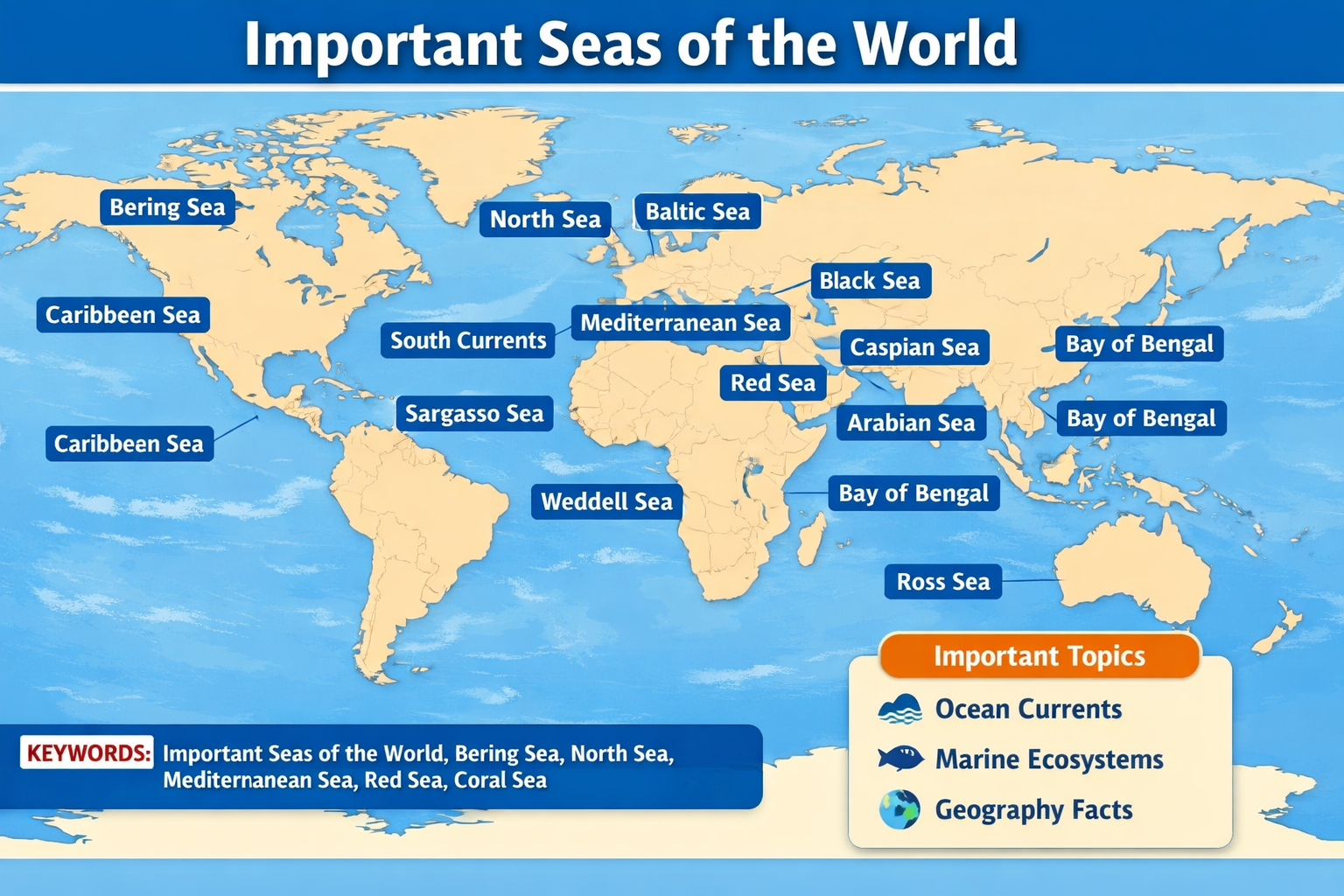
Below is a world map showing the major seas, including the Mediterranean Sea, Caribbean Sea, Red Sea, Arabian Sea, South China Sea, Baltic Sea, Black Sea, Bering Sea, and North Sea, clearly labeled for easy reference.
World Seas and Oceans: Comparative Analysis
Understanding the relationship between world seas and oceans helps in comprehending global climate patterns and marine biology. Oceans like the Pacific, Atlantic, and Indian Oceans host several marginal seas that have distinct salinity levels and temperatures.
-
Pacific Ocean Marginal Seas: Philippine Sea, Coral Sea, Sea of Japan.
-
Atlantic Ocean Marginal Seas: North Sea, Baltic Sea, Gulf of Mexico.
-
Indian Ocean Marginal Seas: Andaman Sea, Bay of Bengal, Red Sea.
Important Seas for UPSC: Mapping and Facts
For aspirants, a list of seas in the world is incomplete without knowing the "landlocked" or "marginal" status:
-
Dead Sea: Known for being the lowest point on land and its extreme salinity.
-
Black Sea: A marginal sea of the Atlantic Ocean, located between Eastern Europe and Western Asia.
-
Sea of Azov: Connected to the Black Sea by the narrow Strait of Kerch.
Preparation Tips for Geography
To master the topic of important seas for UPSC, candidates should:
-
Use Atlases: Regularly practice marking the seas on a physical world map.
-
Focus on Bordering Countries: Questions often ask which countries surround a particular sea (e.g., countries bordering the Mediterranean).
-
Current Affairs: Stay updated on geopolitical issues related to seas like the South China Sea or the Black Sea.
Important Seas of the World FAQs
Which is the largest sea in the world?
What is a marginal sea?
Why is the Mediterranean Sea called the "Cradle of Civilization"?
Which seas are strategically important for global trade?


Have questions about your prep?
Our experts can answer all your questions