Malwa Plateau: Location, Geology, and Geographic Significance

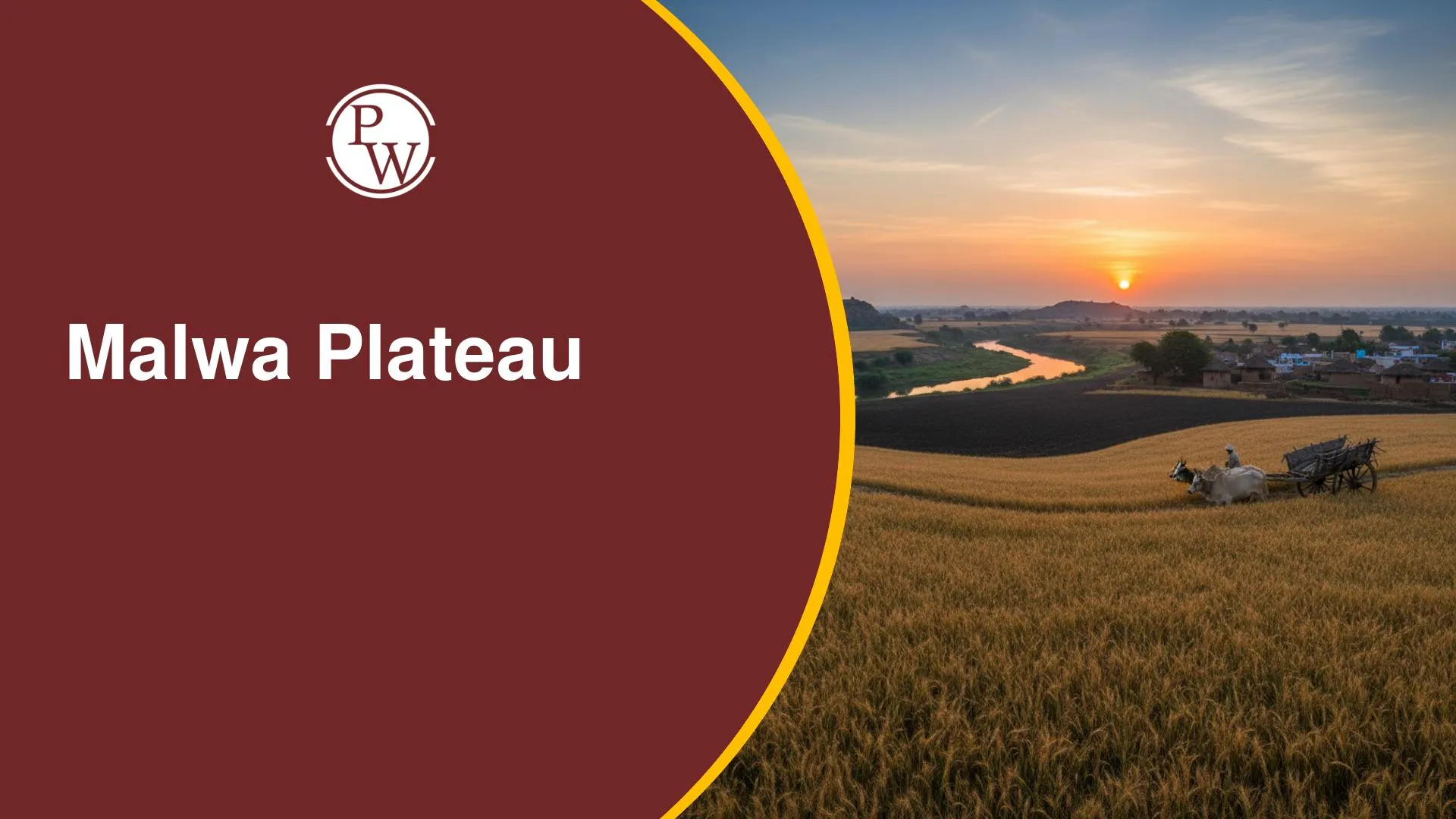
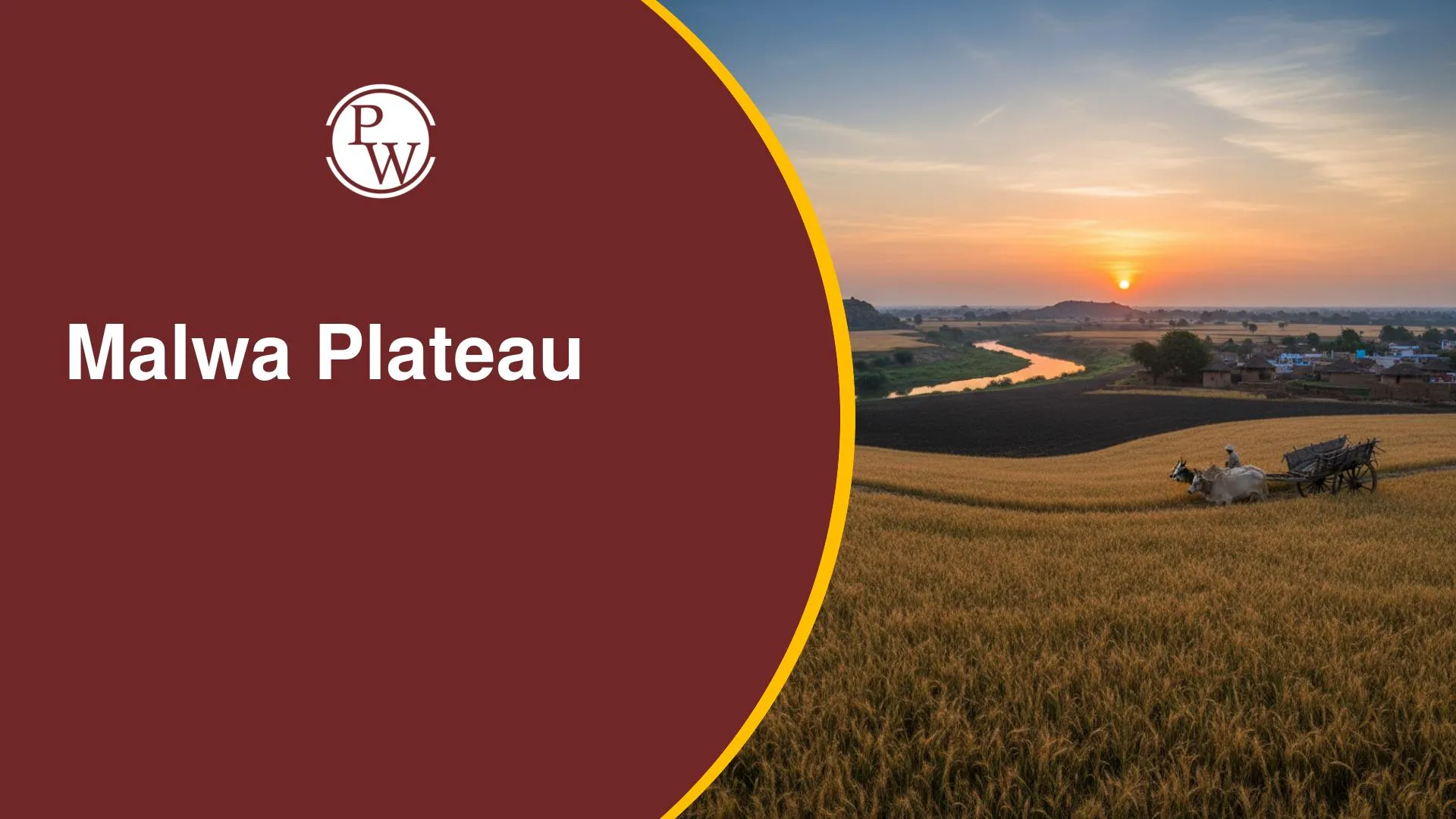
Malwa Plateau stands as one of the most distinct and geologically fascinating physiographic units of the Indian subcontinent. Situated in the heart of the country, it serves as a transitional zone between the Indo-Gangetic plains to the north and the rugged Deccan Traps to the south. This plateau is not just a high-altitude landmass; it is a region defined by ancient volcanic history, fertile soil, and a drainage system that feeds some of India's most iconic rivers.
Understanding the Malwa plateau location and its multifaceted characteristics is essential for anyone studying Indian physical geography, especially those referring to Malwa plateau geography notes for competitive examinations like UPSC.
Malwa Plateau Overview
Below is an overview of the Malwa Plateau, highlighting its key geographical and economic features in a structured format for quick revision.
|
Malwa Plateau Overview |
|
|
Feature |
Details |
|
Region Name |
Malwa Plateau |
|
Location |
Northwestern part of Central India (Central Highlands) |
|
Malwa Plateau States |
Malwa Plateau in Madhya Pradesh (major part) and Malwa Plateau in Rajasthan (southeastern part) |
|
Malwa Plateau Extent |
Spreads over western & central Madhya Pradesh and extends into the Hadoti region of Rajasthan |
|
Malwa Plateau Formation |
Formed due to volcanic activity during the late Cretaceous period |
|
Malwa Plateau Volcanic Origin |
Part of the Deccan Traps formed by fissure eruptions of lava |
|
Malwa Plateau Geology |
Composed mainly of basaltic rocks with step-like “trap” structure |
|
Average Elevation |
500–600 meters above sea level |
|
Malwa Plateau Physiography |
Undulating surface, flat-topped hills, northward slope |
|
Malwa Plateau Black Soil |
Regur (Black Cotton Soil), fertile and moisture-retentive |
|
Malwa Plateau Rivers |
Chambal River, Betwa River, Kali Sindh River |
|
Malwa Plateau Drainage Pattern |
Dendritic (tree-like), rivers flow north and northeast |
|
Malwa Plateau Climate |
Tropical climate with hot summers and moderate monsoon rainfall |
Malwa Plateau Location and Extent
When we look at the physical map of India, the Malwa plateau location is identified within the Central Highlands. It is a sprawling tableland that slopes gently toward the north.
-
Malwa plateau states: The plateau is primarily spread across the state of Madhya Pradesh, covering its western and central parts. However, the Malwa plateau extent also stretches into southeastern Rajasthan, forming a continuous landscape of basaltic uplands.
-
Geographic Boundaries: To the south, the plateau is bounded by the Vindhya Range, which acts as a water divide between the Narmada and the Ganga basins. To the northwest lies the ancient Aravalli Range. To the east, it transitions into the Bundelkhand and Baghelkhand plateaus.
Malwa Plateau Volcanic Origin
The story of the Malwa plateau geology is one of fire and time. The plateau is a part of the "Deccan Traps," a massive volcanic province.
Malwa Plateau Formation
The Malwa plateau formation occurred during the late Cretaceous period, approximately 60 to 68 million years ago. It was the result of massive fissure eruptions where molten magma poured out of the Earth's crust through long cracks. Unlike explosive volcanoes, these were "effusive" eruptions, where lava flowed over vast areas, cooling down to form thick layers of basaltic rock.
Malwa Plateau Geology
The Malwa plateau geology is characterized by these solidified lava flows. Over millions of years, these layers were subjected to denudation and weathering. This volcanic heritage is what gives the plateau its "trap" (stair-like) appearance. The presence of hard basaltic rocks has influenced the Malwa plateau physiography, creating a rolling landscape with occasional flat-topped hills.
Malwa Plateau Black Soil
One of the most defining features of this region is the Malwa plateau black soil. This soil is the direct product of the weathering of the basaltic rocks mentioned in the Malwa plateau geology.
-
Characteristics: Also known as "Regur" or "Black Cotton Soil," it is rich in minerals like iron, lime, calcium, and magnesium.
-
Fertility: The Malwa plateau black soil has an extraordinary capacity to retain moisture. During the monsoon, it becomes sticky, and during the dry season, it develops deep cracks, which help in self-aeration.
-
Agricultural Impact: This soil is the primary reason why Malwa plateau agriculture is so prosperous. It is particularly suited for crops that require high moisture retention.
Malwa Plateau Rivers and Drainage
Malwa plateau drainage pattern is unique. While the southern boundary is the Vindhya Range, the rivers do not flow south into the Narmada. Instead, they flow towards the North and North-East, following the natural slope of the plateau.
1. Chambal River Malwa Plateau
The Chambal river Malwa plateau is the most significant waterway in the region. It has played a massive role in shaping the Malwa plateau physiography. The Chambal is infamous for creating "badland topography"—a network of deep ravines formed by gully erosion. This makes the northern edge of the plateau a unique landscape of sharp ridges and deep valleys.
2. Betwa River Malwa Plateau
The Betwa river Malwa plateau originates in the Vindhya Range and flows northwards through the plateau before joining the Yamuna. It is a lifeline for irrigation and drinking water in the Malwa plateau in Madhya Pradesh.
3. Kali Sindh River Malwa Plateau
The Kali Sindh river Malwa plateau is another major tributary of the Chambal. Along with the Parbati and the Shipra rivers, it ensures that the plateau remains well-drained, contributing to the "dendritic" (tree-like) Malwa plateau drainage pattern.
Malwa Plateau Physiography and Climate
The Malwa plateau physiography is marked by an average elevation of 500 to 600 meters. The landscape is not uniform; it consists of undulating plains interspersed with low hills.
-
Malwa plateau climate: The climate here is tropical. While summers can be quite hot, the elevation of the plateau often makes the nights pleasantly cool. The monsoon brings moderate rainfall, which is essential for the Malwa plateau crops.
-
Vegetation: Historically, the region was covered with dry deciduous forests, though much of it has now been cleared for Malwa plateau agriculture.
Economic Importance and Agriculture
The Malwa plateau economic importance cannot be overstated. It is often referred to as the "wheat basket" of Madhya Pradesh.
Malwa Plateau Agriculture and Crops
The combination of the Malwa plateau black soil and a reliable Malwa plateau drainage pattern creates an ideal environment for farming.
-
Primary Crops: The major Malwa plateau crops include Soyabean, Cotton, Wheat, and Gram. In fact, the Malwa plateau in Madhya Pradesh is one of the largest producers of soyabean in India.
-
Industrial Growth: The agricultural surplus has led to the growth of agro-based industries in cities like Indore and Ujjain.
Regional Perspectives
The Malwa Plateau shows regional variations between Madhya Pradesh and Rajasthan in terms of development, culture, and physical features. Its agricultural productivity and geological structure influence both regions differently.
Malwa Plateau in Madhya Pradesh
In this state, the plateau covers districts like Indore, Ujjain, Dewas, and Bhopal. It is the most developed part of the state, both agriculturally and industrially. The cultural heritage of the Malwa plateau in Madhya Pradesh is also rich, with ancient cities like Ujjain being located on the banks of the Shipra river.
Malwa Plateau in Rajasthan
The Malwa plateau in Rajasthan covers the southeastern portion, known as the Hadoti region (districts like Pratapgarh, Jhalawar, and Kota). Here, the Malwa plateau geology transitions into the hilly terrain of the Aravallis, but the presence of black soil keeps the area agriculturally productive compared to the arid west of Rajasthan.
Malwa Plateau FAQs
What is the height of the Malwa Plateau?
Which is the highest peak in the Malwa Plateau?
Why is the Chambal river famous in this region?
What are the main Malwa plateau crops?