







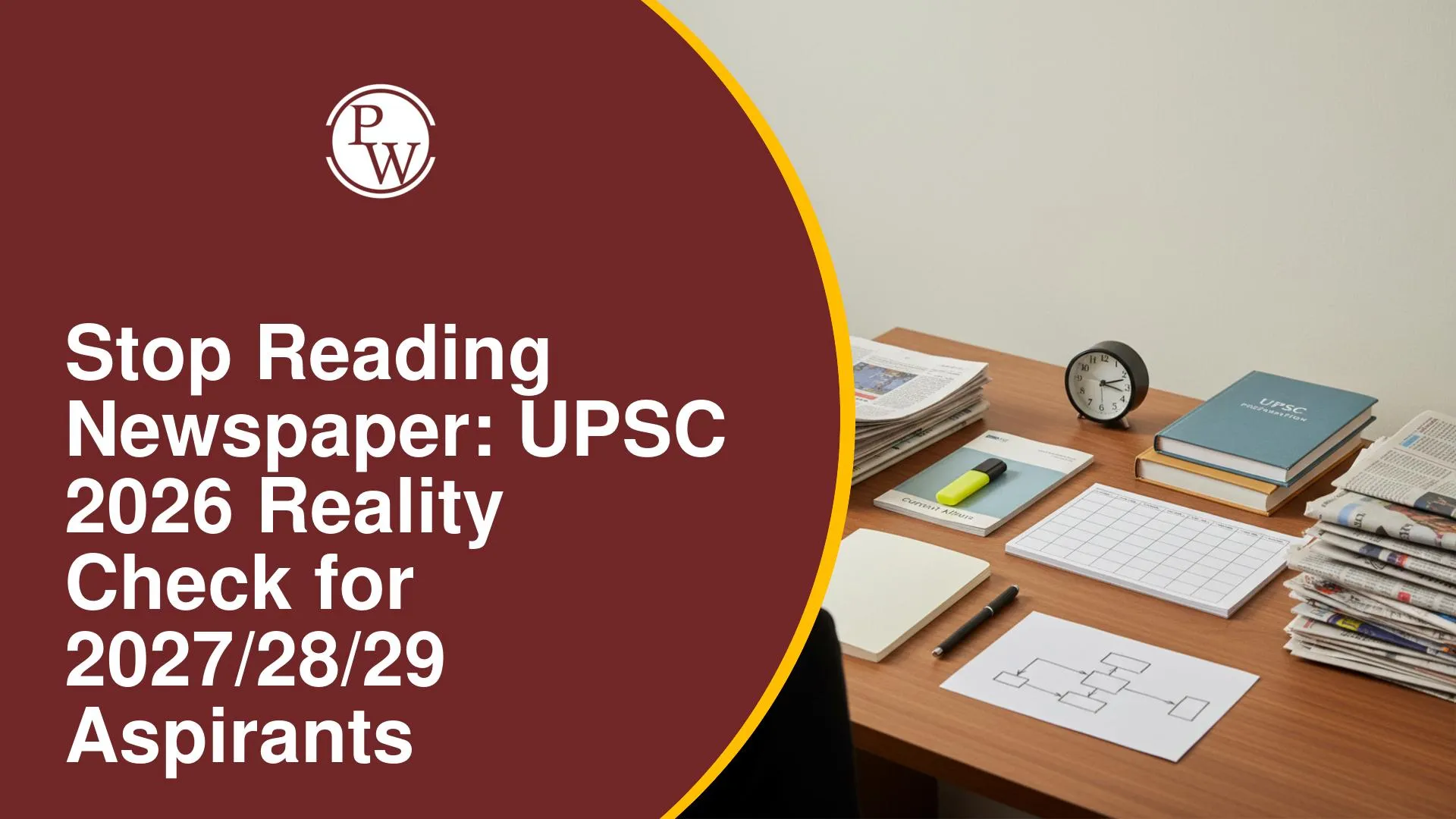
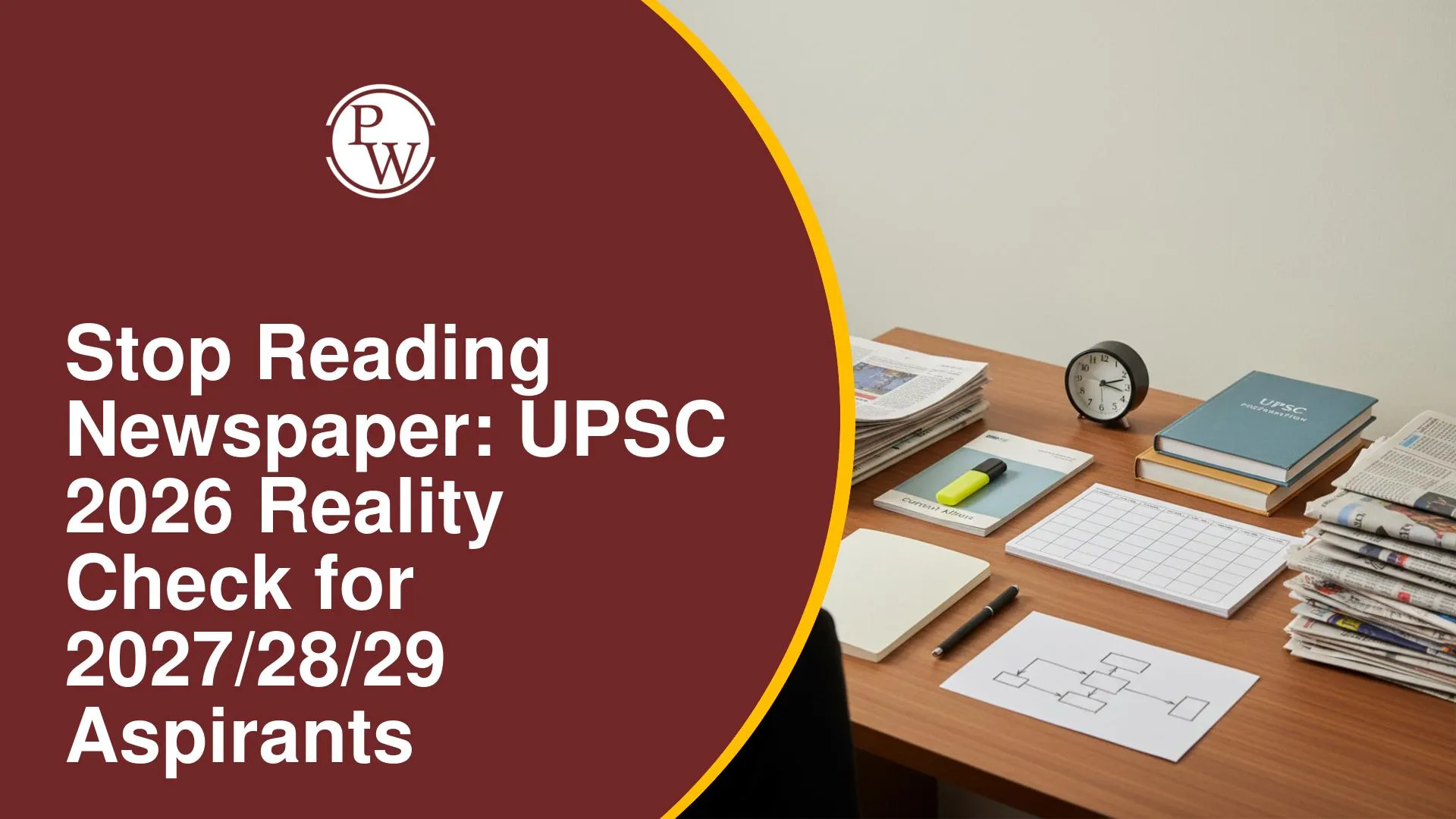
Spending hours reading newspapers every day but struggling to recall important facts or connect news with the UPSC syllabus can make your preparation inefficient. For UPSC CSE 2027, 2028 and 2029 aspirants, the challenge is not just keeping up with daily news but identifying what matters for Prelims and Mains. Reading every headline, making lengthy notes and postponing revision can take time away from static subjects, MCQ practice and answer writing.
PW offers online coaching with experienced faculty, live and recorded classes, regularly updated study material, Prelims-Mains-Interview coverage, mock tests, personalised mentorship and doubt-solving support. These resources can help you build a balanced preparation routine while managing current affairs alongside static subjects, revision and answer writing.
Should You Stop Reading Newspapers for UPSC 2027, 2028 and 2029?
For UPSC CSE 2027, 2028 and 2029, the challenge is to identify relevant news rather than read every headline. Spending hours on newspapers can reduce the time available for static subjects, revision and practice. Focus on syllabus-related developments, such as Supreme Court judgments, government policies and economic issues, and skip routine or repetitive news with little examination relevance.
Before spending time on a news item, ask yourself:
-
Syllabus relevance: Does it connect with a topic in the UPSC syllabus?
-
Exam significance: Could it help you understand a concept or answer a Prelims or Mains question?
-
Background knowledge: Does it require you to study a related static topic?
-
Long-term relevance: Is it an important policy, judgment, report or development worth revisiting?
If a news item has little connection with the syllabus or offers no meaningful exam-related insight, move on. The aim is to understand important developments and their implications, not to finish every page of the newspaper.
Why Newspaper Reading Alone Is Not Enough for UPSC
Newspapers help you understand current developments, but UPSC preparation requires more than awareness of daily events. You must also understand the static concepts behind those events and learn how to apply them in examination questions.
For instance, reading news about a Supreme Court judgment is only the starting point. You may also need to understand the constitutional provisions, legal principles and institutional roles associated with the issue. Similarly, a report on inflation becomes more useful when you understand the relevant economic concepts.
A balanced preparation strategy should include:
-
Static subjects: Build conceptual clarity in subjects such as Polity, History, Geography and Economy.
-
Current affairs: Connect important developments with the relevant syllabus topics.
-
Revision: Revisit notes and important concepts instead of collecting information endlessly.
-
Prelims practice: Solve MCQs to test your understanding and identify gaps.
-
Mains practice: Practise organising arguments, using relevant examples and writing structured answers.
The goal is to convert information into usable knowledge rather than simply increase the number of pages you read.
How to Read a Newspaper for UPSC: A Practical Strategy
A focused reading method helps you identify relevant information without getting distracted by every headline. Before you begin, keep the UPSC syllabus in mind and read with a specific purpose.
1. Start With the UPSC Syllabus
The syllabus gives you a framework for deciding what matters. Read it carefully and connect newspaper topics with the relevant sections. This will help you distinguish examination-relevant developments from routine news.
For example, a report on a new government welfare programme may relate to governance, social justice or vulnerable sections. A development involving international negotiations may connect with India's foreign relations.
2. Select Relevant News Instead of Reading Everything
Prioritise major government policies, Supreme Court judgments, reports, economic developments, environmental issues, international relations and significant scientific developments.
You do not need to memorise every name, date or statistic. Focus on understanding what happened, why it matters and how it connects with the syllabus.
3. Understand the Background of Each Issue
Current affairs often become easier to understand when you connect them with static subjects. If you read about a constitutional amendment, revisit the relevant constitutional provisions. If you read about a change in monetary policy, revise the associated economic concepts.
This approach supports both factual understanding for Prelims and analytical preparation for Mains.
4. Prepare Short, Revision-Friendly Notes
Avoid copying entire newspaper articles into your notebook. Instead, record the main issue, its background, important facts, implications and relevant syllabus connection.
You can organise your notes by GS paper or subject. This makes it easier to locate information during revision and prevents the same topic from being scattered across multiple notebooks.
5. Revise and Practise Questions
Reading a topic once does not guarantee that you will remember it in the examination. Revisit important notes, attempt related MCQs and practise Mains questions where relevant.
Revision also helps you identify which information deserves further study and which details you can safely leave out.
Which Current Affairs Sources Should UPSC Aspirants Follow?
The newspapers and supplementary sources are a part of current affairs preparation. The important principle is to use a manageable set of reliable sources rather than collect information from too many places.
|
Source |
How it can support preparation |
|
The Hindu |
Coverage of national issues, governance, international relations and other syllabus-linked developments. |
|
The Indian Express |
Reporting and analysis of important national, political, economic and international issues. |
|
Press Information Bureau (PIB) |
Official information about government policies, initiatives and announcements. |
|
Yojana |
Discussions of development, public policy and social-sector issues. |
|
Kurukshetra |
Material related to rural development and associated policy issues. |
You do not need to read every source in full every day. Select relevant material, avoid unnecessary duplication and revise the information you have already collected.
Prepare for UPSC with PW
Preparing for UPSC CSE 2027, 2028 or 2029 requires a balance of current affairs, static subjects, revision and regular practice. PW UPSC offers learning resources and preparation support to help aspirants build conceptual clarity, practise questions and prepare for Prelims, Mains and the Interview.
-
Experienced Faculty and Dedicated Guidance: Learn from 20+ experienced teachers who simplify complex concepts and explain exam-focused preparation strategies.
-
Prelims, Mains and Interview Coverage: Prepare for all three stages of UPSC CSE through course coverage aligned with the examination pattern.
-
Live and Recorded Classes: Attend live sessions and revisit recorded lectures according to your study schedule.
-
Complete Study Material: Use well-designed, regularly updated notes aligned with the UPSC syllabus and examination trends.
-
Mock Tests and Test Series: Practise questions, assess your preparation and work on accuracy and time management through mock tests and performance analysis.
-
Personalised Mentorship and Doubt Support: Seek individual guidance, feedback and doubt-clearing support to address learning gaps.
-
Beginner-Friendly Courses: Build your foundation with courses designed for aspirants starting their UPSC preparation.
You do not need to stop reading newspapers for UPSC 2027, 2028 or 2029. You need to stop reading them without a strategy. Focus on relevant developments, connect them with static subjects, prepare concise notes and revise them regularly. PW supports UPSC preparation through experienced faculty, live and recorded classes, study material, mock tests, mentorship and doubt-solving support. Combine these resources with selective current affairs reading and consistent revision to build a more balanced preparation routine.
FAQs
1. Should UPSC aspirants stop reading newspapers completely?
2. Which newspapers can UPSC aspirants follow?
3. Is newspaper reading enough to prepare for UPSC current affairs?
4. How can PW UPSC help with preparation?





 Live & recorded classes available at easeDashboard for progress trackingLakhs of practice questions

