








Union Budget 2026-27: Key Highlights and Process

Union Budget 2026-27: The Union Budget is India's pivotal annual financial event, outlining the Government’s economic priorities. Known as the Annual Financial Statement (Article 112), it details estimated receipts and expenditure. The Union Budget 2026-27 is expected on February 1, 2026. India's budget tradition began in 1860 with James Wilson, followed by R. K. Shanmukham Chetty's first post-independence budget in 1947. This document balances economic growth with fiscal discipline, supporting long-term national goals.
Union Budget 2026-27 Speech – Download PDF (Official)
Key Features of Union Budget 2026-27 – Download PDF (Official)
-
The Union Budget is presented by the Union Finance Minister on February 1 each year. This practice started from the 2017-18 budget year.
-
Earlier, the budget was presented in the last week of February.
-
The Railway Budget merged with the General Budget in 2017-18. This was based on the Bibek Debroy Committee's recommendation. The Railway Budget was separated in 1924 following the Acworth Committee's advice.
-
The Budget Division of the Department of Economic Affairs (Ministry of Finance) prepares the Union Budget Article 112.
Union Budget 2026 Key Highlights
Union Budget is the Indian government's annual financial report. It presents estimated receipts and expenditures for the upcoming fiscal year, running from April 1 to March 31. This document reflects economic policy and financial planning. Article 112 of the Constitution refers to it as the "Annual Financial Statement." This outlines the government's economic strategy and priorities.
The Union Budget serves as the blueprint for the nation's economic trajectory, outlining the government's financial roadmap for the coming year. As the most anticipated economic event in India, it balances the needs of various sectors from infrastructure and defense to social welfare and tax reforms ensuring sustainable growth and fiscal stability.
1. Healthcare & Skills
-
1 lakh Allied Health Professionals (AHPs) to be trained over 5 years across 10 disciplines (radiology, optometry, anaesthesia, applied psychology, OT technology, etc.).
-
1.5 lakh multi-skilled caregivers to be trained in the next year under NSQF (elder care, wellness, assistive devices).
-
Customs duty waived on 17 cancer drugs and medicines for 7 rare diseases.
-
Biopharma Shakti: ₹10,000 crore over 5 years to boost biotech, biologics, biosimilars, R&D, and manufacturing.
-
1,000 accredited clinical trial sites across India.
-
5 regional medical tourism hubs to be developed.
-
NIMHANS 2.0 proposed in North India.
-
3 new All India Institutes of Ayurveda + upgraded AYUSH labs.
2. Education, Women & Social Infrastructure
-
Girls’ hostel in every district, with focus on STEM education.
-
Launch of ‘She MARTS’ – community-owned retail outlets for women entrepreneurs.
-
Divyangjan Skill & Sahara Schemes for inclusive employment and assistive technology.
3. Employment, MSMEs & Services
-
₹10,000 crore SME Growth Fund for job-creating enterprises.
-
₹2,000 crore top-up to Self Reliant India Fund (micro-enterprises).
-
Mandatory TReDS use for CPSE purchases from MSMEs.
-
Training of ‘Corporate Mitras’ to help MSMEs with compliance.
-
High-powered Education-to-Employment-to-Enterprise Committee proposed.
4. Agriculture, Fisheries & Rural Economy
-
20,000 veterinary professionals to be added via loan-linked subsidy.
-
Development of 500 reservoirs & Amrit Sarovars for fisheries.
-
Duty-free fish catch beyond territorial waters; foreign landing treated as exports.
-
Crop-specific schemes for coconut, cashew, cocoa, sandalwood, and hill orchards.
5. Manufacturing, Capex & Infrastructure
-
Capex raised to ₹12.2 lakh crore (3.1% of GDP).
-
7 high-speed rail corridors announced.
-
New freight corridor: Dankuni (East) – Surat (West).
-
Infrastructure Risk Guarantee Fund to support lenders.
-
3 chemical parks under cluster-based plug-and-play model.
-
Rare earth corridors in Odisha, Kerala, Andhra Pradesh, Tamil Nadu.
-
₹40,000 crore Electronics Manufacturing outlay.
-
Launch of India Semiconductor Mission 2.0.
6. Creative Economy & Sports
-
Push for “Orange Economy” (AVGC, culture, design).
-
AVGC Creator Labs in 15,000 schools & 500 colleges.
-
New National Institute of Design in eastern India.
-
Khelo India Mission to transform sports ecosystem.
7. Taxation & Fiscal Discipline
-
Fiscal deficit targeted at 4.3% of GDP (FY 2026–27).
-
Income Tax Act, 2025 effective from 1 April 2026 (simpler rules, single tax year).
-
Buyback tax: proceeds taxed as capital gains.
-
MAT reduced from 15% to 14%.
-
Higher STT on commodity futures (0.02% → 0.05%).
-
₹1.4 lakh crore tax devolution to states.
-
Lokpal allocation reduced to ₹30 crore.
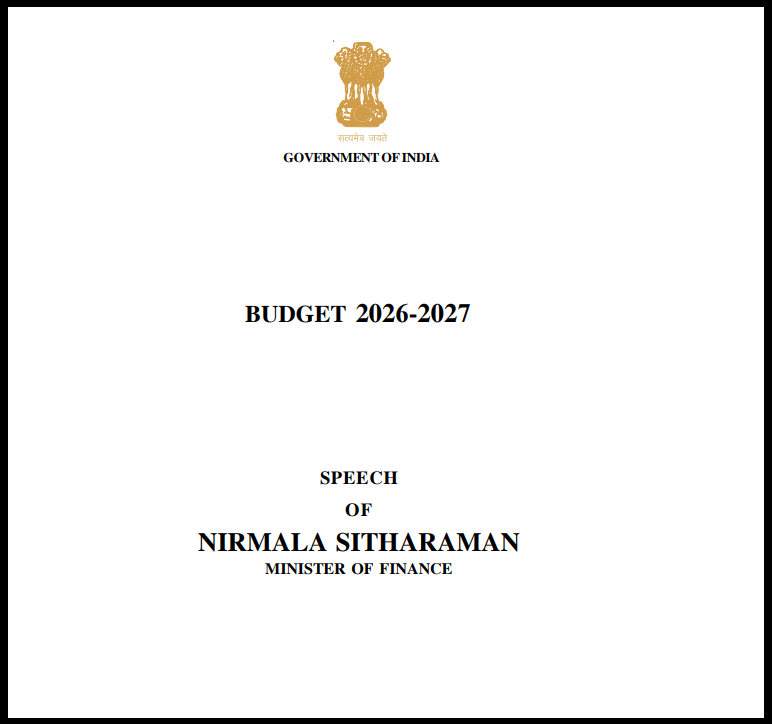
Unioun Budget 2026-27
Every year, the presentation of the Union Budget stands as one of the most significant events in India’s governance calendar. It goes beyond a mere financial statement, serving as a comprehensive reflection of the Government’s economic priorities, fiscal planning, and policy vision for the year ahead. Through the Budget, the State outlines how resources will be mobilised, allocated, and utilised to shape the country’s economic trajectory.
The Union Budget 2026-27 is expected to be presented on 1 February 2026, with the budget announcement time scheduled in the Parliament. As with previous years, it follows the release of the Economic Survey and will likely be guided by the analysis, outlook, and key themes highlighted in the survey. Additionally, the Railway Budget 2026 date is expected to be announced alongside the Union Budget, detailing sector-specific allocations and development plans.
|
Union Budget of India Overview |
|
|
Feature |
Details |
|
Type of Budget |
Union Budget |
|
Primary Article |
Article 112 (Annual Financial Statement) |
|
Presented By |
Union Finance Minister |
|
Presentation Date |
February 1 (Annual) |
|
Budget 2026-27 Date |
February 1, 2026 |
|
Key Related Concepts |
Halwa Ceremony, Finance Bill, Appropriation Bill, Consolidated Fund |
Union Budget 2026-27 Date
The Union Budget 2026-27 is scheduled for presentation on February 1, 2026, by Finance Minister Nirmala Sitharaman in the Parliament's Lok Sabha chamber. This date aligns with the constitutional tradition post the interim budget, allowing full fiscal planning for the upcoming financial year starting April 1. The session begins at 11:00 AM IST, with live telecasts on DD News, Sansad TV, and major news platforms for public access. Stakeholders anticipate detailed economic surveys and policy announcements on this key date.
Last 10 Year Budget Date of India
Since 2017, the Government of India shifted the budget presentation to the first day of February to ensure the proposals are implemented by the start of the new fiscal year on April 1.
|
Last 10 Year Budget Date of India |
||
|
Fiscal Year |
Presentation Date |
Finance Minister |
|
Unioun Budget 2026-27 |
February 1, 2026 |
Nirmala Sitharaman |
|
February 1, 2025 |
Nirmala Sitharaman |
|
|
July 23, 2024* |
Nirmala Sitharaman |
|
|
Unioun Budget 2023-24 |
February 1, 2023 |
Nirmala Sitharaman |
|
2022-23 |
February 1, 2022 |
Nirmala Sitharaman |
|
2021-22 |
February 1, 2021 |
Nirmala Sitharaman |
|
2020-21 |
February 1, 2020 |
Nirmala Sitharaman |
|
2019-20 |
July 5, 2019* |
Nirmala Sitharaman |
|
2018-19 |
February 1, 2018 |
Arun Jaitley |
|
2017-18 |
February 1, 2017 |
Arun Jaitley |
Note: In election years, an Interim Budget is presented in February, followed by a Full Budget after the new government is formed.
Union Budget 2026 Income Tax
Expectations for income tax in Union Budget 2026-27 focus on modest relief rather than major overhauls, building on FY25-26 changes that made income up to ₹12 lakh tax-free under the new regime via rebates. Experts anticipate hikes in standard deduction to ₹1-1.5 lakh from ₹75,000, alongside possible increases in Section 80C limits and LTCG exemption to ₹2 lakh for salaried taxpayers.Simplification of TDS slabs and compliance, plus joint taxation for couples, are likely to ease burdens without structural shifts.No big slab revisions are expected, prioritizing fiscal prudence amid strong adoption of the new regime.
Union Budget 2026 Railway
Indian Railways eyes ₹2.8 lakh crore allocation in Union Budget 2026-27, a 10-12% rise from prior years, emphasizing project execution over new announcements. Capex will prioritize track doubling, electrification, safety upgrades, and capacity enhancement, targeting 80% on-time spending for fewer delays. Expectations include ₹20,000-25,000 crore private investment in freight corridors and terminals, plus signaling for Vande Bharat speeds. Funding for high-speed rail and rolling stock (₹50,000+ crore) aims to decongest routes and boost freight/passenger efficiency.
Union Budget Article
Under Article 112, the Budget is India's Annual Financial Statement, detailing estimated receipts and expenditure. It seeks Parliament’s approval for taxation and spending, reflecting government priorities and often following the Economic Survey 2026. The Department of Economic Affairs, Ministry of Finance, prepares this crucial document.
The Budget Process: From Presentation to Law
The Budget process involves presentation in both Houses, discussion, and examination of Demands for Grants by committees. The Lok Sabha votes on these. Finally, Appropriation and Finance Bills are passed, authorizing government financial actions. This ensures parliamentary oversight of public funds.
-
The process begins with the presentation of the Budget in both Houses of Parliament.
-
A general discussion follows, where members debate the broad themes and priorities of the Budget.
-
Department-related Standing Committees examine the Demands for Grants of various ministries in detail; their reports guide further discussion in the Lok Sabha.
-
The Demands for Grants are then discussed and voted upon in the Lok Sabha.
-
Afterward, the Appropriation Bill and the Finance Bill are passed, giving the government legal authority to withdraw money from the Consolidated Fund of India and implement taxation proposals.
-
In this way, the Budget serves as both a policy statement and a legal instrument.
Income Tax Union Budget 2026
The Income Tax Union Budget is a key financial statement presented by the government, outlining revenue, expenditure, and tax proposals for the coming year. If you’re looking for details, tomorrow budget time is crucial, as it reveals updates on tax slabs, exemptions, and incentives. Make sure to follow the budget timing tomorrow to catch the full announcement and understand how the income tax union budget impacts individuals and businesses.
Union Budget 2026 Expectations
Key highlights for the Union Budget 2026–27 have not been released yet. These will detail specific announcements and policy changes. Here are the Union Budget 2026 expectations presented clearly in points:
The Union Budget 2026–27, to be presented on 1 February 2026 (also referred to as the Railway Budget 2026 date in India), is expected to focus on sustaining economic growth while maintaining fiscal discipline.
-
Higher allocation towards capital expenditure (CapEx) for infrastructure such as roads, railways, housing, and urban development is anticipated.
-
The government may prioritise job creation, skill development, and support for labour-intensive sectors.
-
Tax reforms and simplification, including clarity on the new income tax regime and dispute reduction, are expected to boost taxpayer confidence.
-
Increased support for manufacturing, MSMEs, and startups, aligned with Make in India and Atmanirbhar Bharat initiatives.
-
Focus on technology, digital economy, AI, and R&D incentives to enhance global competitiveness.
-
Continued emphasis on agriculture, rural development, and inclusive growth, ensuring balanced economic progress.
-
Commitment to medium-term fiscal consolidation while funding long-term development priorities.
Stay tuned for Budget 2026 live updates tomorrow to follow the official announcements and key measures as they are presented. This will give clarity on tomorrow budget expectations across all sectors.
Economic Survey 2026
Every year, ahead of the Union Budget presentation in Parliament, the Government of India releases the Economic Survey a document that subtly shapes the country’s economic discourse for the year. More than just a compilation of numbers, it provides an official assessment of India’s economic performance, highlights structural strengths, identifies emerging challenges, and signals the policy direction ahead.
The Economic Survey 2025–26 was tabled in Parliament during the Budget Session on 29 January 2026. As in previous years, it lays the analytical and intellectual groundwork for the Union Budget 2026, guiding key fiscal and policy decisions.
Union Budget 2026-27 FAQs
What is the Union Budget 2026-27?
Who presents the Union Budget 2026-27?
When is the Union Budget 2026-27 presented?
Under which Article of the Constitution is the Union Budget presented?
What is expected in the Union Budget 2026-27?
Does the Union Budget directly affect stock markets?