







UPSC Mechanical Engineering Syllabus 2026
 Aarti .12 Jun, 2026
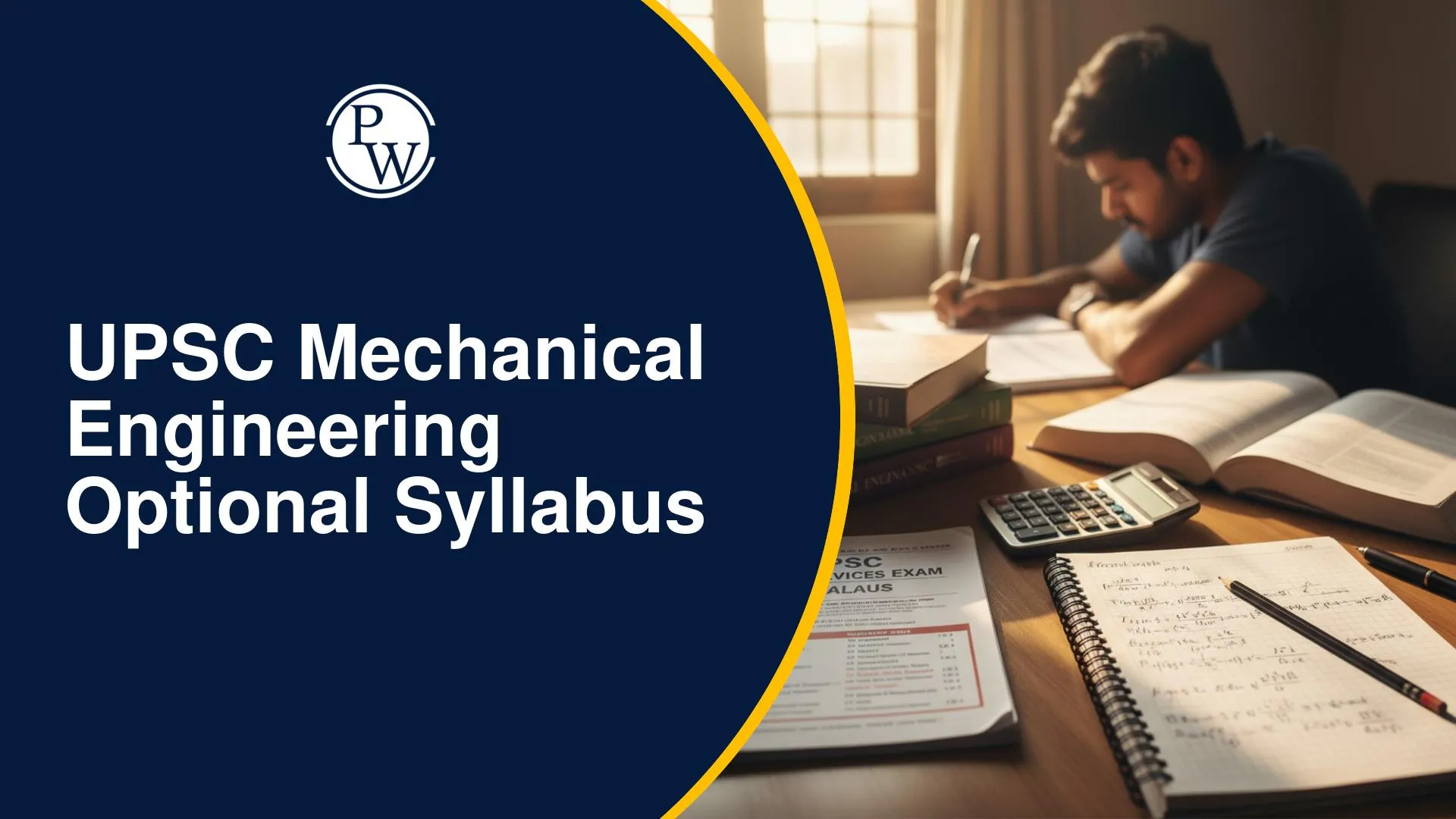
Mechanical Engineering Optional covers the principles and applications that power modern industries, making it a suitable choice for aspirants with a mechanical engineering background. The subject offers a well-defined syllabus and builds on concepts commonly studied during engineering graduation.
The UPSC Mechanical Engineering Optional syllabus includes topics such as Mechanics, Manufacturing Science, Theory of Machines, Thermodynamics, Heat Transfer, IC Engines, Fluid Mechanics, Steam Engineering, and Refrigeration & Air Conditioning. With its emphasis on numerical problem-solving, conceptual clarity, and diagram-based answers, the subject requires consistent practice and focused preparation.
UPSC Mechanical Engineering Syllabus 2026 for Paper I
Paper I focuses on the fundamentals of Mechanical Engineering, including Mechanics, Engineering Materials, Theory of Machines, and Manufacturing Science. It tests both conceptual understanding and application-based problem-solving skills.
|
UPSC Mechanical Engineering Syllabus 2026 for Paper I |
|
|
Mechanics |
1.1 Mechanics of Rigid Bodies
1.2 Mechanics of Deformable Bodies
|
|
Engineering Materials |
|
|
Theory of Machines |
|
|
Manufacturing Science |
4.1 Manufacturing Process
4.2 Manufacturing Management
|
UPSC Mechanical Engineering Syllabus 2026 for Paper II
Paper II covers advanced thermal and fluid science topics, including Thermodynamics, Heat Transfer, Engines, Steam Engineering, and Refrigeration & Air Conditioning. Questions are generally application-oriented and require strong conceptual clarity.
|
UPSC Mechanical Engineering Syllabus 2026 for Paper II |
|
|
Thermodynamics, Gas Dynamics, Turbine |
1.1 Basic concept of First Law and Second Law of Thermodynamics; concept of entropy and reversibility; availability and unavailability; and irreversibility. 1.2 Classification and properties of fluids; incompressible and compressible fluid flows; effect of Mach number and compressibility; continuity, momentum and energy equations; normal and oblique shocks; one-dimensional isentropic flow; flow of fluids in a duct with friction that transfers. 1.3 Flow through fans, blowers and compressors; axial and centrifugal flow configuration; design of fans and compressors; single problem compressors and turbine cascade; open and closed cycle gas turbines; work done in the gas turbine; reheat and regenerators. |
|
Heat Transfer |
2.1 Conduction heat transfer —general conduction equation-Laplace, Poisson and Fourier equations; Fourier law of conduction; one-dimensional steady state heat conduction applied to simple wall, solid and hollow cylinder and spheres. 2.2 Convection heat transfer —Newton’s law of convection; free and forced convection; heat transfer during laminar and turbulent flow of an incompressible fluid over a flat plate; concepts of Nusselt number, hydrodynamic and thermal boundary layer their thickness; Prandtl number; analogy between heat and momentum transfer—Reynolds, Calbom, Prandtl analogies; heat transfer during laminar and turbulent flow through horizontal tubes; free convection from horizontal and vertical plates. 2.3 Black body radiation —basic radiation laws such as Stefan-Boltzmann, Planck distribution, Wein’s displacement, etc. 2.4 Basic heat exchanger analysis; classification of heat exchangers. |
|
Engines |
3.1 Classification, thermodynamic cycles of operation; determination of brake power, indicated power, mechanical efficiency, heat balance sheet, interpretation of performance characteristics, petrol, gas and diesel engines. 3.2 Combustion in SI and CI engines, normal and abnormal combustion; effect of working parameters on knocking, reduction of knocking; Forms of combustion chamber for SI and CI engines; rating of fuels, additives; emission. 3.3 Different systems of IC engines -fuels, lubricating, cooling and transmission systems. Alternate fuels in IC engines. |
|
Steam Engineering |
4.1 Steam generation —modified Rankine cycle analysis; Modern steam boilers; steam at critical and supercritical pressures; draught equipment; natural and artificial draught; boiler fuels: solid, liquid and gaseous fuels. Steam turbines—Principle; types; compounding; impulse and reaction turbines; axial thrust. 4.2 Steam nozzles —flow of steam in convergent and divergent nozzles, pressure at throat for maximum discharge with different initial steam conditions, such as wet, saturated and superheated, effect of variation of back pressure; supersaturated flow of steam in nozzles, Wilson line. 4.3 Rankine cycle with internal and external irreversibility; reheat factor; reheating and regeneration, methods of governing; back pressure and pass-out turbines. 4.4 Steam power plants —combined cycle power generation; heat recovery steam generators (HRSG) fired and unfired, cogeneration plants. |
|
Refrigeration and Air-conditioning |
5.1 Vapour compression refrigeration cycle —cycle on p-H & T-s diagrams; eco-friendly refrigerants—R 134a. 123; Systems like evaporators, condensers, compressors, and expansion devices. Simple vapour absorption systems. 5.2 Psychrometry —properties; processes; charts; sensible heating and cooling; humidification and dehumidification; effective temperature; air-conditioning load calculation; simple duct design. |
Also check: Mechanical Engineering Optional Subject PYQs
Recommended Books for Mechanical Engineering Optional Subject Preparation
Choosing the right reference books can make preparation more focused and concept-driven. Standard textbooks help in understanding theoretical concepts, numerical problem-solving, and engineering applications asked in the UPSC Mains examination.
|
Paper I |
Paper II |
|
Callister’s Materials Science and Engineering |
Thermodynamics by R Yadav |
|
Theory of Machines by Rattan |
Fundamentals of Classical Thermodynamics by Van Wylen |
|
Theory of Mechanism and Mechanics by Jagdish Lal |
IC Engine by ML Mathur and RP Sharma |
|
Machine Design by Shigley, VB Bhandari |
Heat Conversion by Arora and Domkundwar |
|
Manufacturing Technology by P N Rao |
Heat Transfer by Gupta Prakash |
|
Principles of Manufacturing Material & Process by Campbell |
Gas Turbine and Propulsive Systems by PR Khajuria & SP Dubey |
|
Production Management by R K Jain |
Refrigeration and Air Conditioning by CP Arora and Domkundwar |
|
Mechanics of Solids by Popru |
Heat and Mass Transfer by JP Hollman and RC Sachdeva |
|
Strength of Materials by Gere & Timoshenko, BC Unamia, Sadhu Singh |
— |
UPSC Mechanical Engineering Syllabus FAQs
Is Mechanical Engineering Optional a good choice for UPSC?
How many papers are there in the UPSC Mechanical Engineering Optional?
Does the Mechanical Engineering Optional syllabus overlap with General Studies?
Which topics are important in the Mechanical Engineering Optional?







Get Free Counselling Today
and Clear up all your Doubts
 Live & recorded classes available at easeDashboard for progress trackingLakhs of practice questions

