







World Day Against Child Labour 2026 – Theme, History, Significance, Objectives, and UPSC PYQs
 Aarti .4 Jun, 2026
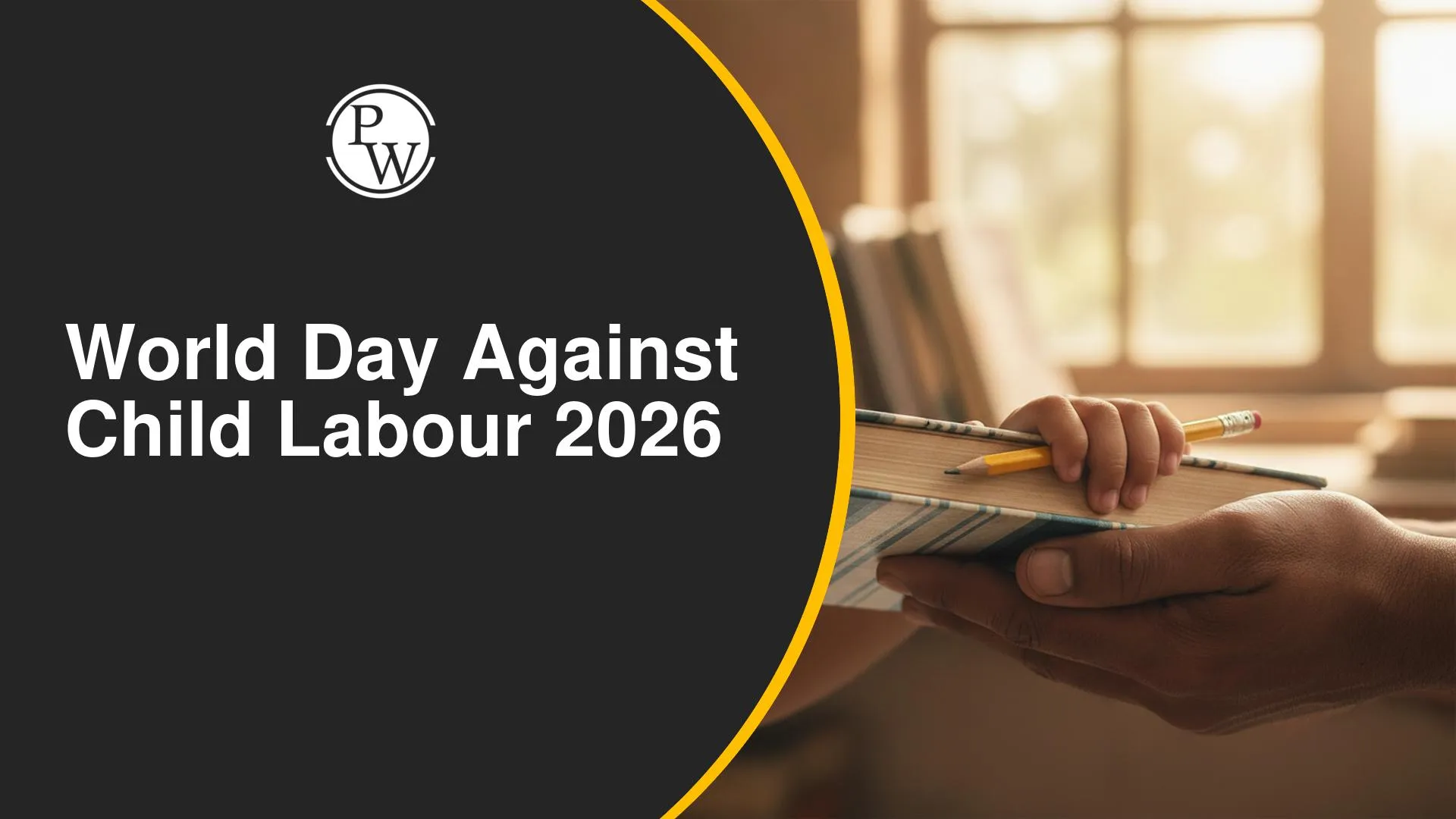
World Day Against Child Labour 2026, to be observed on 12 June, is a global awareness day dedicated to eliminating child labour and protecting children’s rights. Led by the International Labour Organization (ILO) and supported by global partners, it highlights the need for stronger policies, quality education, and social protection systems to ensure that every child grows up in a safe and healthy environment. The 2026 campaign focuses on accelerating action based on global commitments and emphasizes creating decent work opportunities for adults so that families are not forced to rely on child labour.
This topic of ‘World Day Against Child Labour 2026’ is important from the perspective of the UPSC IAS Examination, falling under General Studies Paper II (Social Justice, Vulnerable Sections and International Organizations), and Prelims.
World Day Against Child Labour Theme 2026
The theme for World Day Against Child Labour 2026 is “Red card to child labour: Fair play for children, decent work for adults.”
It focuses on the urgent need to eliminate child labour by strengthening key systems such as quality education, social protection, stronger labour laws, and better enforcement. The theme also highlights the importance of providing decent work and stable livelihoods for adults so that families are not forced to send children into labour.
World Day Against Child Labour 2026 History
World Day Against Child Labour was established by the International Labour Organization (ILO) in 2002 to draw global attention to the issue of child labour and to encourage countries to take stronger action against it. It is observed every year on 12 June as part of worldwide efforts to protect children’s rights and ensure access to education, safety, and a healthy childhood.
Since its beginning, the day has served as a platform for governments, employers, workers’ organizations, and civil society to come together and promote policies that eliminate child labour in all its forms. Over the years, global campaigns have focused on issues such as hazardous work, lack of education, poverty, and weak labour laws.
The observance has also evolved to align with major international frameworks like the Sustainable Development Goals (SDG 8.7), which calls for an end to child labour in all its forms. Each year, the campaign highlights specific themes to strengthen awareness and accelerate action.
Today, World Day Against Child Labour continues to remind the world that ending child labour requires collective responsibility, stronger enforcement, and improved living conditions for families.
Significance of World Day Against Child Labour 2026
World Day Against Child Labour 2026 is an important global observance that highlights the urgent need to eliminate child labour and protect children’s rights. It focuses on strengthening policies, education, and social support systems to ensure a safe and secure childhood for every child.
-
Raises global awareness about the continued problem of child labour
-
Highlights the need to protect children’s rights to education, safety, and development
-
Encourages governments to strengthen laws and enforcement against child labour
-
Promotes access to quality education so children are not forced into work
-
Emphasises social protection systems to support vulnerable families
-
Focuses on creating decent work opportunities for adults to reduce economic pressure on children
-
Supports global efforts under SDG 8.7 to eliminate child labour in all its forms
-
Brings together international organizations, governments, and civil society for collective action
-
Reinforces the message that ending child labour requires long-term policy and social change
-
Helps shift attention from awareness to practical action and implementation
Child Labour in the World: Facts & Figures
Child labour remains a serious global issue, affecting millions of children worldwide and limiting their access to education, safety, and a normal childhood. It is mainly driven by poverty, lack of education, and weak enforcement of labour laws across many regions.
-
Around 138 million children are still engaged in child labour globally (latest ILO–UNICEF estimates).
-
Nearly 54 million children are involved in hazardous work, which directly harms their health and safety.
-
Child labour is more common in low-income and developing countries, especially in rural areas.
-
The agriculture sector accounts for the largest share of child labour worldwide (around 70%).
-
Boys are slightly more likely to be engaged in child labour than girls, though girls are often underreported due to household work.
-
Child labour is concentrated in Africa, Asia, and parts of Latin America.
-
The Sub-Saharan Africa region has the highest number and prevalence of child labour cases.
-
Poverty, lack of access to quality education, unemployment of adults, and weak enforcement of laws are major causes.
-
Many children work in dangerous conditions, including mining, construction, manufacturing, and domestic work.
-
Global efforts under UN Sustainable Development Goal 8.7 aim to eliminate child labour in all forms by 2025–2030 targets.
-
Despite progress in some regions, the pace of reduction is too slow to meet global elimination goals on time.
World Day Against Child Labour 2026 Objectives
World Day Against Child Labour 2026 is observed to strengthen global efforts toward ending child labour and ensuring every child’s right to education, safety, and a healthy childhood.
-
To raise global awareness about the issue of child labour and its impact on children’s lives
-
To promote the complete elimination of child labour in all its forms
-
To encourage governments to strengthen laws and enforcement mechanisms
-
To ensure access to quality education for all children
-
To support social protection systems that reduce poverty-driven child labour
-
To promote decent work opportunities for adults to reduce economic pressure on families
-
To encourage global cooperation among governments, organizations, and civil society
-
To align efforts with Sustainable Development Goal 8.7
-
To highlight the importance of protecting children’s physical and mental well-being
-
To move from awareness to practical action and long-term solutions
Government Initiatives to Eradicate Child Labour in India
The Government of India has instituted a comprehensive blend of legislative reforms, targeted welfare schemes, and structural monitoring networks to enforce Child Protection laws.
1. Legislative Reforms
-
Child Labour (Prohibition and Regulation) Amendment Act, 2016: This landmark amendment completely prohibits the employment of children below 14 years of age in all occupations and processes (with exceptions only for family-run enterprises without disrupting schooling). It also introduced a stricter category for adolescents (14-18 years), completely barring them from hazardous occupations.
-
Right to Education (RTE) Act, 2009: Mandates free and compulsory education for all children aged 6 to 14 years, creating a statutory protective shield keeping children in classrooms rather than factories.
2. National Programs & Digital Interventions
-
National Child Labour Project (NCLP) Scheme: Operates at the district level to identify, rescue, and rehabilitate children engaged in hazardous work. Rescued children are enrolled in special training centers providing bridge education, vocational training, a monthly stipend, and healthcare before mainstreaming into formal schools.
-
PENCiL Portal (Platform for Effective Enforcement for No Child Labour): An electronic platform launched to ensure smooth implementation of the NCLP. It connects the Ministry of Labour and Employment, District Magistrates, Child Labour Inspectors, and citizens, allowing regular folk to report instances of child labour in real time.
3. Integrated Social Protection
-
Juvenile Justice (Care and Protection of Children) Act: Provides the overarching legal safety net for children found in vulnerable situations, treating rescued child labourers as "children in need of care and protection."
-
Samagra Shiksha and Mid-Day Meal Schemes: Designed to subsidize the opportunity costs of education for low-income families, ensuring that nutrition and school infrastructure disincentivize early entry into the workforce.
Sustainable Development Goal (SDG) 8.7 and the Role of the ILO
The global blueprint for Child Labour Elimination is driven by Sustainable Development Goal (SDG) 8.7, which explicitly charges the international community to:
"Take immediate and effective measures to eradicate forced labour, end modern slavery and human trafficking and secure the prohibition and elimination of the worst forms of child labour... and by 2025 end child labour in all its forms."
The International Labour Organization (ILO) spearheads this global mandate through technical advisory programs, monitoring frameworks, and international conventions:
-
Convention No. 138 (Minimum Age): Sets the baseline legal age for employment, stipulating it should not be less than the age of completion of compulsory schooling.
-
Convention No. 182 (Worst Forms of Child Labour): Achieved universal ratification, requiring nations to immediately criminalize and eliminate extreme exploitation.
Despite these legal barriers, achieving SDG 8.7 demands an aggressive integration of living-wage policies, universal social security nets, and stringent supply-chain auditing by multinational corporations.
UPSC Previous Year Questions and Practice Questions
Below are the UPSC Previous Year Questions and Practice Questions related to the topic for better understanding and revision.
UPSC PYQ
Mains Practice Question
World Day Against Child Labour 2026 FAQs
What is World Day Against Child Labour?
Who started World Day Against Child Labour?
What is the main aim of this day?
What is the theme of World Day Against Child Labour 2026?







Get Free Counselling Today
and Clear up all your Doubts
 Live & recorded classes available at easeDashboard for progress trackingLakhs of practice questions

