






SAT Class 11 Syllabus 2026: Subjects, Exam Pattern, and Scholarships
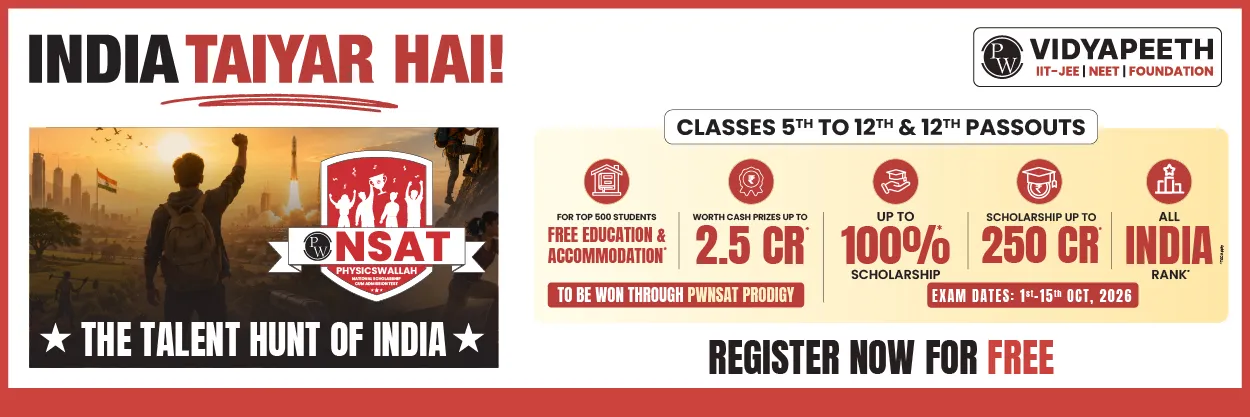
SAT Class 11 Syllabus helps students assess important Class 11 concepts for JEE and NEET preparation while also offering scholarship opportunities. SAT 5.0 is live, with registration open from 11 June 2026 to 31 August 2026. The online exam will be held between 15 June 2026 and 31 August 2026, including offline exams on 28 June 2026 & 05 July 2026.
SAT Class 11 Syllabus is an important academic resource for students moving into focused competitive exam preparation. It helps evaluate a student’s understanding of the Class 11 curriculum, which forms the base for national-level exams like JEE and NEET. By preparing through the SAT Class 11 subjects, students can assess their academic level, understand their preparation gaps, and also get scholarship opportunities for further learning support.
SAT Phase 5.0 is Now Live
The SAT Phase 5.0 exam cycle is now live, offering both online and offline examination options. Interested candidates should note the registration timeline and exam schedule carefully before applying.
-
Registration Start Date: 11 June 2026, 1:25 PM
-
Registration End Date: 31 August 2026, 11:59 PM
-
Online Exam Window: 15 June 2026 to 31 August 2026
-
Offline Exam Dates: 28 June 2026 & 05 July 2026
-
Exam Timings: 10:00 AM – 11:00 AM and 04:00 PM – 05:00 PM
SAT Class 11 Syllabus Overview
SAT (Physics Wallah Scholarship cum Admission Test) for Class 11 acts as a gateway for engineering and medical aspirants to join top-tier coaching. The exam focuses on assessing conceptual depth in core science and math subjects.
|
SAT Class 11 Syllabus Overview |
|
|
Particulars |
Details |
|
Exam Name |
PW SAT (Physics Wallah Scholarship cum Admission Test) |
|
Phase IV Exam Date |
|
|
Class |
Class 11 |
|
Exam Purpose |
Scholarship for offline coaching and academic assessment |
|
Question Type |
Multiple Choice Questions (MCQs) |
|
Subjects Covered |
JEE: Physics, Chemistry, Mathematics NEET: Physics, Chemistry, Botany, Zoology |
|
Negative Marking |
No negative marking in Phase 5 |
|
Result Declaration |
Exam Day + 1 |
Note: The syllabus is strictly aligned with the NCERT curriculum for the current academic year.
SAT Class 11 Syllabus Section-Wise Details
The SAT Class 11 Syllabus is divided into two primary tracks: Engineering (JEE) and Medical (NEET). This ensures students are tested on subjects relevant to their career goals.
SAT Class 11 Physics Syllabus
Physics is a common subject for both JEE and NEET tracks, focusing on foundational mechanics and properties of matter.
|
SAT Class 11 Physics Syllabus |
|
|
Topic Area |
Expected Coverage |
|
Mechanics |
Units & Measurements, Motion in a Straight Line, Motion in a Plane, Laws of Motion |
|
Energy & Power |
Work, Energy, and Power |
|
System of Particles |
Centre of Mass & System of Particles, Rotational Motion |
|
Matter & Heat |
Gravitation, Mechanical Properties of Solids/Fluids, Thermal Properties, Thermodynamics |
SAT Class 11 Chemistry Syllabus
The Chemistry section evaluates the student's understanding of atomic structure, bonding, and organic basics.
|
|
|
|
Subject |
Expected Coverage |
|
Physical Chemistry |
Some Basic Concepts of Chemistry, Structure of Atom, Thermodynamics, Equilibrium |
|
Inorganic Chemistry |
Classification of Elements, Chemical Bonding & Molecular Structure, p-Block Elements |
|
Organic Chemistry |
IUPAC Nomenclature, Isomerism, General Organic Chemistry (GOC), Hydrocarbons |
SAT Class 11 Mathematics Syllabus (For JEE Aspirants)
For students choosing the engineering track, the Mathematics section focuses on algebraic and trigonometric functions.
-
Algebra: Sets, Complex Numbers, Quadratic Equations, Permutations and Combinations.
-
Trigonometry: Trigonometric Functions and their applications.
-
Calculus & Geometry: Limits and Derivatives, Introduction to 3D Geometry.
SAT Class 11 Biology Syllabus (For NEET Aspirants)
Medical aspirants are tested on Botany and Zoology, covering the diversity of life and human physiology.
-
Botany: Cell: The Unit of Life, Cell Cycle & Division, Biological Classification, Plant Kingdom.
-
Zoology: Biomolecules, Breathing and Exchange of Gases, Body Fluids and Circulation, Animal Kingdom.
SAT Class 11 Exam Pattern 2026
The SAT Class 11 Exam Pattern 2026 is designed to be student-friendly, emphasising speed and accuracy within a limited timeframe.
|
SAT Class 11 Exam Pattern 2026 |
|
|
Feature |
Expected Details |
|
Total Marks |
160 Marks |
|
Total Questions |
40 MCQs |
|
Duration |
60 minutes |
|
Language |
English / Hindi |
|
Marking Scheme |
Correct Answer: +4, No Negative Marking (Phase 3) |
SAT Class 11 Scholarship Details
Physics Wallah offers extensive financial support to meritorious Class 11 students to ensure high-quality education is accessible.
-
Up to 90% Scholarship: Top rankers are eligible for up to 90% fee waivers on Vidyapeeth Offline programs.
-
Registration: The test is 100% free of cost for all students.
-
Validity: The scholarship benefit typically expires within 7 days of the result declaration (D+7).
-
Additional Rewards: High scorers may also receive cash rewards and expert mentorship.
Preparation Tips for SAT Class 11
Success in the SAT exam requires a blend of school-level clarity and competitive-level speed.
Prioritize NCERT: Since the syllabus is NCERT-based, ensure every chapter in your Class 11 textbook is thoroughly understood.
Focus on Weightage: Allocate more time to high-weightage chapters in Physics and Chemistry as they are common and scoring.
Solve Sample Papers: Practice with 40-question mock tests to get accustomed to the 60-minute time limit.
Analyze Mistakes: Regularly review mock test errors to identify weak areas in conceptual understanding.
SAT Class 11 Syllabus FAQs
Is there any Mental Ability section in the SAT Class 11 syllabus?
Can Class 11 students get scholarships for online batches?
What is the difficulty level of the SAT Class 11 exam?
When will the SAT Class 11 results be declared?





Get Free Counselling Today
and Clear up all your Doubts
 Live & recorded classes available at easeDashboard for progress trackingLakhs of practice questions

