







BHU BSc Physics Syllabus 2026: Semester-Wise Subjects, Topics & Exam Pattern
BHU BSc Physics Syllabus has six semesters covering Mechanics, Thermal Physics, Optics, Electromagnetic Theory, Quantum Mechanics, Electronics, Statistical Mechanics, Solid State, Nuclear and Atomic Physics, with practicals and a project or elective. Credits: 6 each in I–IV, 18 in V, 22 in VI total.

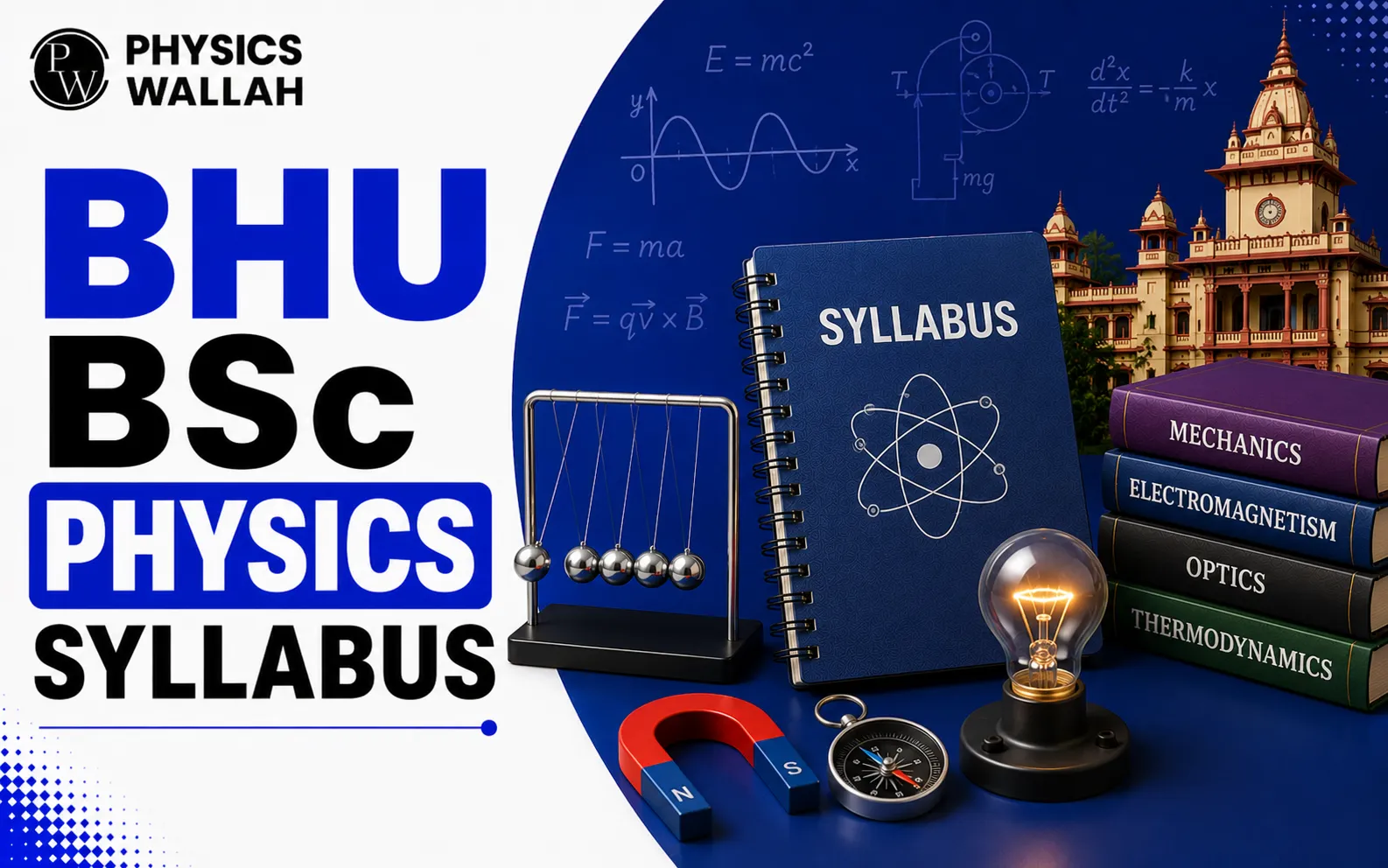
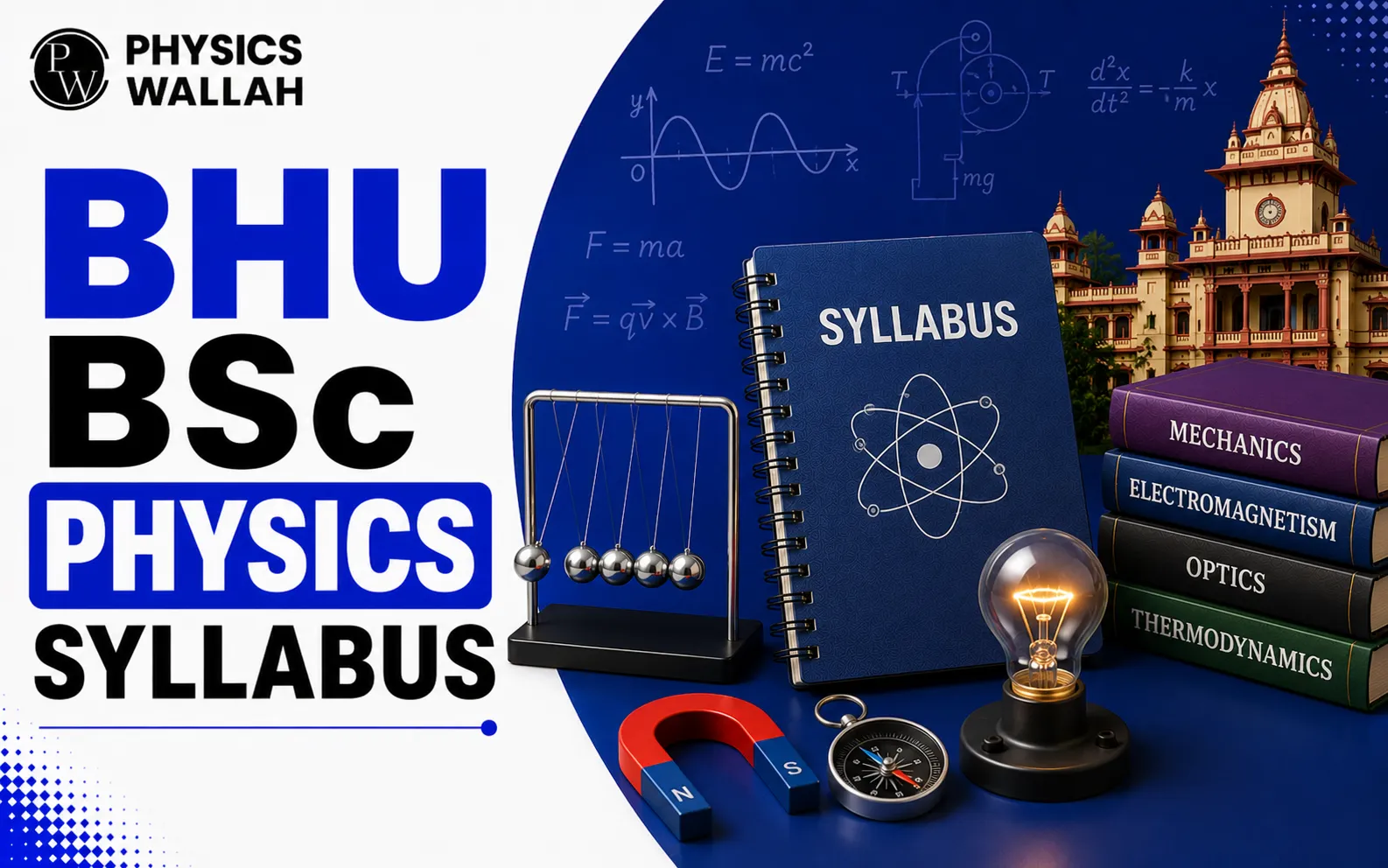
The B.Sc. (Hons.) Physics programme is offered by the Department of Physics, Faculty of Science, Banaras Hindu University. The course structure is divided into six semesters and includes theory papers, practical courses, and an elective or project option in the final semester.
The BHU BSc Physics syllabus covers a wide range of topics, including mechanics, thermal physics, optics, electromagnetism, quantum mechanics, electronics, statistical mechanics, solid state physics, nuclear physics, and atomic physics.
BHU BSc Physics Syllabus 2026 Highlights
The course structure is distributed across six semesters. The first four semesters have theory and practical courses, while the fifth and sixth semesters include several specialised theory and practical papers. The BHU BSc Physics syllabus 2026 document also lists the credits assigned to each course.
| Particular | Details |
| University | Banaras Hindu University |
| Department | Department of Physics, Faculty of Science |
| Programme | B.Sc. (Hons.) Physics |
| Duration | Six semesters |
| Semester I | Mechanics and Relativity + Practical |
| Semester II | Thermal Physics + Practical |
| Semester III | Optics + Practical |
| Semester IV | Electromagnetic Theory and Basic Electronics + Practical |
| Semester V | Mathematical Physics, Classical Mechanics, Quantum Mechanics, Electronic Devices and Circuits + Practical |
| Semester VI | Statistical Mechanics, Solid State Physics, Elements of Nuclear Physics, Atomic Physics and Laser + Practical + Project or Elective |
| Semester I–IV Credits | 6 credits each |
| Semester V Credits | 18 |
| Semester VI Credits | 22 |
BHU BSc Physics Detailed Syllabus
The BHU BSc Physics syllabus is divided into theory and practical courses across six semesters. The theory courses cover core areas of physics, while practical courses include laboratory experiments related to the topics studied in the programme.
BHU BSc Physics Syllabus for 1st Year
The first year includes Mechanics and Relativity in Semester I and Thermal Physics in Semester II. Both semesters also have a practical course carrying 2 credits.
| Semester | Course | Topics Covered |
| I | Mechanics and Relativity | Inertial and non-inertial frames, centrifugal and Coriolis forces, centre of mass, collisions, scattering, conservation of linear and angular momenta, special theory of relativity, Lorentz transformation, length contraction, time dilation, relativistic velocity transformation, mass-energy relation, and energy-momentum relation |
| I | Practical | Stefan’s constant, PN junction diode and Zener diode characteristics, Young’s modulus, modulus of rigidity, Poisson’s ratio, condenser capacity, bending of beam, LCR circuits, acceleration due to gravity, focal length of lenses, and solar cell experiment |
| II | Thermal Physics | Maxwell’s speed distribution, mean free path, transport phenomena, real gases, Van der Waals equation, thermodynamics, entropy, thermodynamic functions, Maxwell’s thermodynamic equations, phase transition, Joule-Thomson effect, liquefaction of gases, liquid helium, superfluidity, superconductivity, and blackbody radiation |
| II | Practical | Internal resistance of micro ammeter, modulus of rigidity, logic gates, viscosity, magnetic field along the axis of Helmholtz galvanometer, resistance measurement, dispersive power of prism, temperature coefficient of resistance, and thermal conductivity |
The practical courses in the first year are organised into two groups. Students perform experiments from one group in Semester I and exchange groups in Semester II.
BHU BSc Physics Syllabus for 2nd Year
The second year covers Optics in Semester III and Electromagnetic Theory and Basic Electronics in Semester IV. Each semester also includes a practical course carrying 2 credits.
| Semester | Course | Topics Covered |
| III | Optics | Interference, Lloyd’s mirror, thin films, Newton’s rings, Michelson interferometer, Fabry-Perot interferometer, Fresnel diffraction, zone plate, Fraunhofer diffraction, diffraction grating, polarisation, Nicol prism, retardation plates, optical activity, and polarimeter |
| III | Practical | Sodium yellow line by Fresnel’s biprism, specific rotation of cane sugar, mercury lines by diffraction grating, telescope resolution, self-inductance, triode valve characteristics, velocity of ultrasonic waves, and wavelength of Balmer line |
| IV | Electromagnetic Theory and Basic Electronics | Vector calculus, electromagnetism, Maxwell’s equations, vector and scalar potentials, Poynting vector, electromagnetic wave propagation, polarisation, reflection and transmission, waveguides, coaxial transmission line, semiconductor physics, PN junction diode, rectifiers, LED, photodiode, and transistor circuits |
| IV | Practical | Sodium yellow line by Newton’s rings, Planck’s constant using Wien’s radiation formula, diffraction, energy band gap of silicon, mutual inductance, LCR circuits, transistor characteristics, and resolving power of prism |
The practical experiments for Semesters III and IV are also divided into two groups, with students exchanging groups between the two semesters.
BHU BSc Physics Syllabus for 3rd Year
The third year introduces advanced theory courses and specialised practical work. Semester V includes Mathematical Physics, Classical Mechanics, Quantum Mechanics, and Electronic Devices and Circuits. Semester VI includes Statistical Mechanics, Solid State Physics, Elements of Nuclear Physics, Atomic Physics and Laser, practical courses, and a project or elective option.
| Semester | Course | Topics Covered |
| V | Mathematical Physics | Curvilinear coordinates, tensors, matrices, eigenvalue problems, differential equations, Bessel functions, Legendre functions, Hermite and Laguerre functions, Dirac delta function, and Fourier analysis |
| V | Classical Mechanics | Systems of particles, constraints, generalised coordinates, D’Alembert’s principle, Lagrange’s equation, calculus of variations, Hamilton’s principle, Lagrangian and Hamiltonian mechanics, Poisson brackets, canonical transformations, Hamilton-Jacobi theory, central force problem, and Kepler problems |
| V | Quantum Mechanics | Blackbody radiation, photoelectric effect, Compton effect, de Broglie hypothesis, wave-particle duality, uncertainty principle, Schrödinger equation, wave function, operators, observables, eigenvalues and eigenfunctions, expectation values, harmonic oscillator, angular momentum, spin, and hydrogen atom |
| V | Electronic Devices and Circuits | FETs, JFET and MOSFET characteristics, FET biasing, silicon controlled rectifier, unijunction transistor, operational amplifier, cathode ray oscilloscope, transistor amplifiers, feedback, oscillators, modulation, Boolean algebra, logic gates, adders, and subtractors |
| V | BPL-501 Practical | Magnetic susceptibility of nickel ion, half-life of Indium-116, Cauchy’s constant, prism spectrograph, wavelength of laser, and thickness of wire |
| V | BPL-502 Practical | Logic gates, LCR circuit response, negative feedback amplifier, power supply and filter characteristics, Zener regulated power supply, and Fourier analysis |
| VI | Statistical Mechanics | Random walk problem, probability distribution, phase space, density of states, Liouville’s theorem, ensembles, classical ideal gas, Gibbs paradox, Bose-Einstein statistics, Fermi-Dirac statistics, and Maxwell-Boltzmann statistics |
| VI | Solid State Physics | Crystal symmetry, Bravais lattices, Miller indices, crystal structures, bonding in solids, X-ray diffraction, reciprocal lattice, Brillouin zones, lattice vibrations, phonons, electronic properties, energy bands, Hall effect, Fermi surface, and magnetic properties |
| VI | Elements of Nuclear Physics | Nuclear properties and models, binding energy, nuclear forces, deuteron, alpha decay, beta decay, gamma decay, accelerators, detectors, elementary particles, quantum numbers, and quarks |
| VI | Atomic Physics and Laser | Bohr and Sommerfeld models, Rydberg constant, electron spin, atomic orbitals, quantum numbers, magnetic moments, angular momenta, spin-orbit interaction, fine structure, Zeeman effect, LS and JJ coupling, Einstein coefficients, laser action, He-Ne and Nd-YAG lasers, and second harmonic generation |
| VI | BPL-601 Practical | Planck’s constant, grating spectrograph, GM counter, B-H curve, hysteresis loss, fiber optics, and wedge angle and refractive index of water using laser |
| VI | BPL-602 Practical | Hartley and phase shift oscillator, amplitude modulation and demodulation, FET and MOSFET characteristics, wave shaping circuits, and UJT as a relaxation oscillator |
| VI | Project OR Elective | Project, Topics in Modern Physics, or Elementary Nanoscience and Exotic Materials |
The Semester VI elective Topics in Modern Physics includes relativity, astrophysics and cosmology, atoms, nuclei and solids. The other elective, Elementary Nanoscience and Exotic Materials, covers nanomaterials, electronic properties, high-temperature superconductors, colossal magnetoresistance materials, and quasicrystals.
BHU BSc Physics Syllabus PDF
You can refer to the BHU BSc Physics syllabus PDF for the complete course structure, course codes, credits, detailed topics, reference books, and practical experiments. The document is issued for the B.Sc. (Hons.) Physics programme offered by the Department of Physics, Faculty of Science, Banaras Hindu University.
The PDF contains the semester-wise distribution of courses and credits from Semester I to Semester VI. It also provides detailed syllabi for individual theory papers and lists the practical experiments for the programme.
BHU BSc Physics Exam Pattern
The BHU BSc Physics syllabus is organised across six semesters and includes core theory papers, practical courses, advanced physics subjects, and project or elective components. The course structure covers important areas such as mechanics, thermal physics, optics, electromagnetic theory, quantum mechanics, statistical mechanics, solid state physics, nuclear physics, atomic physics, and laser physics.
| Semester | Theory Courses | Practical Courses | Total Credits |
| I | Mechanics and Relativity | Practical | 6 |
| II | Thermal Physics | Practical | 6 |
| III | Optics | Practical | 6 |
| IV | Electromagnetic Theory and Basic Electronics | Practical | 6 |
| V | Mathematical Physics, Classical Mechanics, Quantum Mechanics, Electronic Devices and Circuits | BPL-501, BPL-502 | 18 |
| VI | Statistical Mechanics, Solid State Physics, Elements of Nuclear Physics, Atomic Physics and Laser | BPL-601, BPL-602 | 22 |
For Semesters I to IV, each semester has one theory course carrying 4 credits and one practical course carrying 2 credits. Semester V has four theory courses and two practical courses, with 18 total credits. Semester VI has four theory courses, two practical courses, and a 4-credit project or elective option, with 22 total credits.
BHU BSc Physics Syllabus FAQs
How many semesters are there in the BHU BSc Physics syllabus?
What are the main BHU BSc Physics subjects?
Does the BHU BSc Physics syllabus include practical courses?
Is there a project or elective in the BHU BSc Physics syllabus?


Have questions about your prep?
Our experts can answer all your questions


 Live & recorded classes available at easeDashboard for progress trackingLakhs of practice questions


