






B.Sc Complete Career Guide 2026 | Admission, Scope, Salary, Jobs & Top Colleges
The B.Sc Complete Career Guide 2026 explains the NEP-based undergraduate programme, admission through CUET UG and merit, eligibility, specialisations, career opportunities, salary, internships, top colleges, and higher-study options like MSc, MBA, B.Ed, and PhD to help students plan their academic and professional journey.
 Neha Tanna31 Jul, 2026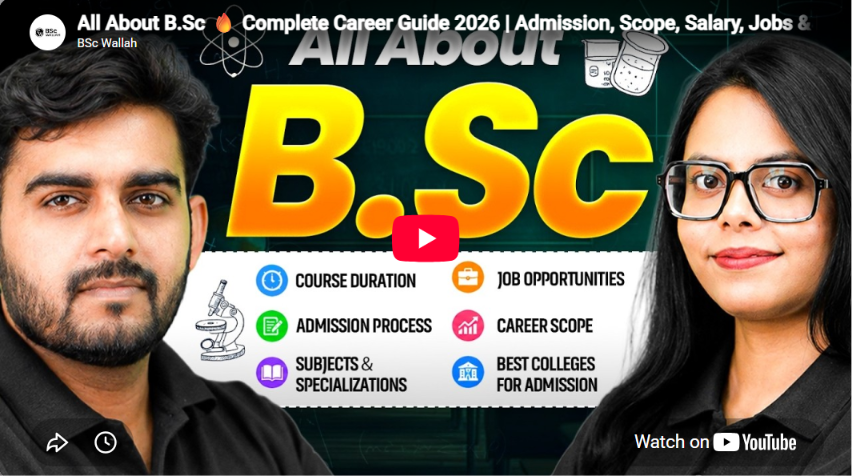
A Bachelor of Science (B.Sc) is one of the most popular undergraduate programmes for students interested in science, research, healthcare, technology, and education. With the implementation of NEP 2020, many universities now offer a flexible four-year undergraduate programme that includes multiple exit options, interdisciplinary learning, internships, and research opportunities.
This guide explains the updated admission process, course structure, career scope, salary, higher-study options, and top colleges for B.Sc aspirants.
B.Sc Complete Career Guide 2026
The B.Sc Complete Career Guide 2026 helps students understand the updated B.Sc programme under the National Education Policy. It covers admissions, course structure, specialisations, career opportunities, salary prospects, and higher-study options.
Whether you plan to enter the workforce or pursue an MSc or PhD, this guide provides the essential information to make informed academic and career decisions.
1. Introduction to BSc Program and NEP Changes
The National Education Policy (NEP) has brought significant changes to the BSc program, impacting both its structure and duration.
The main objective of these reforms is to enhance student flexibility and promote skill development, preparing graduates for a dynamic future.
2. BSc Program Duration and Multiple Exit Options
The NEP introduces a four-year BSc program with multiple exit options, offering students unparalleled flexibility.
This structure allows students to gain recognition for their studies even if they choose to exit before completing the full four years.
| Duration of Study | Traditional BSc | NEP 2020 BSc |
|---|---|---|
| 1st Year | No recognition | Undergraduate Certificate |
| 2nd Year | No recognition | Undergraduate Diploma |
| 3rd Year | Bachelor's Degree | Bachelor's Degree |
| 4th Year | Not applicable | Bachelor's Degree with Research |
The four-year program is specifically designed to offer research-oriented learning, distinguishing it from the traditional three-year structure and providing substantial academic benefits.
3. BSc Admission Process
The admission process for BSc programs involves specific eligibility criteria, various selection routes, and a series of application steps.
A. Basic Eligibility
-
Class 12th pass from any recognised board (e.g., CBSE).
-
Required Science background, including subjects like Physics, Chemistry, Mathematics, and Biology, depending on the chosen BSc program specialisation.
B. Selection Routes
-
Entrance Exam: Most universities now consider an entrance test for undergraduate admissions. The primary national-level entrance exam is CUET UG (Common University Entrance Test Undergraduate). Qualifying this exam grants admission to numerous universities and colleges.
-
Merit-Based Admission: Some colleges continue to use a traditional merit-based approach, where admission is based on the percentage of marks scored in core subjects in the 12th grade.
C. Application Steps
-
Course Selection: Choose the desired course based on interest (e.g., Chemistry Honors, Mathematics Honors).
-
Online Application: Applications are typically submitted online through the university or college portal.
-
Document Submission: Submit 12th-grade scores and, if applicable, CUET scores.
-
Counselling & Seat Allotment: A counselling process follows, where preferences are given to candidates with higher scores.
4. Major BSc Subjects and Specialisations
BSc programs offer a diverse range of specialisation subjects, catering to various scientific interests:
-
Physical Science: Examples include Chemistry, Physics, Mathematics, Electronics, Statistics.
-
Life Science: Examples include Botany, Zoology, Biochemistry, Biotechnology, Microbiology.
-
Computing Science.
-
Environmental Areas.
-
Mathematical Combinations.
-
Applied Combinations: These specialisations vary by university and are structured according to the UGCF (Undergraduate Curriculum Framework).
Curriculum Components: Beyond Core Subjects
The NEP-aligned BSc curriculum extends beyond traditional core subjects, integrating interdisciplinary learning and comprehensive skill development.
| Category | Description |
|---|---|
| Major | Refers to the core subjects of a student's chosen specialisation (e.g., Quadrates, Non-chordates in Zoology; core Chemistry topics). |
| Minor | Allows students to study subjects outside their primary specialisation (e.g., a Biology student can opt for Chemistry as a minor), promoting interdisciplinary learning. |
A. Skill Enhancement Courses
The curriculum includes mandatory courses in each semester for holistic development:
-
AEC (Ability Enhancement Course): Focuses on enhancing extra-curricular activities and foundational skills.
-
SEC (Skill Enhancement Course): Aims at developing practical skills.
-
VAC (Value Added Course): Designed for holistic development, including social awareness and communication skills, which are crucial for future employment.
These courses contribute significantly to improving communication skills and provide valuable insights into employment opportunities.
B. Internships and Research Orientation
Students have internship opportunities integrated within the program. The new model strongly emphasises research orientation, particularly in the fourth year (7th and 8th semesters), which is entirely based on Research Methodology. This provides students with early and in-depth exposure to research practices.
Job Opportunities and Career Pathways after BSc
A BSc degree opens doors to various job sectors, including both government and private roles. A BSc degree is often compulsory for major government jobs.
A. Laboratory & Scientific Roles
-
Lab Technician: Utilises basic lab skills acquired during graduation.
-
Scientific Assistant, Graduate Trainee, Junior Scientist: Roles in various sectors, including PSUs (Public Sector Undertakings) like ISRO, DRDO, BARC, CSIR, IOCL, NTPC, BHEL. These positions can range from Lab Assistant to Scientific Officer.
B. Healthcare & Pharma Field
Students with research experience gained during their BSc can find opportunities in these critical sectors.
C. Data & IT Roles
Relevant if students opt for Data Analytics or IT-related subjects as part of their SEC options during their degree.
D. Education & Teaching
Opportunities exist in institutions like KVS (Kendriya Vidyalaya Sangathan) and NVS (Navodaya Vidyalaya Samiti), as well as state government schools. A B.Ed degree in addition to BSc is required to be eligible for TGT (Trained Graduate Teacher) and PGT (Post Graduate Teacher) positions.
E. Environmental & Field Services
Possible if Environmental Science is chosen as an optional subject during the BSc program.
F. Government-linked Opportunities
BSc graduates are eligible for competitive exams such as the Civil Services Examination (IAS, IPS, IFS) and State Service Examinations. Opportunities also exist in the SSC (Staff Selection Commission) for roles like Income Tax Inspector or CBI.
7. Higher Study Options
Beyond immediate employment, BSc graduates have several pathways for higher studies to further their academic and professional development.
A. Academic Continuation (Science Stream)
-
Masters (MSc): Students can pursue a Master's degree in their chosen academic field (e.g., Chemistry, Zoology, Botany, Mathematics).
-
PhD: After completing an MSc, students can undertake a PhD for advanced research work and to pursue academic careers.
-
Professor/Assistant Professor: After a Master's degree, qualifying for the NET JRF (National Eligibility Test Junior Research Fellowship) exam makes individuals eligible for Assistant Professor vacancies across various states.
B. Financial Stability in Research
Qualifying the JRF exam provides financial stability through a monthly fellowship for those pursuing PhD research, supporting their academic endeavours.
C. Alternative Higher Education
-
MBA (Master of Business Administration): An option for students interested in management roles.
-
B.Ed (Bachelor of Education): Essential for a career in teaching.
D. Research Track and Private Sector
A strong research track developed during the BSc can open up opportunities in private sector research and development roles. Opportunities also exist in the public sector domain for research-oriented positions.
8. Choosing a College / University
Selecting the right institution is a crucial step for a successful academic and career journey.
A. Top Universities in India
-
University of Delhi (DU): A premier institution with approximately 80 colleges under its umbrella (e.g., Hansraj, Ramjas, Miranda House, St. Stephen's, Hindu College, Kirori Mal, ARSD, Lady Shri Ram).
-
Banaras Hindu University (BHU).
-
Patna University.
-
Rajasthan University.
-
Central Universities located across various states (e.g., Hyderabad Central University).
B. Key Considerations for College Selection
-
Laboratory Facilities: Crucial for science fields, providing essential practical skills.
-
Faculty Strength: The quality and expertise of mentors, often available on official websites.
-
Internship Exposure: Opportunities for gaining practical experience.
-
Scope for Higher Studies: The pathways and support available for further education.
-
Affordability: Financial considerations for tuition and living expenses.
-
Research Culture: The presence and quality of research work within the university.
-
Program Availability: Ensuring the desired BSc program and specialisations are offered.
9. Choosing a BSc Pathway
The most important factor in choosing a BSc pathway is the student's interest in a particular scientific field (e.g., Mathematics, Chemistry, Physics, or Biology).
Opting for the four-year route offers the significant benefit of in-depth research, allowing students to learn at an advanced level. This should not be perceived as an "extra" year but rather as a substantial opportunity to gain research depth and enhance valuable skills. (The shift in the BSc model allows students to experience research at the Bachelor's level, which was traditionally part of a Master's or PhD. This creates a better education ecosystem, preparing students earlier for advanced research and enabling contributions to the nation.)
10. College Ecosystem Considerations
When deciding on a university, it is important to thoroughly review several aspects:
-
Laboratory Facilities: Ensure they are specific and adequate for the chosen field.
-
Faculty Profile: Check their expertise and background on official university websites.
-
Additional Opportunities: Investigate what extra benefits or experiences the university offers beyond the core curriculum.
-
Official Curriculum: Understand the detailed syllabus and academic framework.
-
Eligibility Criteria: Verify university-specific admission requirements, such as CUET scores.
-
Research Work: Investigate the university's research output and overall research culture.
Choosing a B.Sc degree can open doors to diverse careers in science, research, healthcare, IT, education, and government sectors.
With the NEP-based curriculum offering greater flexibility, skill development, and research opportunities, students are better prepared for evolving industry needs. Use this B.Sc Complete Career Guide 2026 to understand admissions, course options, career prospects, and higher-study pathways, helping you make a confident and informed decision for your future.
B.Sc Complete Career Guide 2026 FAQs
What are the main changes introduced by the National Education Policy (NEP) to the BSc program?
What are the multiple exit options available in the NEP-aligned BSc program?
What are the primary ways to gain admission to a BSc program in India?




Get Free Counselling Today
and Clear up all your Doubts
 Live & recorded classes available at easeDashboard for progress trackingLakhs of practice questions

