






B.Sc Physics 1st Semester Syllabus 2026: University-wise Subjects, Practicals & Exam Preparation
B.Sc Physics 1st Semester syllabus primarily focuses on Mechanics, including vectors, differential equations, rotational dynamics, gravitation, oscillations, and the Special Theory of Relativity. Some universities also introduce Wave Optics and Optics in the first semester. Practical laboratories are an essential part of the curriculum, covering experiments like moment of inertia, Young's modulus, and determination of gravitational acceleration.

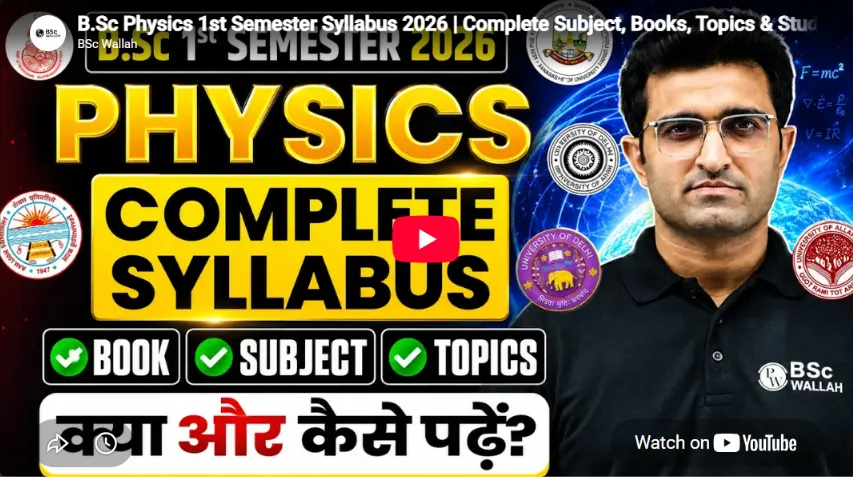
The B.Sc Physics 1st Semester Syllabus introduces students to the fundamental concepts of classical physics and builds the foundation for advanced topics taught in later semesters. While the syllabus varies slightly across universities, most institutions cover Mechanics, Vector Algebra, Differential Equations, Rotational Dynamics, Gravitation, Oscillations, and the Special Theory of Relativity.
Some universities also include introductory Wave Optics to strengthen students' understanding of light and wave phenomena. Along with theory, practical laboratory work is an essential part of the curriculum. Students perform experiments on moment of inertia, Young's modulus, pendulums, gravitational acceleration, and wave optics, helping them develop analytical and experimental skills.
Here we provide a university-wise overview of the B.Sc Physics 1st Semester syllabus, including core subjects, practical experiments, and important topics for semester examinations.
B.Sc. First Semester Physics Syllabus
The B.Sc. First Semester Physics syllabus has been revised in many universities under the National Education Policy (NEP) 2020. While the exact curriculum may vary from one university to another, the overall structure remains similar across most institutions.
As a Major/Core subject, the first semester generally focuses on building a strong foundation in fundamental physics concepts and laboratory skills. Most universities include the following components under the NEP framework:
-
Core (Major) Physics Theory Papers covering fundamental concepts of mechanics, properties of matter, waves, electricity, and related topics.
-
Physics Practical/Laboratory to develop experimental skills and understand the application of theoretical concepts.
-
Skill, Ability Enhancement, or Value-Added Courses may also be part of the semester, depending on the university's curriculum.
-
The detailed syllabus, credit structure, and paper pattern may vary according to the university and the adopted NEP scheme.
1st Semester structure of Undergraduate Programme in Physical Sciences under UGCF 2022 is as follows:
| Component | Semester I Details |
| Discipline Specific Core (DSC) | DSC 1: Chemistry 1DSC 2: Physics 1 (2T+2P)DSC 3: Mathematics 1 |
| Discipline Specific Elective (DSE) | Not Applicable (NA) |
| Generic Elective (GE) | Choose one course from a pool of coursesGE 1 (2T+2P / 3T+1P / 3T+1Tut) |
| Ability Enhancement Course (AEC) | Choose one AEC from a pool of courses |
| Skill Enhancement Course (SEC) | Choose one course from a pool of courses(0T+2P / 1T+1P) |
| Internship / Apprenticeship / Project / Community Outreach (IAPC) | Not Applicable (NA) |
| Value Addition Course (VAC) | Choose one course from a pool of courses |
| Total Credits | 22 Credits |
Semester I Core Subjects:
-
Chemistry 1 (DSC 1)
-
Physics 1 (DSC 2) – Theory + Practical (2T+2P)
-
Mathematics 1 (DSC 3)
Note: Students completing Semester I and II with required 44 credits are awarded an Undergraduate Certificate in Physical Sciences.
University-wise B.Sc Physics 1st Semester Syllabus
The B.Sc. First Semester Physics Syllabus covers the core subjects and university-specific topics that build a strong foundation in fundamental concepts of physics.
B.Sc Physics 1st Semester Syllabus for University of Delhi
The first core subject for the University of Delhi is Mechanics.
-
Unit 1: Review of Vectors and Ordinary Differential Equations (ODEs): These topics act as tools essential for understanding subsequent physics concepts. Vector Algebra basics are crucial prerequisites.
-
Unit 2: Fundamentals of Dynamics
-
Unit 3: Rotational Dynamics and Oscillatory Motion
-
Unit 4: Gravitation: The content here is comparatively less, building on 11th-grade knowledge.
-
Special Theory of Relativity: This is a new and important topic in B.Sc. physics, exploring phenomena at speeds comparable to the speed of light.
-
Reference Books (Examples): Commonly recommended texts include Schaum's Outline Series for Vector Analysis and D.S. Mathur for Mechanics.
B.Sc Physics 1st Semester Syllabus for Kurukshetra University
This university also focuses on Mechanics as a core subject.
-
Unit 1: Vectors
-
Unit 2: Ordinary Differential Equations (ODEs): Both serve as fundamental tools for comprehending physics concepts. Vector Analysis is highly important as it also applies significantly in Electricity & Magnetism.
-
Unit 3: Laws of Motion
-
Rotational Dynamics: Includes concepts like Angular Velocity, Angular Momentum, and Torque.
-
Gravitational Study: Specifically covers the Motion of Particles in a Central Force System.
-
Oscillatory Motion: Focuses on Simple Harmonic Motion (SHM), which requires knowledge of Differential Equations.
-
Special Theory of Relativity: A common topic discussing Frame of Reference
-
Physics Lab: Features common experiments like Moment of Inertia of a Flywheel and finding the Value of 'g' using Bar and Kater's Pendulum.
B.Sc Physics 1st Semester Syllabus for Maharshi Dayanand University (MDU)
MDU's core subject is also Mechanics.
-
Unit 1: Mechanics of Single Particle and System of Particles: This syllabus does not explicitly include a dedicated 'basic tools' unit like vectors/ODEs within this first unit.
-
Generalized Notation: Discusses Degrees of Freedom and Generalized Coordinates.
-
Coordinate Transformations: Covers transformations between different coordinate systems, shifting from 12th-grade Cartesian to B.Sc. level cylindrical and spherical systems.
| Coordinate System | Typical Usage Level |
|---|---|
| Cartesian (X, Y, Z) | 12th Grade |
| Cylindrical | B.Sc. Level |
| Spherical | B.Sc. Level |
-
Rotational Dynamics: Emphasizes Moment of Inertia as an important topic at the graduation level.
-
Special Theory of Relativity: Focuses on motion relative to the speed of light .
-
Practicals: Features common experiments such as Moment of Inertia of a Flywheel, Young's Modulus (Bending of Beam), and 'g' using Bar Pendulum.
B.Sc Physics 1st Semester Syllabus for Kumaun University (Nainital)
Kumaun University also covers Mechanics as a core subject.
-
Unit 1: Vector Algebra: Explicitly part of Physics, including Stokes' Theorem, Gauss's Theorem, and Green's Theorem.
-
Unit 2: Gravitational Field and Potential
-
Rotational Translation, Motion and Conservation Laws
-
Dynamics of a Rigid Body: Includes Moment of Inertia.
-
Properties of Matter: A common unit across universities.
-
Wave Oscillations: Focuses on Simple Harmonic Motion (SHM)
-
Lab Experiments: Includes determining 'g' and the velocity of a freely falling body, Young's Modulus, and 'g' using Bar and Kater's Pendulum.
-
Importance of Labs in B.Sc.: B.Sc. labs feature more advanced experiments than 12th grade, building on basic measurements. Lab work is mandatory, carries significant marks, and offers a one-time opportunity for academic career development.
B.Sc Physics 1st Semester Syllabus for Chaudhary Charan Singh University (CCSU)
CCSU's core subject is also Mechanics.
-
Unit 1: Vector Algebra and Vector Calculus: Vectors are treated as fundamental tools, whose properties are essential. Students are advised to revise 12th-grade Vector Analysis and basic Differential Equations.
-
Unit 3: Coordinate Systems
-
Unit 4: Tensor: Tensor is introduced in the first semester, often taught in higher semesters elsewhere, representing an advanced level beyond vector mathematics. This means Moment of Inertia will be discussed in Tensor form, a notable difference.
-
Dynamics of System of Particles, Rigid Body Rotational Motion
-
Gravitation: Covered under Motion of Planets and Satellites.
-
GPS (Global Positioning System): Introduced as a navigation system (USA-based), linking to satellite and gravitational motion concepts.
-
Wave Motion: A wave is a disturbance. Understanding wave motion and Simple Harmonic Motion (SHM) requires Differential Equations. Students should revise 12th-grade basics.
-
Lab Experiments: Includes Moment of Inertia (Flywheel) and Young's Modulus (Bending of Beams).
B.Sc Physics 1st Semester Syllabus for University of Lucknow
This university includes two core subjects: Mechanics and Wave Motion and Optics.
Subject 1: Mechanics and Wave Motion
-
Galilean Transformations
-
Transformation of Space and Time: Relates to the Theory of Relativity.
-
Postulates of Special Relativity.
-
Tools Unit: Includes Gauss's Divergence Theorem and Stokes' Curl Theorem.
-
Elastic and Inelastic Collisions in Two Dimensions.
-
Center of Mass.
-
Dynamics of a Rigid Body and Rotational Motion: Includes Moment of Inertia for various bodies (e.g., rings, disks, solid spheres, hollow spheres). Unlike CCSU, this is in standard form, not tensor form.
-
Reduction of the Two-Body Central Force Problem into a One-Body Problem.
-
GPS (Global Positioning System): Included as a navigation system related to satellites and gravitation.
-
Differential Equations: Essential for understanding SHM. Students should study Differential Equations thoroughly before Wave and Oscillations.
Subject 2: Optics
-
Nature of Optics: While 12th-grade Optics primarily covers Ray Optics and basic Wave Optics, B.Sc. Optics delves into advanced levels of Wave Optics.
-
Interference: Beyond Young's Double Slit, advanced topics include Fresnel's Biprism and Lloyd's Mirror.
-
Division of Amplitude: A new concept at the B.Sc. level, with Thin Films being an important topic.
-
Newton's Rings: An important topic in theory, with a corresponding experiment.
-
Diffraction: Covers Fresnel and Fraunhofer diffraction types, including Diffraction Grating and patterns from single/double slits.
-
Polarization: Implied as a standard follow-up, completing the study of wave phenomena.
A Core Course is mandatory and non-optional throughout the four-year degree program (eight semesters). Students must pursue these subjects without choice, forming the fundamental pillars of their chosen discipline.
B.Sc Physics 1st Semester Syllabus FAQs
What is the primary focus of the B.Sc. First Semester Physics syllabus?
How does the New Education Policy (NEP) affect the B.Sc. First Semester Physics course structure?
What role do Vectors and Ordinary Differential Equations (ODEs) play in the B.Sc. First Semester Physics syllabus?
What is unique about the Special Theory of Relativity in the B.Sc. First Semester syllabus?





Get Free Counselling Today
and Clear up all your Doubts
 Live & recorded classes available at easeDashboard for progress trackingLakhs of practice questions

