






CFA vs Financial Modeling Course: Salary, Scope & Career Comparison
 Priyanka Yadav12 May, 2026
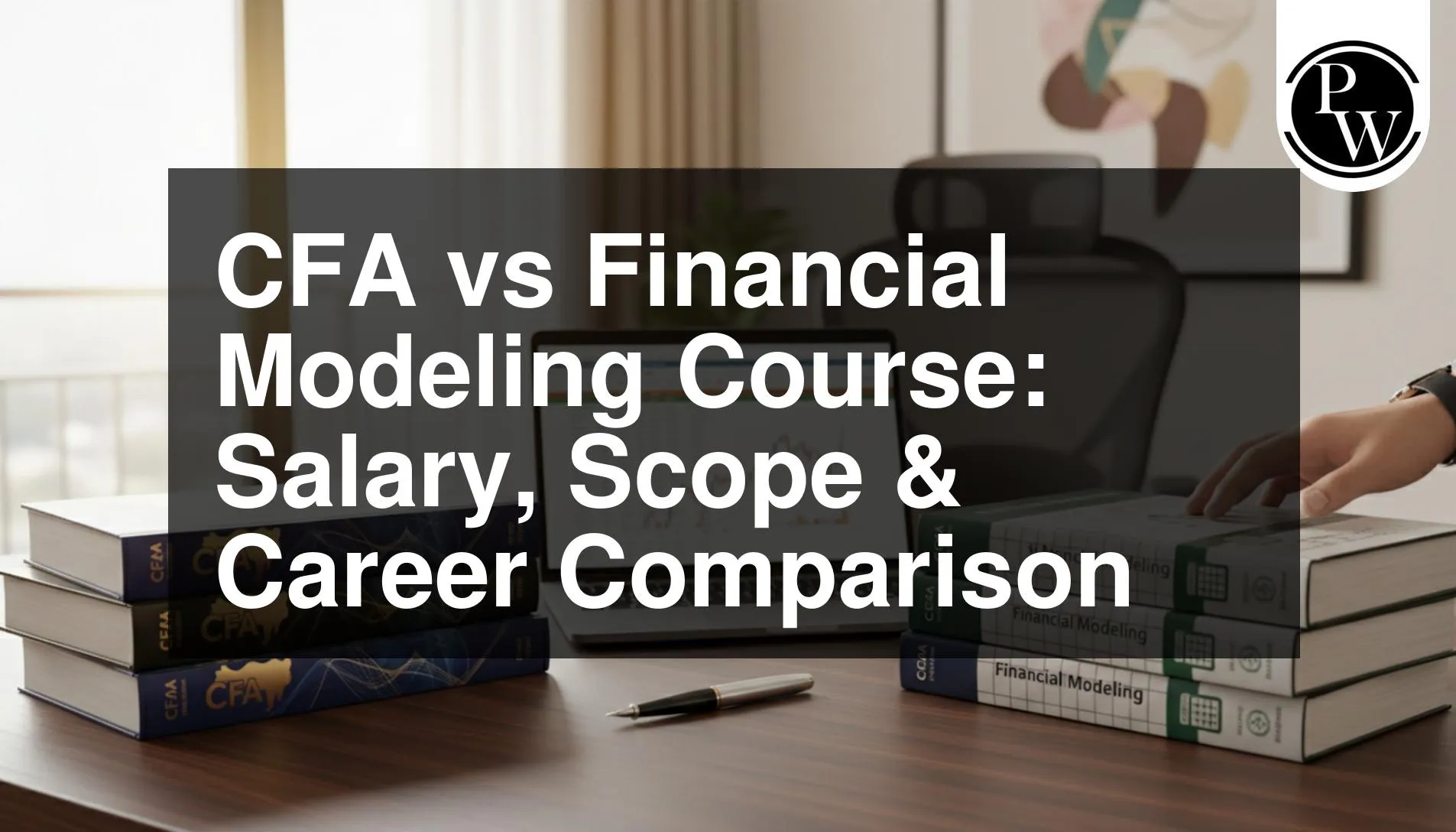
CFA and Financial Modeling serve different but complementary roles in finance careers. CFA offers strong theoretical knowledge, global recognition, and long-term growth in investment and asset management roles.
Financial Modeling focuses on practical, job-ready skills like valuation and deal execution, essential for investment banking and corporate finance. While CFA builds credibility, Financial Modeling enhances execution ability—combining both creates better career opportunities, higher salaries, and a strong profile in the finance industry.
CFA Program vs. Financial Modeling Dilemma
Students often face a dilemma: whether to pursue the CFA Program or Financial Modeling, and in what order. This discussion clarifies the distinct roles and benefits of both, helping aspiring finance professionals make informed career decisions.
Both paths offer unique advantages and cater to different career aspirations within the dynamic finance industry.
What is the CFA Program
The CFA Program (Chartered Financial Analyst) is a globally recognized certification from the CFA Institute, considered a gold standard in the finance and asset management industry. It is structured as a three-level examination, demanding over 900 hours of preparation across all levels (with at least 300 hours recommended per level).
-
Structure: Three-level examination, covering extensive theory, financial concepts, and ethics.
-
Focus: Primarily on investment analysis and portfolio management.
-
Preferred Roles: Ideal for asset management, research, and other high finance roles, particularly in core finance sectors like portfolio management. It is one of the most sought-after certifications for these areas.
What is Financial Modeling
In contrast to the CFA Program, Financial Modeling is a skill set, not a certification or degree. It emphasizes execution and practical application.
-
Definition: The practical skill of building financial models in Excel.
-
Purpose: Financial models serve as decision-making tools, assisting in informed choices for financial activities, transactions, and investments. The art of building financial models is known as Financial Modeling.
-
Scope: Covers models like DCF, LBO, M&A, and Three-Statement Models.
-
Focus: Primarily on deal execution and valuation for company/business valuation, leveraged buyouts (LBOs), mergers & acquisitions (M&A), and project financing.
-
Learning Methods: Can be learned through specialized courses or on the job.
-
Preferred Roles: Essential for investment banking, private equity, FP&A, and corporate finance roles. It is a demanded skill set for entry into these core finance positions.
-
Financial Modeling is like the subject of Mathematics for finance professionals. Just as mathematics is applied in various fields (accounts, physics, chemistry), financial modeling is the "math" that can be applied to any financial decision-making process.
CFA vs Financial Modeling Syllabus
Here’s what you will study in the CFA Program and Financial Modeling courses, covering both theoretical concepts and practical finance skills:
A. CFA Program Curriculum
The CFA Program covers key areas vital for investment professionals:
-
Ethics
-
Quantitative Methods (Mathematics and Statistics)
-
Economics
-
Financial Reporting and Analysis: Focuses on studying and analyzing company financial statements.
-
Equity Investments
-
Fixed Income Investments (Debt Markets)
-
Derivatives
-
Alternative Investments
-
Portfolio Management
-
Wealth Planning (Wealth Management)
B. Financial Modeling Curriculum
Financial Modeling typically covers practical skills needed for financial analysis:
-
Three Statements: Building Income Statement, Balance Sheet, and Cash Flow Statement.
-
Valuation Models: Discounted Cash Flow (DCF) and Comparables Analysis (Comps).
-
M&A Accretion/Dilution Modeling
-
Leveraged Buyout (LBO) Models
-
Scenario and Sensitivity Analysis: To aid in informed decision-making.
-
Advanced Excel and Charts
-
Financial Modeling also requires understanding financial statement analysis, financial mathematics (e.g., CAGR, XIRR, NPV), and underlying valuation concepts. Financial Modeling is your destination; Excel is your vehicle. To reach your destination effectively, you must learn to drive your vehicle well. Strong Excel proficiency is foundational; without it, mastering financial modeling will be challenging.
Career Options After CFA vs Financial Modeling
Explore the top career options after CFA and Financial Modeling to understand which path aligns better with your finance career goals:
A. CFA Program Career Paths
A CFA Charter can lead to roles primarily on the buy-side:
-
Portfolio Manager
-
Research Analyst
-
Chief Investment Officer (CIO)
-
Hedge Fund Analyst
-
Risk Manager
-
Wealth Manager
B. Financial Modeling Career Paths
Financial Modeling skills are crucial for roles focused on deal execution:
-
Investment Banking Analyst
-
Private Equity Analyst
-
FP&A (Financial Planning & Analysis)
-
Corporate Finance
-
M&A (Mergers & Acquisitions)
-
Equity Research Analyst
-
Venture Capital Analyst
For these roles (Investment Banking, Private Equity, Venture Capital, Equity Research), Financial Modeling is not just important; it is a deal breaker. Without it, even with a CFA, one might not be able to secure or succeed in these positions, as they involve daily model building and execution.
CFA vs Financial Modeling Salary Comparison in India
Compare CFA vs Financial Modeling salary in India to understand earning potential, growth, and ROI of both career paths:
|
Feature |
CFA Program |
Financial Modeling |
|
Time Commitment |
Minimum 2.5 to 3 years (assuming regular attempts). |
3 to 4 months (to acquire the skill set). |
|
Cost |
Approximately ₹3 to ₹3.5 lakhs. |
Varies from ₹15,000 to ₹1 lakh, depending on the institution. |
|
Difficulty |
Not a piece of cake; requires dedication, effort, and discipline. |
Doable; can be managed alongside work or on weekends. |
|
Focus |
Theory and Ethics. |
Highly practical and requires Excel proficiency. |
|
Best For |
Buy-side and Asset Management. |
Investment Banking, Private Equity, FP&A, and Corporate Finance roles. |
|
Recognition |
Global credential, recognized in 160+ countries. |
Global and universal skill set; financial concepts are consistent worldwide. |
|
Salaries |
Entry: ₹12-15 lakhs, can go up to ₹35-40 lakhs. |
Varies widely based on other qualifications and the complexity of problems one can solve using models. A plain graduate with FM might start at ₹5-8 lakhs. |
CFA vs Financial Modeling: Which Should You Choose?
Choose between CFA and Financial Modeling based on your career goals, whether you want long-term credibility or job-ready finance skills.
A. Reasons to Choose CFA Program
The CFA Program is a necessity if your goals include:
-
Managing portfolios or becoming a fund manager.
-
Preferring research, market, and economic analysis.
-
Aiming for long-term credibility in finance.
-
Desiring global recognition for career exploration abroad (across 160+ countries).
-
Targeting High Net Worth Individual (HNI) wealth management or CIO roles, where it is often a mandatory criterion.
B. Reasons to Choose Financial Modeling
Financial Modeling becomes a deal breaker and an essential skill if you:
-
Aim for roles in Investment Banking, Private Equity, Venture Capital, Equity Research, FP&A, or Corporate Finance.
-
Enjoy deal-making, M&A, and valuation.
-
Seek job-ready skills within three to six months (short-term game for immediate execution).
-
Target FP&A, Corporate Finance, or startup roles.
-
Want to complement existing degrees like MBA or CA, adding a practical skill set.
Should You Do CFA and Financial Modeling Together?
The ultimate answer is that the CFA Program and Financial Modeling are complementary, not competing.
-
The CFA Program provides knowledge, credentials, and credibility: It teaches the theory of investments, ethics, and portfolio strategies, and offers global recognition.
-
Financial Modeling enables execution: It teaches how to convert theoretical knowledge into practical work in an office environment, mastering Excel, deal-making, and building valuation models.
Without the ability to execute the theoretical knowledge gained from the CFA, the theory remains just theory. Financial Modeling puts that knowledge into practice.
Financial Modeling is a thing of practice. It cannot be learned purely from books or by observation. The only way to truly learn Financial Modeling is by doing: building models, making mistakes, and fixing them to become industry-ready.
Benefits of Combining Both:
-
Higher potential for higher salaries and broader roles.
-
Offers more career options by showcasing both credibility and execution skills.
-
Makes you both globally recognized (via CFA) and deal-ready (via Financial Modeling).
CFA vs Financial Modeling – Best Career Path
Professionals typically build both skill sets over time. It is advisable to start with CFA Level 1 to gain foundational knowledge and simultaneously learn Financial Modeling in parallel. Financial Modeling should be learned as early as possible to allow ample time for practice, which is crucial for mastery.
Think of your finance career as a train. The CFA Program and Financial Modeling are the two parallel tracks that allow the trainee to run smoothly and in a balanced way, leading to a wonderful finance career.
In conclusion, it is not CFA versus Financial Modeling; it is always CFA with Financial Modeling for a successful and comprehensive finance career. The CFA provides the necessary theoretical understanding and knowledge for long-term career building and investment management, while Financial Modeling provides the execution skills to become job-ready and apply that knowledge in practice.
Finance Career Pathways FAQs
What is the primary difference between the CFA Program and Financial Modeling?
Which career paths are best suited for a CFA Charter holder?
For which roles is Financial Modeling considered a "deal breaker"?
How long does it typically take to acquire each qualification/skill set?
Is it recommended to pursue both CFA and Financial Modeling?





Get Free Counselling Today
and Clear up all your Doubts
 Live & recorded classes available at easeDashboard for progress trackingLakhs of practice questions

