






Reproductive System of Earthworm
Anatomy of Earthworm,Cockroach & Frog of Class 11
Reproductive System
Earthworms are monoecious or hermaphrodites.
They are protandrous, there is no self-fertilization.

Fig. Reproductive organs of Pheretima
Copulation has been studied in Pheretima communissima.
Male organs include
– Testes (two pairs) (segments 10 and 11)
– Seminal vesicles (segments 11 and 12)
– Accessory glands (segments 17 and 19)
– Genital papillae (segments 17 and 19)
– Male genital apertures (segment 18)
– Prostate gland (segments 17-20)
Female organs include
– Ovary (one pair) (segment 13)
– Female genital pore (segment 14)
– Spermatheca (4 pairs) (segments 6, 7, 8, 9)
– Open outside on intersegmental groove 5/6, 6/7, 7/8, 8/9.
Spermatheca are used to store sperm after copulation.
Copulation occurs between two earthworms generally at night during rainy season.
Cocoons formed by glandular clitellum.
Fertilization external and occurs in cocoon.
Cleavage holoblastic and unequal, development direct without any larval stage. Young worm comes out of cocoon in 2-3 weeks.
Metamorphosis absen in earthworm.
Cocoon may have several fertilized eggs but only one embryo develops.
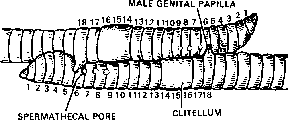

Fig. Anterior parts of two copulating earthworms Fig. The process of releasing a cocoon into soil
A cocoon may contain many fertilized eggs, but only one embryo develops, other eggs serve as nurse cells.



