CBSE Class 12 Accountancy Exam Important Update, Complete Details

CBSE Class 12 Accountancy Exam Important Update: The CBSE Class 12 Accountancy Exam 2026 brings significant updates to enhance student experience. Allowing basic calculators, implementing the On-Screen Marking (OSM) system, and simplifying the re-evaluation process are key reforms aimed at improving accuracy, transparency, and efficiency. Scheduled for 24 February 2026, the exam includes an 80-mark theory paper and a 20-mark project, evaluating students across understanding, application, and analytical skills, helping them perform confidently and fairly.
CBSE Class 12 Accountancy Exam 2025-26
The CBSE Class 12 Accountancy Exam 2025-26 is scheduled to be conducted on 24 February 2026. The theory paper will carry 80 marks, while the project work carries 20 marks, with a total duration of 3 hours. Students are advised to complete their preparation according to the question paper design and marking scheme.
CBSE Class 12 Accountancy Exam Weightage 2025-26
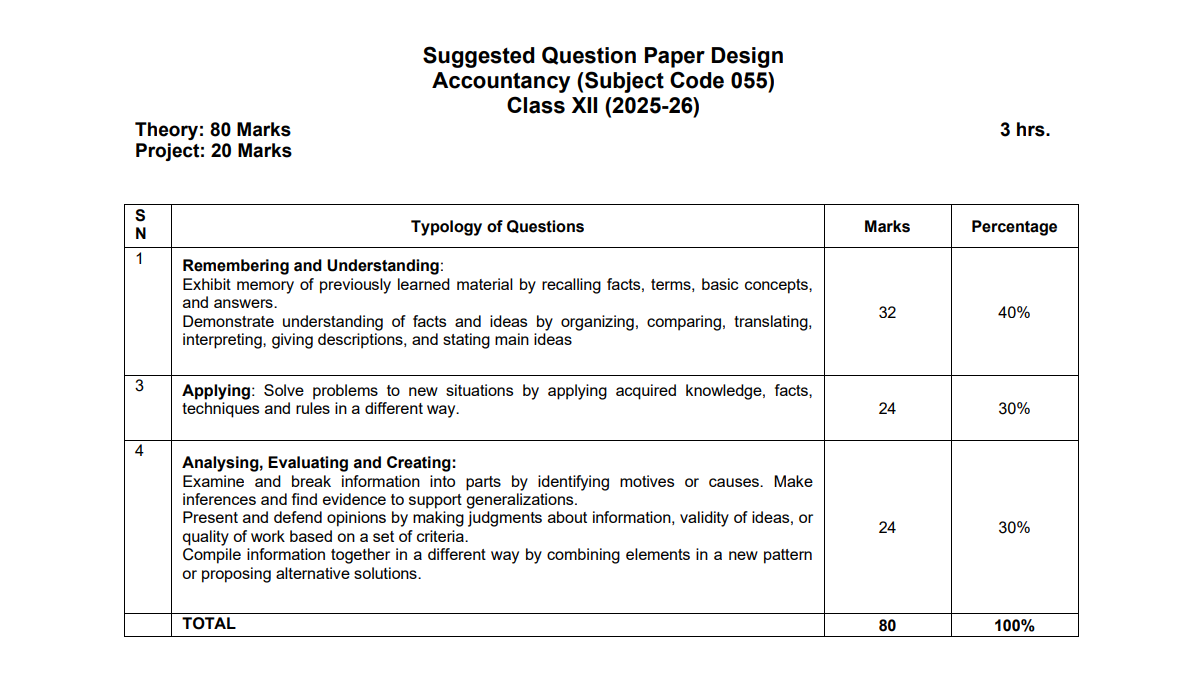
The Accountancy Class XII examination (Subject Code 055) is designed to evaluate students across three cognitive levels: Remembering & Understanding, Applying, and Analysing, Evaluating & Creating. The theory paper carries 80 marks while the project carries 20 marks, with a total duration of 3 hours. The table below summarizes the typology of questions, marks distribution, and corresponding weightage.
| CBSE Class 12 Accountancy Exam Weightage 2025-26 | |||
|---|---|---|---|
| S. N | Typology of Questions | Marks | Percentage |
| 1 | Remembering and Understanding:Exhibit memory of previously learned material by recalling facts, terms, basic concepts, and answers. Demonstrate understanding of facts and ideas by organizing, comparing, translating, interpreting, giving descriptions, and stating main ideas. | 32 | 40% |
| 2 | Applying:Solve problems to new situations by applying acquired knowledge, facts, techniques, and rules in a different way. | 24 | 30% |
| 3 | Analysing, Evaluating and Creating:Examine and break information into parts by identifying motives or causes. Make inferences and find evidence to support generalizations. Present and defend opinions by making judgments about information, validity of ideas, or quality of work based on a set of criteria. Compile information together in a different way by combining elements in a new pattern or proposing alternative solutions. | 24 | 30% |
| TOTAL | 80 | 100% | |
Here we have attached official snap of CBSE Class 12 Accountancy Exam Weightage 2025-26:
Introduction of On-Screen Marking (OSM) System
One of the biggest changes CBSE is implementing is the On-Screen Marking (OSM) system in select subjects. Under this system, students' answer sheets will be scanned and evaluated digitally instead of being physically transferred to examiners. The OSM system is expected to:
Reduce manual errors in the evaluation process.
Speed up the result declaration process.
Ensure better transparency in marking.
Minimize logistical challenges associated with the physical transportation of answer sheets.
CBSE had previously tested this system in 2013-14 but faced certain challenges. However, with advancements in digital technology and a more structured approach, the board is confident in successfully implementing this system for the 2025-26 academic session.
Simplified Re-Evaluation Process for Students
CBSE has also revised its re-evaluation process to make it more student-friendly. Earlier, students had to undergo multiple steps, such as:
- Verification of marks.
- Requesting photocopies of answer sheets.
- Applying for re-evaluation.
Now, students can directly request a photocopy of their answer sheets and then decide whether they want verification, re-evaluation, or both. This streamlined approach will help students quickly address their concerns regarding exam evaluation, reducing unnecessary delays and ensuring a fair assessment process.
How Will These Changes Benefit Students?
CBSE’s latest reforms, including the allowance of basic calculators, the On-Screen Marking system, and a simplified re-evaluation process, are designed to:
Enhance Exam Efficiency: By permitting basic calculators, students can solve complex numerical problems faster and with greater accuracy.
Improve Evaluation Accuracy: The digital evaluation system will help minimize errors, ensuring fair and precise marking.
Reduce Exam Stress: With calculators allowed and a more transparent marking system in place, students can focus more on understanding concepts rather than worrying about calculation errors or evaluation delays.
CBSE’s Commitment to Transparency and Fairness
These reforms highlight CBSE’s commitment to making the board exams more student-friendly and efficient. The board aims to ensure that students have the necessary tools and a streamlined evaluation process to perform to the best of their abilities.
With these changes, CBSE is taking a significant step toward modernizing the examination process. Allowing basic calculators in Class 12 Accountancy exams is expected to ease the burden on students, while the digital evaluation system will enhance transparency and efficiency. As CBSE continues to introduce student-centric policies, further announcements regarding the execution of these reforms are expected in the coming months.
Students preparing for the 2026 board exams should stay updated with CBSE’s latest notifications and guidelines to make the most of these beneficial changes.
CBSE Class 12 Accountancy Exam Important Update FAQ
Can students use scientific calculators in the CBSE Class 12 Accountancy exam?
How will the On-Screen Marking (OSM) system affect result processing?
What are the benefits of the revised re-evaluation process?
Will all subjects have On-Screen Marking in the 2025 CBSE board exams?