







Nikita Joshi CSIR NET Success Story: How PW Helped Her Secure AIR 27
Nikita Joshi secured AIR 27 and qualified for JRF in CSIR NET June 2026 Chemical Sciences. Her success story covers the challenges she faced during preparation, the approach she followed to strengthen her preparation and the role of PW in her journey.
 Neha Tanna18 Sept, 2026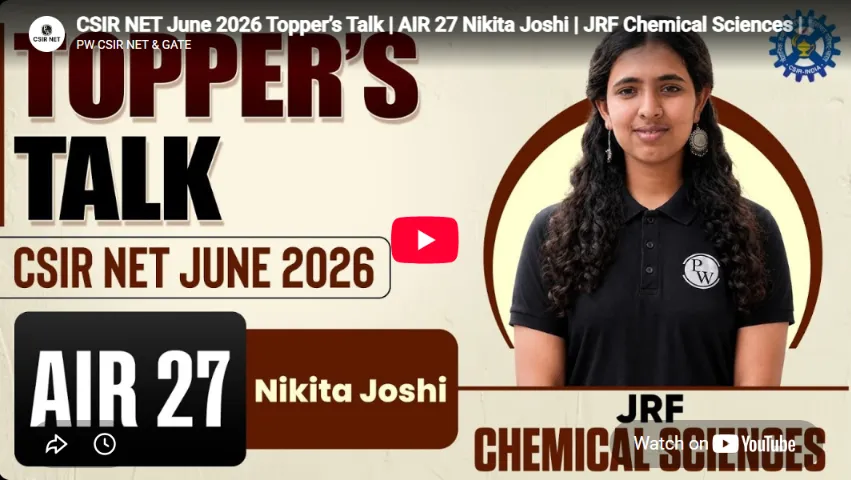
Nikita Joshi secured AIR 27 in CSIR NET June 2026 Chemical Sciences, marking an important achievement in her academic journey. Her preparation involved working through the wide Chemical Sciences syllabus and building a consistent approach towards the examination.
In her conversation with PW, Nikita shared her experience of preparing for the examination, the areas that required greater attention and how she used PW during her preparation. Her journey provides a closer look at the preparation process behind her AIR 27 result.
How Nikita Joshi Started Preparing for CSIR NET Chemical Sciences
Nikita began her preparation right after completing her master's degree. She had strong motivation but needed a dedicated routine. The wide syllabus of Chemical Sciences felt challenging initially.
"Mera basic concepts par focus tha, lekin syllabus itna vast tha ki start kahan se karein samajh nahi aa raha tha."
This uncertainty made her look for dedicated guidance. She decided to organise her daily timetable and focus on core chapters first.
"Maine decide kiya ki daily targets banaungi aur standard books se topic samjhugi."
Her daily routine gave her early momentum. She slowly built confidence in fundamental theories.
Nikita Joshi Faced Major Preparation Challenges
Managing three vast branches of Chemistry was not easy. Physical Chemistry required fast calculation speed, while Organic Chemistry demanded clear mechanism pathways. She often lost accuracy during mixed-topic problem-solving.
"Mock tests me negative marking bahut zyada ho rahi thi, especially Organic mechanism questions me."
She realised that theoretical knowledge alone was not enough. Negative marking pulled down her test scores.
"Mujhe lagta tha syllabus cover ho gaya hai, par questions solve karte time speed slow ho jati thi."
These hurdles made her re-evaluate her study methods. She focused on reducing guesswork and improving calculation accuracy.
Nikita Joshi Used PW Lectures to Strengthen Concepts
Nikita turned to PW CSIR NET batches for revision and practice. The faculty provided step-by-step breakdowns of complex reaction mechanisms and Quantum Chemistry formulas.
"PW ke teachers ne concepts ko itna simple kar diya ki difficult topics bhi scoring lagne lage."
She attended live sessions regularly and solved Class DPPs every single day. Detailed test analysis helped her spot silly mistakes quickly.
"Test analysis aur faculty ke doubt sessions ne meri accuracy ko double kar diya."
This support gave her the right strategy to manage exam pressure. She gained strong control over tricky sections.
Nikita Joshi Observed Rapid Score Improvement
With regular mock tests, Nikita noticed a steady rise in her test ranks. Her error rate dropped significantly in calculation-heavy questions.
"Last two months me mock scores dekh kar mera confidence clearly increase hone laga."
Her timing improved across all three exam parts. She could finish Part B faster, leaving more time for Part C analytical questions.
"Part C ke questions me selection strategy sahi hone se score direct boost hua."
Targeted revision cycles kept formulas and Named Reactions fresh in her mind. She entered the examination centre with high self-belief.
Nikita Joshi Secured AIR 27 in CSIR NET June 2026
The final result proved her dedication. Nikita secured All India Rank 27 in the Junior Research Fellowship. Her achievement established her as the CSIR NET June 2026 Chemical Sciences Topper, Nikita Joshi, AIR 27.
"Jab result me AIR 27 dekha, toh laga ki har din ki mehnat successful ho gayi."
This top rank opened doors to premier research institutes. Her balanced study plan and test discipline led to this remarkable milestone.
Lessons Nikita Joshi Shares with Aspirants
Nikita advises all CSIR NET aspirants to stay consistent and analyse every mock test. Success comes from fixing weak areas early rather than studying new topics at the last moment.
She emphasises smart question selection in the exam hall.
Aspirants should solve previous years' papers multiple times to understand question patterns. Self-discipline and regular practice remain the key to cracking competitive examinations.








Get Free Counselling Today
and Clear up all your Doubts
 Live & recorded classes available at easeDashboard for progress trackingLakhs of practice questions

