








CSIR NET June 2026 Physical Sciences Topper Ankuran Pathak Secures 99.62%ile With PW
CSIR NET June 2026 Physical Sciences Topper Ankuran Pathak secured 99.62 percentile after focusing on lectures, DPPs, mock tests, revision and test analysis. His journey also highlights how he used PW’s preparation support to strengthen weak areas and improve his practice before the exam.
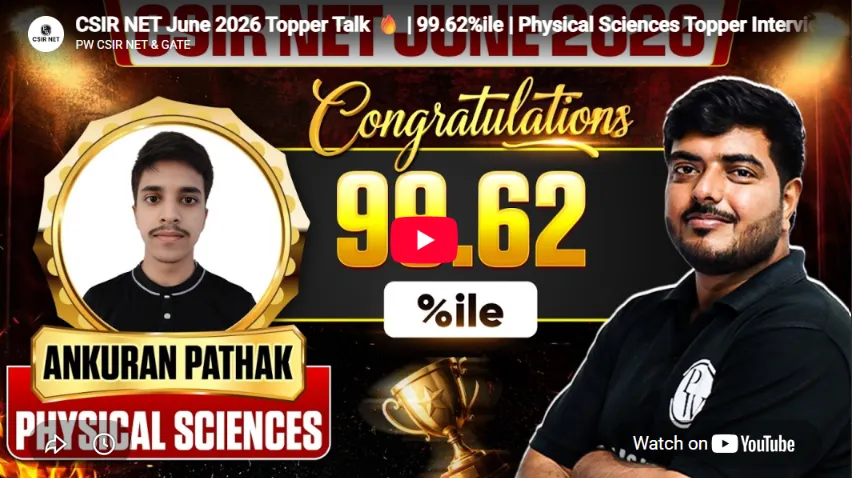
Preparing for CSIR NET Physical Sciences requires more than completing lectures. Regular practice, revision, mock tests and analysing mistakes are also important parts of the preparation process. For Ankuran Pathak, balancing his studies with his Master's initially made it difficult to maintain regular practice.
His approach changed when he focused more on DPPs, tests, revision and mistake analysis. This consistent preparation helped CSIR NET June 2026 Physical Sciences Topper Ankuran Pathak achieve a 99.62 percentile. His interview explains how he organised his preparation and used PW resources along the way.
Ankuran Pathak Started With Lectures but Needed More Practice
Ankuran had earlier enrolled in a PW batch while pursuing his Master's at DU. He attended the lectures, but his academic workload made it difficult to maintain regular question practice and tests.
Talking about his earlier preparation, Ankuran said:
"Tab maine padha gaya tab lekin hua nahi tha kyunki mera jyada practice nahi hua tha."
This experience helped him identify an important gap in his preparation. He realised that watching lectures alone was not enough and that he needed consistent practice to strengthen his preparation.
He later chose the June Foundation batch, particularly because he wanted to focus more on practice and work on topics where he was weak.
How Ankuran Used PW DPPs and Tests for Practice
After joining the Foundation batch, Ankuran started using DPPs and tests more consistently. He completed the DPPs and also made it a habit to analyse the questions he got wrong.
He explained his approach:
"Sare approx sara hi DPP kiya aur test vagairah achhe se diya to test test mein matlab theek tha matlab kabhi-kabhi aisa hota hai ki thoda bahut kam bhi aata hai to usko analyse karna jaruri hai."
Instead of treating an incorrect answer simply as a mistake, he used it as a point for further practice. He maintained an extra notebook where he wrote down questions that he had answered incorrectly and solved them again.
This gave him a separate collection of questions to revisit during revision and helped him focus on the areas where he needed more work.
Ankuran's Revision Strategy Focused on Notes and Mistakes
With regular practice in place, Ankuran also developed a detailed note-making and revision method. His notes included important points, shortcuts and formulas that he felt needed to be remembered.
He shared:
"Mera to pura notes matlab complete tha. Matlab aisa nahi tha ki main jab bhi matlab notes banata hun pura ekdam jaise matlab sare jo bolte hue matlab wo bhi matlab likh kar rakhta hun."
For particularly important points, he maintained additional sheets. He also prepared formula sheets for topics where formulas needed frequent revision.
His method was not limited to reading notes. Questions that he could not solve were also added to his revision material. He explained:
"Jo jo matlab mere se nahi bana usko main matlab ek extra copy rakha tha jiski matlab main actually aisa karta tha ki wahan par jo jo galti hua hai ya phir jo jo question mujhse bana nahi bilkul bhi wo question likh ke uska solution likhta tha pura complete."
This approach allowed him to revise both concepts and the mistakes associated with them before the examination.
How PW Support Helped Ankuran Strengthen His Preparation
Ankuran's preparation became more practice-oriented after he joined the Foundation batch. Along with the lectures, he used DPPs and regular tests to evaluate his preparation.
He also highlighted the importance of the tests in identifying mistakes before the actual examination:
"Mock test mein galti hoga tab to sahi ho payega. To isliye mock test dena to bahut jaruri hai."
For Ankuran, mock tests were not only about checking marks. They helped him identify mistakes in a practice environment, giving him an opportunity to correct them before the actual exam.
The combination of PW classes, DPPs, tests, revision and analysis gave him an organised way to continue practising and improving.
Ankuran's CSIR NET Exam Attempt Strategy
Ankuran also followed a specific strategy while attempting the CSIR NET Physical Sciences paper. He started with Part A, which he generally completed in around 35–40 minutes.
He said:
"Actually mera aisa tha ki main pehle A part hi karta tha approx 35 35 to 40 minutes mein."
He then moved to Part C, as he was comfortable attempting questions carrying higher marks. His strategy was based on identifying the sections where he could maximise his score and then using the remaining time accordingly.
This approach reflected his preparation-based understanding of the paper rather than following a fixed strategy without considering his strengths.
Ankuran's Advice for CSIR NET Aspirants
Based on his experience, Ankuran recommended that students preparing for the upcoming examination should combine lectures with regular practice and revision.
His advice was:
"Main yahi bolunga ki mock test do DPP karo aur jo jo matlab at least notes mein likha hua hai usko revise karna jaruri hai to revise karte raho regular aur test ka analysis karna jaruri hai bahut jyada."
His preparation journey shows the importance of following a complete study cycle: learn the concepts, practise questions, attempt tests, analyse mistakes and revise regularly.
For aspirants preparing for CSIR NET, this approach can help make preparation more systematic and ensure that mistakes identified during practice are addressed before the examination.
CSIR NET June 2026 Physical Sciences Topper Ankuran Pathak's 99.62%ile reflects a preparation journey that gradually became more focused on practice and self-analysis. His experience shows how moving beyond lectures to DPPs, mock tests, detailed notes, mistake analysis and regular revision can make preparation more structured.
His story also carries a practical message for future aspirants: consistent effort and proper use of available learning support can help students identify their weak areas and keep improving throughout their preparation.


Have questions about your prep?
Our experts can answer all your questions



 Live & recorded classes available at easeDashboard for progress trackingLakhs of practice questions

