








CUET PG History Unit 1: Stone Age: Paleolithic, Mesolithic, and Neolithic Age

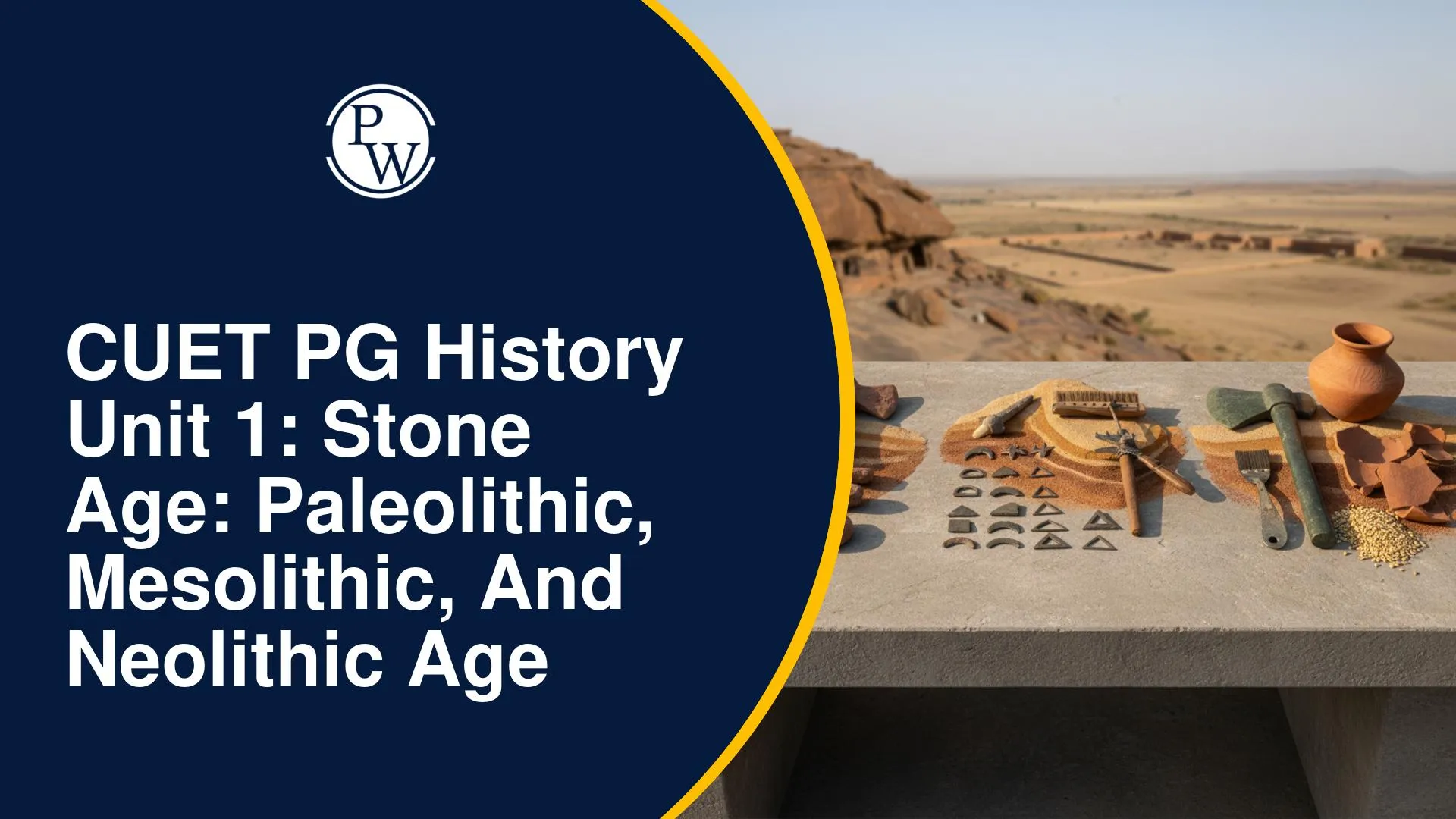
The CUET PG History Stone Age topic covers the Paleolithic, Mesolithic and Neolithic Ages and explains how early human communities evolved through changes in tools, technology, food habits and settlement patterns. From hunting and gathering in the Paleolithic to microliths in the Mesolithic and agriculture, polished tools and settled life in the Neolithic, these phases mark major stages of human development in India.
For CUET PG 2027 preparation, understanding the Stone Age chronology, tools, important sites and key facts is essential. CUET PG history syllabus topic Stone Age covers major sites such as Bhimbetka, Hathnora, Bori, Nevasa, Bagor, Burzahom and Mehrgarh, along with important dates, discoveries and exam-focused facts for quick revision.
What Is the Stone Age?
The Stone Age is the earliest stage of human history, named after the stone tools that survived through time. Here are its key features:
-
Stone was the main material used for tools, weapons, and implements.
-
Tools made of wood or bone mostly decomposed, so stone tools survived best.
-
The Stone Age in India ran from about 2–2.5 million years ago to roughly 6000–2500 BC.
-
It ended when people began using metals.
-
Historians study this age mainly through stone tools, since it comes before any form of writing.
What Is the Three Age System?
Human technological history is grouped into three broad stages based on tool material. Key points to remember:
-
The Three Age System divides history into the Stone Age, Bronze Age, and Iron Age.
-
It was first proposed by P.F. Suhm and Christian Jurgensen Thomsen in 1820.
-
Jacob Worsaae later validated this system.
-
In India, a Chalcolithic (Copper) Age is also recognised as a bridge between the Stone Age and the Bronze/Iron Age cultures (covered separately under Unit 1).
How Is the Stone Age Classified?
Scholars split the Stone Age using three factors: geological time, tools, and food habits. Here is how the classification works:
-
John Lubbock first divided the Stone Age into Paleolithic (Old Stone Age) and Neolithic (New Stone Age) in 1865.
-
The Mesolithic (Middle Stone Age) was added later as a transitional phase between the two.
-
Edouard Lartet further split the Paleolithic into Lower, Middle, and Upper phases.
-
Classification rests on the geological epoch, the tools and technology used, and the subsistence strategy (how people got food).
-
The Paleolithic falls in the Pleistocene epoch (the Ice Age); the Mesolithic and Neolithic both fall in the Holocene epoch, this is the Pleistocene Holocene epoch link students must remember.
A Quick Look at Human Evolution
Before moving to Indian sites, it helps to place the Stone Age on the human evolution timeline. Key milestones include:
-
Australopithecus, close ancestors of modern humans, lived between 4.4 and 1.4 million years ago.
-
Homo habilis, the earliest member of the genus Homo, lived in sub-Saharan Africa around 2 to 1.5 million years ago.
-
The first Homo erectus fossil was found on Java Island in 1891.
-
The first Homo sapiens neanderthalensis fossil was found in Germany in 1856.
-
Homo sapiens are believed to have evolved in Africa around 315,000 years ago.
-
The oldest Homo sapiens sapiens fossils were found at Cro-Magnon, France, dated to 100,000–125,000 years ago.
-
In India, the earliest human evidence is Homo erectus narmadensis, found in the Narmada Valley, Madhya Pradesh.
-
Ancient Indian history is divided into the Pre-historic, Proto-historic, and Historical periods.
Paleolithic Age India: Hunters and Food Gatherers
The Paleolithic Age is the oldest phase of the Stone Age, when people lived only by hunting and gathering. Important points:
-
The term "Paleolithic" was given by John Lubbock in 1865.
-
Tools were mostly made of quartzite, so people of this age are also called "Quartzite Men."
-
People had no knowledge of farming, pottery, or metal.
-
Sir Alexander Cunningham was the first Director-General of the Archaeological Survey of India (established 1861).
-
Robert Bruce Foote, the Father of Indian Pre-history, discovered the Pallavaram Hand Axe, his landmark find.
Lower Paleolithic Age (up to 100,000 BC)
-
Main tools: hand axes, cleavers, choppers, and chopping tools.
-
Chopper tools were unifacial, linked to the Sohan culture; hand axes and chopping tools were bifacial, linked to the Acheulian culture.
-
People lived by foraging, hunting, and fishing; shelters were made from branches, leaves, and stones.
-
No burials have been found from this phase.
-
Key sites: Belan Valley, Bhimbetka, Jodgaha, Bagor, Budha Pushkar, Patne, Nandipalle, Renugunta, Kurnool Caves, Singhbhum, and the Sohan Valley.
-
Attirampakkam (Tamil Nadu) is notable for Acheulian tools India; Hathnora (Madhya Pradesh) is the site of the Narmada Man Hathnora discovery, India's only Paleolithic human skeleton found so far; Bori (Maharashtra) has India's earliest human evidence, dated to about 1.4 million years ago.
-
Raw material use varied by region: basalt in Maharashtra, limestone in Karnataka, and quartzite almost everywhere else.
Middle Paleolithic Age (100,000–40,000 BC)
-
Tools were based on flakes and a crude pebble industry, with blades, points, and borers as the main types.
-
Made using the Levallois technique, from agate, jasper, and chert.
-
Belan Valley (Uttar Pradesh) is rich in stone tools and animal fossils like cattle and deer.
-
Nevasa (Maharashtra) gives its name to the "Nevasa industry" of flake tools.
-
Other sites: Bhimbetka, Narmada Valley, Bagor, Karmali Valley, Didwana, and Singhbhum.
Upper Paleolithic Age (40,000–10,000 BC)
-
Tools included burins, scrapers, and a developed flint industry, made using pressure flaking.
-
This phase saw the emergence of modern humans, or Homo sapiens.
-
Belan Valley remains show greater use of goats, sheep, and cattle.
-
Patne (Maharashtra) gave engraved ostrich eggshells with cross designs, an early sign of art.
-
Tarnool and Renugunta (Andhra Pradesh) show evidence of cooking hearths.
-
Other sites: Kurnool Caves, Nevasa, Sabarmati Valley, Singrauli, Hunsgi Valley, Attirampakkam, Pahalgam, and Kortallayar Valley.
Bhimbetka Rock Shelters: A Must-Know Site
Bhimbetka in Madhya Pradesh is one of the most important sites across all three Stone Age phases. Key facts:
-
One of the largest pre-historic complexes in India.
-
Home to the country's oldest known rock art.
-
Declared a UNESCO World Heritage Site in 2003.
-
Discovered by V.S. Wakankar in 1957.
-
Shows the shift from hunter-gatherer life to farming, plus early artistic expression.
Mesolithic Age India: Hunters and Herders (9000–4000 BC)
The Mesolithic Age bridges the Paleolithic and Neolithic phases and falls in the Holocene epoch. Important points:
-
Defined by microliths Mesolithic Age tools: tiny, sharp stone tools, about one centimetre long and half a centimetre wide, made from flint or chert.
-
India's Mesolithic phase is generally dated from around 7000 BC.
-
Marks the first evidence of animal domestication, starting with the dog.
-
Ghagaria rock shelter has the highest number of human skeletons found in this age.
-
Adamgarh (Madhya Pradesh) and Bagor (Rajasthan) show early domestication of cows and horses.
-
Mesolithic art and paintings appear at Bhimbetka, Adamgarh, Pratapgarh, and Mirzapur.
-
Damdama (Uttar Pradesh) is known for three human skeletons found in a single grave.
-
Carlyle discovered microliths in India in 1867 at the Vindhyan Rock Shelters.
-
People used bows and arrows for hunting and wore clothing made from animal skin.
-
This period saw the first human settlement of the Ganga plains.
-
Sanganakallu (Karnataka) gave India's first pottery: rough, hand-made, brown or black in colour.
-
Other sites: Langhnaj, Tilwara, Patne, Hatkhamba, Chopani Mando, Pachmarhi, and Kuchai.
Neolithic Age India: Food Producers (4000–1000 BC)
The Neolithic Age is the final Stone Age phase, marked by farming and settled life. Key points:
-
The term "Neolithic" was coined by Sir John Lubbock in 1865.
-
Known for polished stone tools called celts, along with the wheel and the use of fire.
-
People grew ragi, horse gram, cotton, rice, wheat, and barley — hence the name "food producers."
-
Domesticated cattle, sheep, and goats; built round or rectangular houses using mud and reed.
-
The Mehrgarh Neolithic site (Balochistan) is the oldest known Neolithic site in the Indian subcontinent, dating to 7000 BC, with remains spanning up to the Harappan Civilisation.
-
Pottery styles included grey ware, black-burnished ware, and mat-impressed ware.
-
Surplus food production and shared property rights encouraged settled community life.
-
The Burzahom Gufkral Kashmir Neolithic sites had pit-houses with plastered mud sides, and people buried pet dogs alongside their owners.
-
Gufkral is known for pit dwellings, stone tools, and house graveyards.
-
Kashmir is the only region in India without microliths; Chirand (Bihar) is known for bone tools and weapons.
-
Other sites: Kili Gul Muhammad, Daojali Hading, Chopani Mando, Mahagarha, Chechar, Tekkalakota, Sanganakallu, Narsipur, Hallur, Kupgal, Kodekal, Brahmagiri, Nagarjunakonda, Piklihal, Utnur, and Paiyampalli.
Pre-Historic Art in the Stone Age
Stone Age people expressed themselves through early art forms found at several key sites. Main points:
-
Three main art forms: cave painting, rock engraving, and miniature figurative carvings.
-
Early rituals and shaman-like ceremonies also began in this period.
-
Art was made on cave walls and bones using pigments like ochre and burnt wood.
-
Found across all three phases at Bhimbetka, Belan Valley, and Narmada Valley.
-
Depicts humans, animals, geometric patterns, and scenes of family life.
Burial Practices in the Stone Age
Stone Age communities followed careful methods to bury their dead. Key facts:
-
Burials often took place in separate cemeteries or graveyards away from the main dwelling.
-
Some burials used stone boxes called "cists."
-
Burial pits inside houses were often marked with four or five posts.
-
Differences in grave goods and monument size reflected status and rank.
-
This practice became more common later in the Megalithic culture (covered separately under Unit 1).
Regional Variation Across India
Stone Age culture did not grow the same way across India. Key points:
-
Different regions were often at different technological stages at the same time.
-
Raw material use varied by geography: basalt in Maharashtra, limestone in Karnataka, quartzite almost everywhere else.
-
Neolithic culture and features in Kashmir were quite different from those in the Deccan region.
Quick Revision: Stone Age Phases in India
Use this Stone Age chronology of India table to revise all three phases together right before your exam.
| Phase | Geological Age | Tools & Technology | Subsistence | Key Sites |
| Lower Paleolithic | Lower Pleistocene | Choppers, chopping tools, hand axes, cleavers | Hunting & gathering | Attirampakkam, Sohan Valley, Hathnora, Bori |
| Middle Paleolithic | Middle Pleistocene | Flake tools, Levallois technique | Hunting & gathering | Nevasa, Bhimbetka |
| Upper Paleolithic | Upper Pleistocene | Blades, burins, pressure flaking | Hunting & gathering | Bhimbetka, Belan Valley, Patne |
| Mesolithic | Holocene | Microliths, early animal domestication | Hunting, gathering, domestication | Bagor, Adamgarh, Sanganakallu, Langhnaj |
| Neolithic | Holocene | Polished tools (celts), pottery, agriculture | Farming + domestication | Mehrgarh, Burzahom, Gufkral, Chirand |
Important CUET PG History Unit 1 Stone Age Exam Key Points
These facts are often asked in CUET PG-style questions, so keep them handy while making your CUET PG history notes.
-
Edouard Lartet divided the Paleolithic Age into Lower, Middle, and Upper phases.
-
The Nevasa industry belongs to the Middle Paleolithic Age.
-
Pressure flaking was the key skill of the Upper Paleolithic Age.
-
Narmada Man was found at Hathnora in Madhya Pradesh.
-
The earliest sign of humans in India is from Bori, Maharashtra, about 1.4 million years old.
-
Engraved ostrich eggshells were found at Patne in Maharashtra.
-
John Lubbock gave the term "Paleolithic" in 1865.
-
Sir Alexander Cunningham was the first Director-General of the ASI.
-
Robert Bruce Foote is called the Father of Indian Pre-history.
-
Mehrgarh is the oldest Neolithic site in the Indian subcontinent.
-
V.S. Wakankar found the Bhimbetka caves in 1957.
-
The first Mesolithic pottery is believed to be from Sanganakallu, Karnataka.
-
P.F. Suhm and Christian Jurgensen Thomsen proposed the Three Age System in 1820.
Get Exam-Ready with PW's CUET PG History Support
Along with these notes, PW offers dedicated resources to help you revise the full CUET PG History syllabus faster and practice more questions before exam day.
| PW Resource | What It Helps With |
| CUET PG History Course | Structured video lessons covering the full CUET PG History syllabus, including the Stone Age |
| CUET PG History Previous Year Papers | Practice previous year questions to understand the exam pattern and identify frequently asked History topics |
| CUET PG Test Series | Full-length and topic-wise tests to improve speed, accuracy, and exam readiness |
| CUET PG History Exam Overview | Exam pattern, syllabus, eligibility, marking scheme, and other key details for CUET PG History |
| CUET PG Stone Age Questions & PYQs | Practice sets and previous year questions to test your preparation |
Understanding the CUET PG History Stone Age Paleolithic Mesolithic Neolithic Age requires a clear grasp of their chronology, tools, sites and major developments. Revise the key differences, important archaeological sites and exam facts to strengthen your preparation and tackle Stone Age questions with confidence.
FAQs
What is the Stone Age in Indian history?
What is the difference between Paleolithic, Mesolithic and Neolithic Age?
Who discovered the Bhimbetka caves?
Which is the oldest Neolithic site in India?


Have questions about your prep?
Our experts can answer all your questions




 Online Classes for CUET PG Exams.Learn from PW's Educators through Live Lectures.Live & Recorded Classes are available at ease.Lectures are available in Hinglish (Hindi and English mix).Get access to Study Materials, Notes & Mock Tests.

