







From AIR 4000 to AIR 274 in NIMCET 2026: How Physics Wallah Helped Manu Singh Reach MANIT Bhopal
Manu Singh discovered NIMCET only a few months before her first attempt and secured AIR 4000. After taking a drop and preparing with Physics Wallah's Samarth batch, focused mentorship, and regular mock analysis, she improved to AIR 274 in NIMCET 2026 and earned admission to MANIT Bhopal.

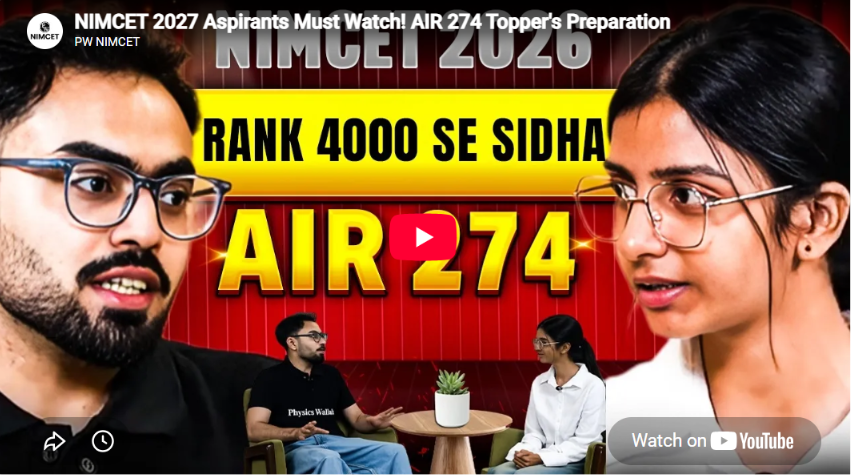
Manu Singh's journey to cracking NIMCET was far from planned. After an unsuccessful attempt at JEE Main, she completed her BSc in Mathematics, and it was only in the final year of her degree that she discovered NIMCET even existed.
With just two to three months left to prepare, her first attempt landed her an All India Rank of around 4000, enough to clear the exam, but not enough for the college she wanted. Rather than settle, she took a drop to prepare properly.
Her success on the second attempt came through a full year of structured preparation with Physics Wallah's Samarth batch, dedicated guidance from Punit Ma'am for her weakest subject, and consistent mock analysis that turned early struggles into steady improvement.
This is the story of how Manu Singh went from a rushed, underprepared first attempt to All India Rank 274 in NIMCET 2026 and a seat at MANIT Bhopal.
How Manu Singh Found NIMCET After a JEE Setback
Manu's academic foundation was always mathematics-heavy. She scored 91% in 10th and 92% in 12th, and her comfort with math was strong enough that she chose it as her core subject early on. Her first real goal, though, was JEE Mains - an attempt that didn't work out.
She explained how that setback quietly shaped her next few years:
"Fir uske baad mujhe laga tha ki matlab pehle to maine JEE Mains ke liye try kiya tha, but unluckily I failed. So fir uske baad maine BSc Mathematics ki.
After JEE didn't materialize, Manu pursued BSc Mathematics, and it was only in the final year of her degree - while exploring what to do next in the same field - that she stumbled upon NIMCET. By the time she understood what the exam involved, she barely had two to three months left before it. She joined the newly launched PW batch anyway, trusting the brand she already knew:
"Firstly mera itna wo nahi tha. Jaise mujhe 2025 mein pata chala tha ki NIMCET jaisa kuch hota hai. But us time pe I had only 2–3 months to prepare. Mera poora starting se hi bharosa PW pe tha because 11th–12th bhi maine PW se hi kari hai."
That first attempt, done in a rush with only a couple of months of preparation, landed her an All India Rank of around 4000 - enough to know she was on the right track, but not enough for the NIT she wanted. So she made a decision that changed the course of her preparation:
"Then I took a drop. Uske baad fir Samarth batch aaya tha. Maine usko start karke padhna shuru kiya."
With a full year ahead of her this time, Manu enrolled in PW's Samarth batch, ready to prepare properly instead of scrambling in the last few months.
The Subject Manu Singh Struggled With Most
Every NIMCET aspirant carries at least one subject that feels harder than the rest. For Manu, that subject was Computer Awareness - a section she had never studied formally before and one that worried her from day one of serious preparation.
"Meri computer thodi weak thi. Starting se hi weak thi."
There was also a quieter struggle running alongside the academic one. Committing to a full year of preparation meant stepping back from most social interactions, and Manu admits she leaned on an unusual companion during the isolating stretches of self-study:
"Mere friends bahut kam hain. Matlab main bahut kam friendship karti hoon. To jab main padhti thi, meri sabse zyada chatting agar kisi se hui hogi, to wo ChatGPT se hoti thi."
Between a genuinely weak subject and long, largely solitary study days, Manu had to find structured support that could actually close the gap - not just motivate her, but teach her the subject from scratch.
How Physics Wallah Helped Manu Improve Her Weakest Subject
The turning point for Computer Awareness came through Punit Ma'am's classes at PW, which Manu credits directly for making the subject click - and for questions that mirrored the actual exam.
Beyond the classroom, Manu also relied heavily on PW's Telegram community, where faculty like Shashank Sir and Keshav Sir, along with fellow aspirants, kept doubt-solving fast and constant:
"Matlab Telegram pe main koi bhi question post karti thi, to aisa nahi tha ki reply na aaye. Ek baccha, do-teen bacche, chaar-paanch bacche fatafat jawab de dete the. Wahan poora padhai ka mahaul bana hua tha."
Her actual study routine was methodical: watch the scheduled lecture, immediately solve practice questions on that topic, and if something still felt unclear, turn to supplementary YouTube lectures from Shashank Sir and Sachin Sir for a second explanation. She paired this with reference books like Arihant and RD Sharma, using AI only to clarify a leftover doubt - and reserving unresolved questions for faculty on Telegram. This layered support system - structured lectures, dedicated faculty for her weakest subject, and an always-on doubt community - is what slowly turned Computer Awareness from her biggest worry into a manageable, even comfortable, section.
How Mock Tests and PYQs Helped Manu Secure AIR 274
With her syllabus in place a few months out, Manu shifted fully into mock tests and previous year questions (PYQs) - the phase she calls non-negotiable for anyone serious about NIMCET.
Her mock scores climbed steadily as she built the habit of analyzing every mistake instead of just attempting more papers, and her PYQ practice was thorough enough that she noticed something interesting on exam day itself - even NIMCET 2026's famously tough paper repeated a question she had already prepared:
"Aur 2026 mein itna hard paper hone ke baad bhi ek PYQ hamara aaya tha."
Her mock performance had been consistently strong - regularly in the 500–600 range, which gave her a sense of quiet confidence heading into the exam. But the actual exam hall felt different, and it showed in how she felt walking out:
"Mere mocks mein 500–600 aise aate the, but jab main paper dekar ghar aayi thi, to mujhe lag raha tha ki nahi, maine achha nahi kiya. Matlab jitna main mocks mein perform kar rahi thi, utna main wahan perform nahi kar paayi."
Her actual score confirmed that gap between mock and real performance:
"Mera 31 hai."
A score far lower than her mock average, on paper, felt like a step backward. But NIMCET 2026 was an unusually difficult paper for everyone, and when results were declared, that same score translated into All India Rank 274 - comfortably enough for her to secure a seat at MANIT Bhopal, one of her genuinely preferred colleges.
What Aspirants Can Learn From Manu Singh's Journey
Manu Singh's path wasn't linear, and she is upfront about that - a failed JEE attempt, a late discovery of NIMCET, a rushed first try, and a nerve-wracking gap between her mock scores and her real exam score.
What carried her through wasn't a flawless run, but consistent habits: properly maintained notes that she revised instead of touching old copies in the final months, honest mock analysis instead of just chasing scores, and the discipline to keep working on her weakest subject until it stopped being weak.
For aspirants staring at a syllabus that feels too big or a subject that feels impossible right now, Manu's result is proof that a structured, supported preparation plan - even one that starts late - can still end in a rank worth celebrating.

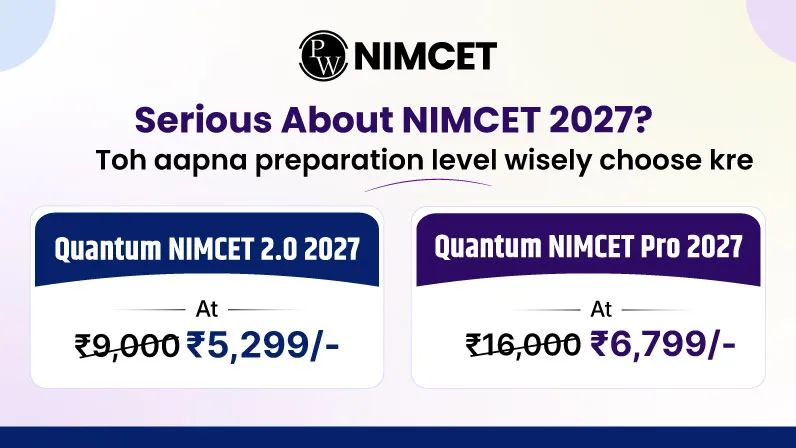






Get Free Counselling Today
and Clear up all your Doubts
 Live & recorded classes available at easeDashboard for progress trackingLakhs of practice questions

