






NCERT Solutions for Class 3 EVS Chapter 11 From Here to There
 Neha Tanna18 Aug, 2025
Share
NCERT Solutions for Class 3 EVS Chapter 11: NCERT Solutions for Class 3 EVS Chapter 11 From Here to There introduces children to different modes of transport. It explains how people move from one place to another using various means like buses, trains, bicycles, boats, and airplanes. These from here to there class 3 EVS question answers help students learn through relatable examples.
The chapter encourages children to observe how transport has evolved over time, and the importance of roads, railways, and waterways. It also emphasizes the role of transportation in daily life and helps students understand its impact on our environment. Through simple exercises, the chapter promotes awareness of traffic rules and safety measures while traveling.
NCERT Solutions for Class 3 EVS Chapter 11 Overview
From Here to There Class 3 EVS is an essential chapter that introduces young learners to the concept of transportation and its significance in daily life. It explains the various modes of transport such as land, water, and air, highlighting how they help people move from one place to another. This EVS Class 3 Chapter 11 question answer section is designed to make learning interactive and engaging.
This chapter is important as it not only teaches students about the development and diversity of transport but also encourages them to appreciate its role in making travel and communication easier. Additionally, it promotes awareness about traffic safety and the environmental impact of different transport systems. The chapter fosters observational and critical thinking skills through engaging activities and examples, helping students understand the importance of transportation in modern society and its contribution to connecting people and places efficiently.
NCERT Solutions for Class 3 EVS Chapter 11 PDF
Below is the From Here to There Class 3 EVS PDF for the ease of the students so they can download it and access it offline. These Class 3 EVS Chapter 11 question answers cover all exercises in a simple and clear manner.NCERT Solutions for Class 3 EVS Chapter 11 PDF
NCERT Solutions for Class 3 EVS Chapter 11 From Here to There
NCERT Solutions for Class 3 EVS Chapter 11 From Here to There give clear answers to all questions, helping students understand transportation through land, water, and air. These solutions cover the From Here to There class 3 EVS question answer and class 3 EVS chapter 11 question answer in a simple, exam-friendly way.THE TRAIN
Question 1 :
How did you like the poem?Answer :
I loved the poem.Question 2 :
Have you ever travelled in a train? When?Answer :
Yes, I always take the train when we visit my grandmother during the summer.Question 3 :
Can a train move anywhere? Why?Answer :
A train cannot move in any direction. It is limited to moving on rails or tracks.Question 4 :
What is meant by ‘roads of iron’?Answer :
Roads of iron means iron rails on which the train moves.Question 5 :
What places did the train pass by? Make a list.Answer :
The train went past fields with beautiful greenery and a potato field, as well as farmers, hills, mills, villages and wells.Question 6 :
Which vehicles have you travelled in? Write their names in your notebook.Answer :
I have travelled in a bicycle, bike, auto, car, bus, train and aeroplane.Question 7 :
Which all vehicles did the children travel in? _______________ _______________ _______________ _______________ _______________ _______________ _______________ _______________ _______________Answer :
Children travelled in: 1. Bus 2. Train 3. Car 4. Flight 5. Taxi 6. Cycle 7. Boat 8. Horse 9. RickshawQuestion 8 :
How would you choose to go from your house to the places written below? Write in the box.Answer :

Question 9 :
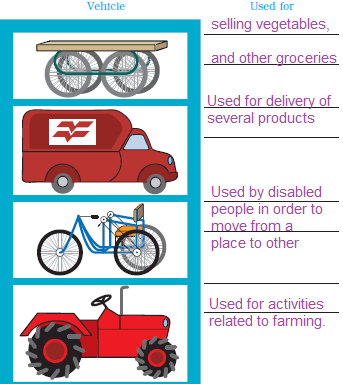
Write in front of each picture what the vehicle is used for. In the spaces provided, draw the pictures of some other vehicles. Write their names and what they are used for. Are all these vehicles used for our travel?Answer :

Question 10 :
Names of some vehicles are given in the centre of a wheel. Join these on one side to the number of wheels each vehicle has and on the other, join them to what is used to run them.Answer :
| Vehicle | Number of Wheels | Driven By |
| Bus | 4 or more than 4 | Humans, diesel/petrol |
| Bullock-cart | 2 | Animals |
| Cart | 2 or 4 | Humans |
| Scooter | 2 | Humans, petrol/diesel |
| Rickshaw | 3 | Humans |
| Car | 4 | Humans, petrol/diesel/gas |
| Metro Rail | More than 4 | Humans, electricity |
| Train | More than 4 | Humans, petrol/electricity |
| Boat | None | Humans |
| Truck | 4 or more than 4 | Humans, petrol/diesel |
| Bicycle | 2 | Humans |
| Motorcycle | 2 | Humans, petrol/diesel |
Question 11 :
Find out from your elders – How did people travel fifty years ago? Were the present means of travel available at that time also?Answer :
The first humans travelled fifty years ago on bullock carts, buses, trains, automobiles, taxis, bicycles, and other means. Yes, there were some of the modern forms of transportation available back then, like cars, buses, trains, cabs, etc.Question 12 :
Can you imagine which vehicles people will use for travel twenty years from now? Ask your family members and friends and fill in the table. You can add more –Answer :
| Whom You Asked | Their Answer |
| You | Solar-powered bicycles |
| Friend | Battery/electricity motorcycles |
| Chacha | Solar-powered cars |
| Teacher | Electronic public transports |
| Mummy | Electronic small cars |
| Daddy | Solar-powered taxis |
YOUR OWN TRAIN
Question 1 :
If anybody makes a ‘chhuk-chhuk’ sound you know at once that it is being made for a train. From the sounds given below can you tell which vehicle it is? One example is given.Answer :
| Chhuk-chhuk | Train |
| Peen-peen | Scooter |
| Pon-Pon | Truck |
| Tup-tup | Horse-cart |
| Gharr-gharr | Motorcycle |
| Tring-tring | Bicycle |
Question 2 :
These are the sounds of single vehicles. How does it sound when many vehicles run together on the road making different noises? Isn’t there a lot of noise?Answer :
In fact, a lot of noise is present. Numerous cars running together on the road produce an unsettling noise as a group.Question 3 :
Where have you heard the maximum noise?Answer :
At the traffic signals.Question 4 :
Do you like so much noise? Why? Answer: No, I don’t like so much noise because it is very disturbing.Question 5 :
What all can you see in the picture?Answer :
One of the buildings in the image is on fire. Firefighters are attempting to extinguish it. There's an ambulance, a police vehicle, and two fire trucks.Question 6 :
Which vehicles can you see in the picture?Answer :
Fire-trucks, police-van and ambulance.Question 7 :
What are these vehicles usually used for?Answer :
Firefighters utilise fire vehicles, also known as fire-brigade vans, to respond to any area that has caught fire. There is a lot of water, as well as aerial and ground ladders, in the fire vehicles. Police officers travel from one location to another in a police van. Patients are transported in ambulances.Question 8 :
Look at the boxes in the picture on the top. Draw them in the correct sequence in the bottom boxes and colour. What did you get? Write its name.Answer :

Benefits of NCERT Solutions for Class 3 EVS Chapter 11
The From Here to There Class 3 EVS question answer set offers several benefits:Concept Clarity : Solutions provide a clear and concise explanation of transportation, helping students understand various modes of transport, their uses, and importance.
Easy Learning : The solutions break down complex topics into simple, child-friendly language, making it easier for young learners to grasp.
Enhanced Problem-Solving : By practicing the provided solutions, students improve their problem-solving skills and can answer questions with more confidence.
Better Retention : Engaging explanations and practical examples help students retain concepts for a longer time.
Exam Preparation : Well-structured solutions help students prepare effectively for exams, covering all important points and questions in the chapter. Join Online Tuition Class for Kids Now!!
NCERT Solutions for Class 3 EVS Chapter 11 FAQs
How would you keep yourself safe while travelling EVS?
What is the meaning of roads of Iron?
Can a train move everywhere?
What are vehicles class 3?
What is one safety rule that we must follow while travelling?




 Live & recorded classes available at easeDashboard for progress trackingMillions of practice questions at your fingertips

