






NCERT Solutions for Class 5 EVS Chapter 11 Sunita in the Space
Delve into Class 5 EVS Chapter 11 NCERT Solutions, detailing Sunita's space journey. Simple, clear explanations perfect for young learners.
 Jasdeep Bhatia11 Apr, 2024
NCERT Solutions for Class 5 EVS Chapter 11
Explore the straightforward NCERT Solutions for Class 5 EVS Chapter 11 : Sunita in Space, an engaging part of the Class 5 EVS syllabus that takes students on a journey into the vastness of space with Sunita, providing insights into the life of an astronaut and the wonders of the universe. To fully understand the concepts and information presented in this chapter, students can turn to the NCERT solutions crafted by educational specialists. Excelling in exams is vital for students, and completing the exercises in the NCERT Class 5 EVS textbook is key to success. Nevertheless, some exercises might pose challenges. To support them, NCERT Solutions for Class 5 EVS Chapter 11, in line with the CBSE curriculum and created by our team of expert educators, are available to resolve any queries.
NCERT Solutions for Class 5 EVS Chapter 11 Overview
In Chapter 11 of the Class 5 EVS textbook, titled "Sunita in Space," children embark on an exciting exploration of an astronaut's journey through space. This chapter unveils interesting facts and insights about space travel and astronaut life. For students aiming for excellence in their exams and looking for extra assistance with this chapter, the Curious Jr guide is an excellent aid. Scoring well is crucial, and diligently completing the exercises in the Class 5 EVS book plays a significant role in achieving this goal. But, should students come across any challenging exercises, there's no need for concern! The Curious Jr guide for Chapter 11 has been specifically designed for such instances, perfectly aligned with the school curriculum. Crafted by expert educators, this guide effectively resolves any queries, making the learning journey into space both fun and educational.Related Links -
NCERT Solutions for Class 5 EVS PDF Download
The NCERT solutions for Class 5 EVS Chapter 11, titled "Sunita in Space," offer a streamlined approach to studying by breaking down the chapter into smaller, easier-to-understand sections. These solutions are designed to help students grasp the concepts more effectively and boost their academic performance. They are especially useful for Class 5 students, laying a solid foundation for tackling more complex subjects in the future. Adhering to these solutions is crucial for students aiming for the highest marks in their exams. Moreover, utilizing NCERT solutions to review the material helps students accurately gauge their exam preparedness. This article presents links to the NCERT solutions for Class 5 EVS Chapter 11, Sunita in Space. Accessing these resources will arm Class 5 students with the essential tools needed for their educational journey, using straightforward language to ensure comprehension without directly copying content, thereby maintaining originality.NCERT Solutions for Class 5 EVS PDF Download
NCERT Solutions for Class 5 EVS Chapter 11 Sunita in the Space
NCERT Solutions for Class 5 EVS Chapter 11 Sunita in Space provides clear and thorough answers to every question in this chapter. These solutions help Class 5 students dive into the exciting journey of Sunita in space, exploring concepts of space travel and life as an astronaut. By studying these materials, learners can expand their knowledge of space and its mysteries. Crafted by education experts, these solutions are concise and focused on helping students efficiently complete their homework and prepare confidently for their exams. Access to all the answers for the NCERT Class 5 EVS textbook questions for Chapter 11 is available here, free of charge. Next, we’ll delve into the solutions for Sunita in the Space.NCERT Solutions for Class 5 EVS Chapter 11
Straight from the heart
Question: What do you think the earth looks like? Make a drawing of the earth in your notebook. Answer: The Earth looks like a sphere, covered in blue (water) and green/brown (land) when viewed from space.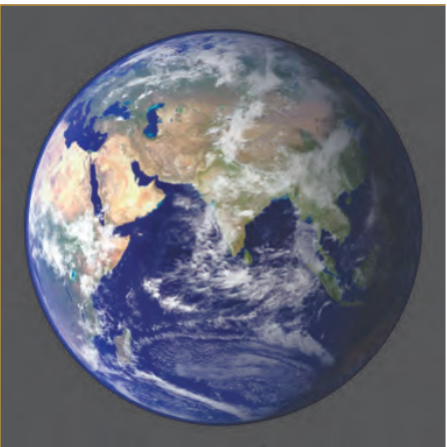
What do you think
Question: If the earth is round like a globe, how is it that we do not fall off? Answer: Earth's gravity pulls everything towards its center, preventing us from falling off. Question: Do the people in Argentina stand upside down? Answer: No, because of gravity, everyone on Earth feels like they are standing upright, regardless of their location.Look at the Photograph and Write
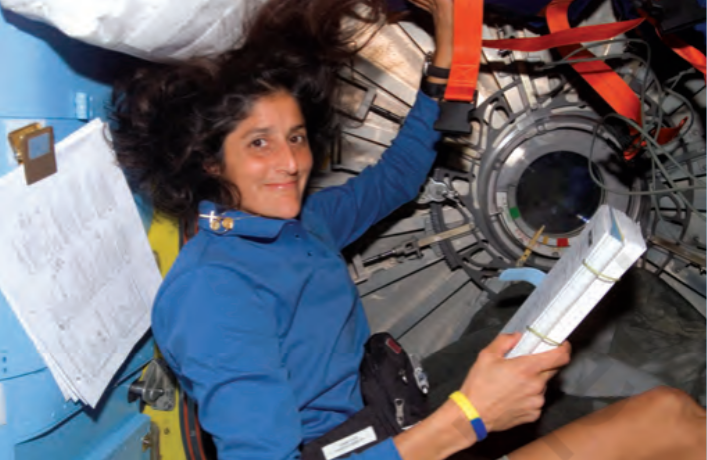 Question: Can you think why Sunita’s hair was standing?
Answer: Sunita's hair was standing because of the zero gravity in space, making everything float.
Question: Look at Sunita’s photographs and the dates written on each of them. Write what all is happening and when?
Question: Can you think why Sunita’s hair was standing?
Answer: Sunita's hair was standing because of the zero gravity in space, making everything float.
Question: Look at Sunita’s photographs and the dates written on each of them. Write what all is happening and when?
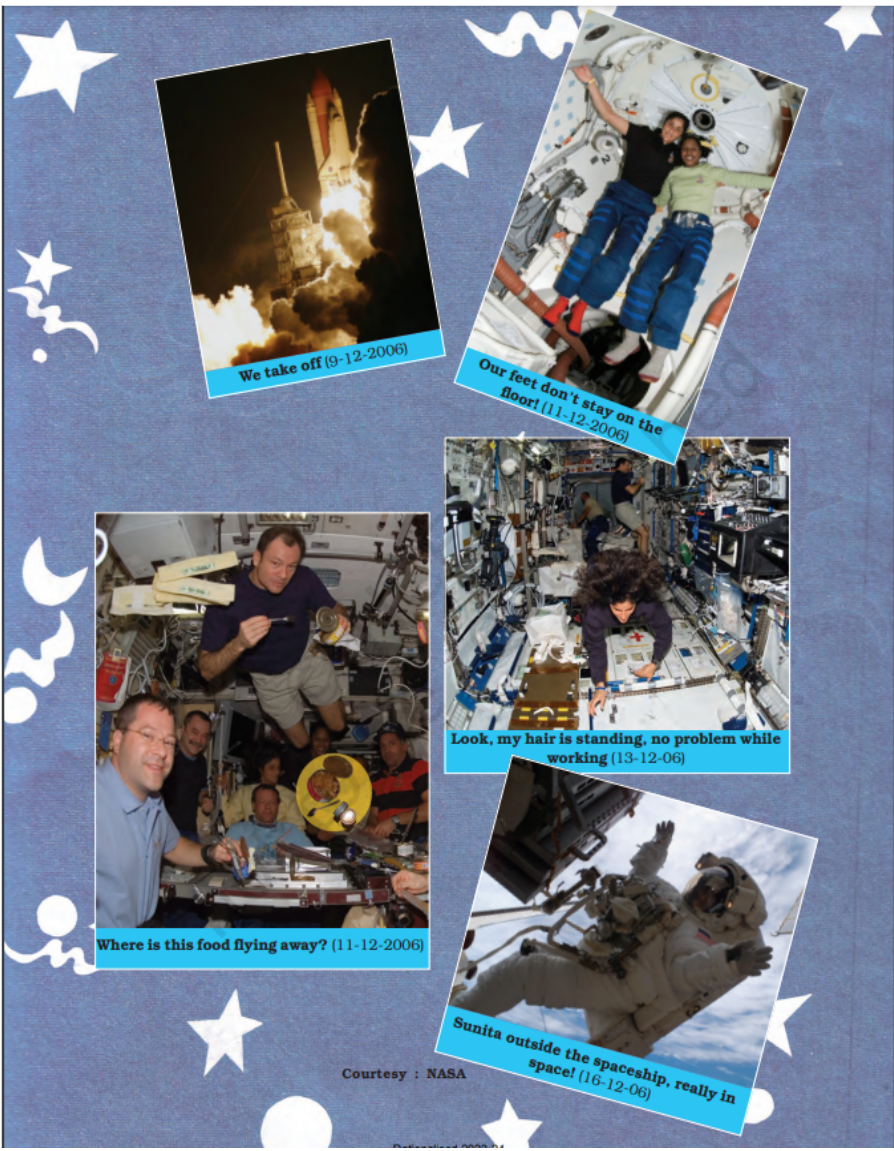 Answer: The dates and photos capture various moments of Sunita's space mission, including takeoff, daily activities in space, and spacewalking.
The Classroom becomes a Spaceship
Question: Close your eyes. Imagine that your class is a spaceship. Now say:- Are you able to sit at one place?
- What about your hair?
- Oh, look ... where are your bags and books going?
- And what is your teacher doing? Where is her chalk?
- How did you eat your food during the break? How did you drink water? What happened to the ball that you threw up?
Isn’t it amazing?
Question: Can you now say why Sunita’s hair kept standing? Answer: Sunita’s hair kept standing due to the absence of gravity in space. Question: Think why water flows downwards on any slope. On mountains too water flows downwards not upwards. Answer: Water flows downwards due to Earth's gravitational force pulling it towards the center.Magic 1 – A tiny paper races a coin
Question: Take a 5 rupee coin and a small piece of paper.- Hold the coin in one hand and the paper in the other. Drop them at the same time. What happened?
- Now place the tiny paper on the coin and drop them. What happened this time? Surprised! Answer: The coin falls faster when dropped separately due to less air resistance, but when the paper is placed on the coin, they fall at the same speed, showing how air resistance affects falling objects.
Magic 2 – A mouse lifts an elephant
Question: To play this you will need a small stone, a bigger stone, a thick roll of paper, a mouse, and an elephant made of paper.- Take a string about 2 feet long.
- At one end of the string tie the small stone.
- Stick or tie the mouse to the stone.
- Put the string into the roll of paper.
- At the other end of the string tie the bigger stone and stick the elephant.
- Hold the roll of paper and move your hand to rotate the small stone
- Who is pulling whom? You will be surprised! The mouse lifts the elephant!
- How did this magic happen? Answer: When you spin the small stone fast, which is the mouse, it pulls up on the big stone, the elephant. It's because spinning the stone fast makes a force that lifts the elephant up.
Look at this photograph and tell
Question: Can you see India?
Answer:
Yes, on the globe, India is clearly visible with its distinct geographical boundaries.
Question: Can you recognize any other place?
Answer:
Sri Lanka is also recognizable near India, marked by its island shape on the globe.
Question: Where is the sea?
Answer:
The sea is shown in blue on the globe, indicating water bodies surrounding the continents.
Question: Do you find anything similar between the globe and this picture of the earth? In what ways are they different?
Answer:
Both the globe and the picture of the earth depict land and water, making it easy to differentiate between them. However, identifying specific countries or cities is more straightforward in the picture of the earth than on the globe due to the detailed representations.
Question: Do you think Sunita could make out Pakistan, Nepal, and Burma separately, when she saw the earth from space?
Answer:
From space, distinguishing individual countries like Pakistan, Nepal, and Burma is challenging, as specific country outlines are not easily visible from such a great distance.
Look at the globe in your school and tell
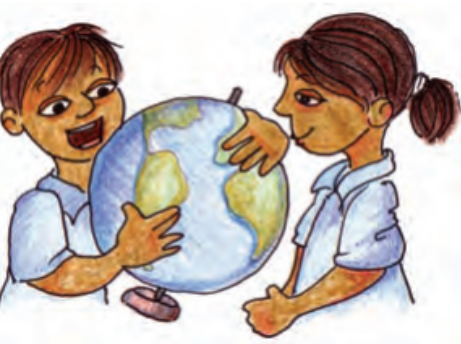 Question: Can you find India?
Answer:
Yes, India can be easily identified on the globe due to its distinct geographical location.
Question: Where all do you find the sea?
Answer:
The sea is represented by the blue color, covering vast areas on the globe around the continents.
Question: Which countries can you see?
Answer:
I can observe various countries across the globe including India, the USA, Australia, South Africa, China, Germany, and countries in Europe.
Question: Can you see some of the countries with which India plays cricket matches?
Answer:
Yes, countries like England, Australia, Pakistan, Bangladesh, and South Africa, with whom India plays cricket, are visible.
Question: What else can you see on the globe?
Answer:
Besides seas and countries, the globe also displays islands, mountain ranges, and other geographical features.
Question: Can you find India?
Answer:
Yes, India can be easily identified on the globe due to its distinct geographical location.
Question: Where all do you find the sea?
Answer:
The sea is represented by the blue color, covering vast areas on the globe around the continents.
Question: Which countries can you see?
Answer:
I can observe various countries across the globe including India, the USA, Australia, South Africa, China, Germany, and countries in Europe.
Question: Can you see some of the countries with which India plays cricket matches?
Answer:
Yes, countries like England, Australia, Pakistan, Bangladesh, and South Africa, with whom India plays cricket, are visible.
Question: What else can you see on the globe?
Answer:
Besides seas and countries, the globe also displays islands, mountain ranges, and other geographical features.
Look at the map of your country and tell
Question: Can you find the state in which you live? Write its name on the map. Answer: Yes, I found Punjab on the map, the state where I live. Question: Which are the states next to the state you live in? Answer: The states bordering Punjab are Haryana, Himachal Pradesh, Jammu and Kashmir, and Rajasthan. Question: Have you been to any other state? Answer: I have visited neighboring states like Haryana, Himachal Pradesh, and Rajasthan. Question: Shahmir thinks that there are lines drawn on the ground between the states. What do you think? Answer: I think those lines are only present on maps to show boundaries and are not actually drawn on the ground.Look at the sky
Question: Why don’t you try to do the same with a coin? How many centimetres away from the eye did you keep the coin to hide the moon? Answer: To hide the moon completely, the coin needs to be held at a specific distance, showcasing how objects can appear larger or smaller depending on their distance from the observer.Think
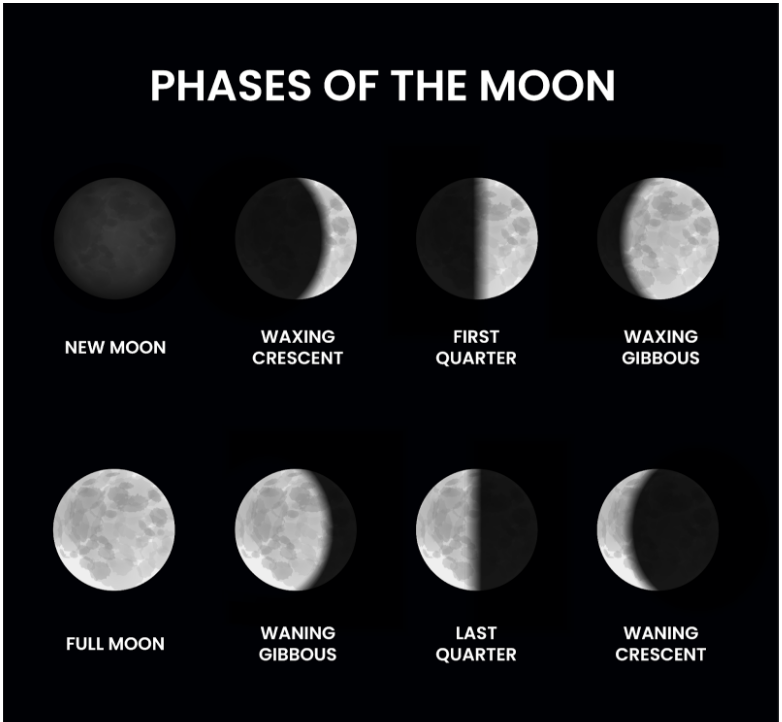
Question: Do you think the moon is flat like the coin or round like a ball? Answer: The moon is round like a ball, not flat. Question: Look at the moon tonight and draw what it looks like. Look and draw again after one week and then after 15 days. Answer: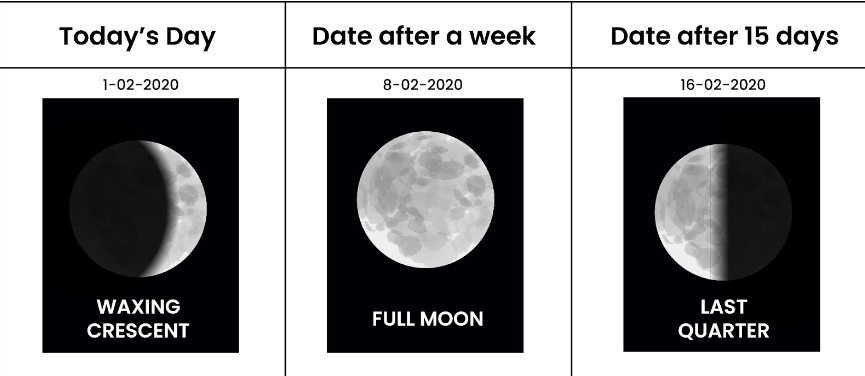
Find out
Question: When is the next full moon? At what time will the moon rise on this day? What does the moon look like on this day? Draw it. Answer: The date and time of the next full moon vary, but it appears as a complete white circle in the sky.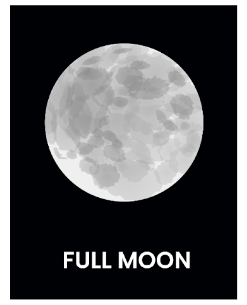 Question: What are the festivals related to the moon?
Answer:
Festivals like Karwa Chauth, Holi, and Eid are related to the moon.
Question: At night, look at the sky carefully for 5 minutes. What could you see? Did you see anything moving in the sky? What do you think it could be? A star or a shooting star or a satellite?
Answer:
Observing the night sky might reveal the moon, stars, and possibly moving objects like satellites or shooting stars, depending on their speed and trajectory.
Question: What are the festivals related to the moon?
Answer:
Festivals like Karwa Chauth, Holi, and Eid are related to the moon.
Question: At night, look at the sky carefully for 5 minutes. What could you see? Did you see anything moving in the sky? What do you think it could be? A star or a shooting star or a satellite?
Answer:
Observing the night sky might reveal the moon, stars, and possibly moving objects like satellites or shooting stars, depending on their speed and trajectory.
Look at the table and tell
Question: Given below are the times at which the moon rises and sets in Delhi (on the given days).| Date | Time of moon rise (hours : minutes) | Time of moon set (hours : minutes) |
| 28-10-2007 | 19:16 | 08:50 |
| 29-10-2007 | 20:17 | 10:03 |
| 30-10-2007 | 21:22 | 11:08 |
| 31-10-2007 | 22:29 | 12:03 |
- On 28 October the moon came out at ___ minutes past ___ o’clock.
- On 29 October the moon came out at ___ minutes past ___ o’clock.
- On 29 October there was a difference of ___ hours and ___ minutes in the time of the moon rise (as compared to 28 October).
Answer:
- On 28 October, the moon came out at 16 minutes past 7 o’clock.
- On 29 October, the moon came out at 17 minutes past 8 o’clock.
- On 29 October, there was a difference of 1 hour and 1 minute in the time of the moon rise (as compared to 28 October).
An interesting photograph!
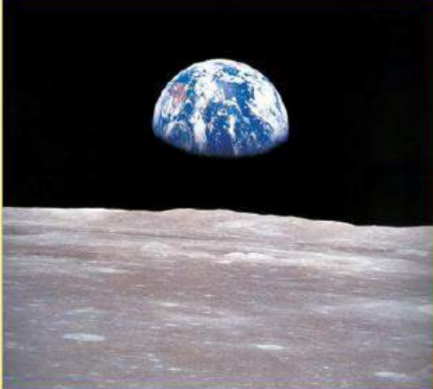 Question: A spaceship went to the moon. This photograph of the earth was clicked from the surface of the moon. See how the earth is looking. Can you see the surface of the moon? Do you have some questions after looking at this picture? Write down those questions and discuss them in the class.
Answer:
The surface of the moon is indeed visible. Looking at the photo, I'm curious about several things:
Question: A spaceship went to the moon. This photograph of the earth was clicked from the surface of the moon. See how the earth is looking. Can you see the surface of the moon? Do you have some questions after looking at this picture? Write down those questions and discuss them in the class.
Answer:
The surface of the moon is indeed visible. Looking at the photo, I'm curious about several things:
- Who clicked this picture on the moon?
- What steps did they take to land there?
- Is there anything like water or air on the moon?
- Why is the moon so full of holes and bumps?
- What is it like to walk on the moon?
- Can anything grow on the moon?
What we have learnt
Question: Why do children always slide down the slide and not slide up? If this slide were there in Sunita’s spacecraft, would children slide like this? Why? Answer: Children slide down due to Earth's gravity. In space, the absence of gravity would prevent sliding in the usual way; instead, they would float.Question: Why do we see stars mostly at night?
Answer: Stars are mostly visible at night because the absence of sunlight allows us to see their light. Question: Looking at Earth from space, Sunita said, “Different countries cannot be seen as separate from here. These lines are on paper. They are made by us.” What do you understand by this? Answer: This statement highlights that political boundaries are human-made and not visible from space, emphasizing the unity and continuity of Earth's surface as seen from space.Importance of NCERT Solutions for Class 5 EVS Chapter 11
The NCERT solutions for Class 5 EVS Chapter 11, "Sunita in Space," serve as an invaluable learning tool for students fascinated by space exploration and the life of astronauts. These solutions walk students through the extraordinary journey of Sunita in space, providing clear and simple explanations of complex concepts related to space travel, life in zero gravity, and observations of Earth from space. By studying these solutions, students can broaden their understanding of important topics in environmental studies, such as the effects of space travel on the human body, the challenges of living in space, and how astronauts conduct scientific research in orbit. This foundational knowledge helps students appreciate the challenges and triumphs of space exploration and its significance in expanding our knowledge of the universe.Benefits of NCERT Solutions for Class 5 EVS Chapter 11
NCERT Solutions for Class 5 EVS Chapter 11, "Sunita in Space," open up a world of discovery for young minds curious about space exploration and the experiences of astronauts. Here are the advantages of using these solutions:- Comprehensive Grasp of Space Concepts: This chapter invites students into the world of space travel, exploring astronaut Sunita's adventures. The solutions enrich students' understanding with detailed explanations, helping them master the essentials of this exciting subject.
- Enhanced Curiosity and Inquiry: The detailed solutions encourage students to delve deeper into the life of an astronaut, the conditions in space, and celestial phenomena. This stokes their natural curiosity and develops their investigative skills.
- Examination Preparedness: The solutions address all the key questions from the chapter, equipping students with the knowledge to face their exams with confidence and ensuring they're ready to answer questions thoughtfully.
- Doubt Resolution: Anytime students encounter complexities within the chapter, the NCERT Solutions are there to demystify concepts with clarity, thus reinforcing their understanding and self-assurance in the subject matter.
- Interactive Learning: Alongside the solutions, additional resources like diagrams of spacecraft, engaging activities about life in space, and studies on gravity's effects make learning an active and enjoyable process.
- CBSE Syllabus Compliance: Tailored to align with the CBSE syllabus for Class 5 EVS, these solutions ensure that students' learning is focused on the curriculum, aiding in efficient study and optimal exam preparation.
NCERT Solutions For Class 5 EVS Chapter 11 FAQs
Who was the first person to walk on the moon?
The first person to walk on the moon was an astronaut named Neil Armstrong.
What do astronauts wear in space?
Astronauts wear special suits called spacesuits that help them breathe and protect them from space's dangers.
How do astronauts eat in space?
Astronauts eat food that is specially packed to not float away in space, and they drink water from special bags.
Can we see other planets from the moon?
Yes, just like from Earth, you can see other planets from the moon, but they look like bright stars.
Does the moon have days and nights?
Yes, the moon has days and nights, but they are longer than on Earth, lasting about two weeks each.
Why does the moon look different on different days?
The moon looks different due to its phases, which change as it moves around Earth and is lit differently by the sun.
What is gravity, and is it the same on the moon?
Gravity is the force that keeps us on the ground. It's weaker on the moon, so you would feel much lighter there.





Check out these Related Articles

Join 15 Million students on the app today!
 Live & recorded classes available at easeDashboard for progress trackingMillions of practice questions at your fingertips


Free Learning Resources
PW Books
Notes (Class 10-12)
PW Study Materials
Notes (Class 6-9)
Ncert Solutions
Govt Exams
Our Other Websites
Class 6th to 12th Online Courses
Govt Job Exams Courses
UPSC Coaching
Defence Exam Coaching
Gate Exam Coaching
Other Exams
Know about Physics Wallah
Physics Wallah is an Indian edtech platform that provides accessible & comprehensive learning experiences to students from Class 6th to postgraduate level. We also provide extensive NCERT solutions, sample paper, NEET, JEE Mains, BITSAT previous year papers & more such resources to students. Physics Wallah also caters to over 3.5 million registered students and over 78 lakh+ Youtube subscribers with 4.8 rating on its app.
We Stand Out because
We provide students with intensive courses with India’s qualified & experienced faculties & mentors. PW strives to make the learning experience comprehensive and accessible for students of all sections of society. We believe in empowering every single student who couldn't dream of a good career in engineering and medical field earlier.
Our Key Focus Areas
Physics Wallah's main focus is to make the learning experience as economical as possible for all students. With our affordable courses like Lakshya, Udaan and Arjuna and many others, we have been able to provide a platform for lakhs of aspirants. From providing Chemistry, Maths, Physics formula to giving e-books of eminent authors like RD Sharma, RS Aggarwal and Lakhmir Singh, PW focuses on every single student's need for preparation.
What Makes Us Different
Physics Wallah strives to develop a comprehensive pedagogical structure for students, where they get a state-of-the-art learning experience with study material and resources. Apart from catering students preparing for JEE Mains and NEET, PW also provides study material for each state board like Uttar Pradesh, Bihar, and others
Copyright © 2026 Physicswallah Limited All rights reserved.