






Agriculture of Bihar, Crops, Agricultural Problems in Bihar
Agriculture of Bihar has been discussed here in this article. Get details of the Agriculture of Bihar, the Cropping System, and the Problems of Agriculture in Bihar.
 Priyanka Gupta31 May, 2024
Share
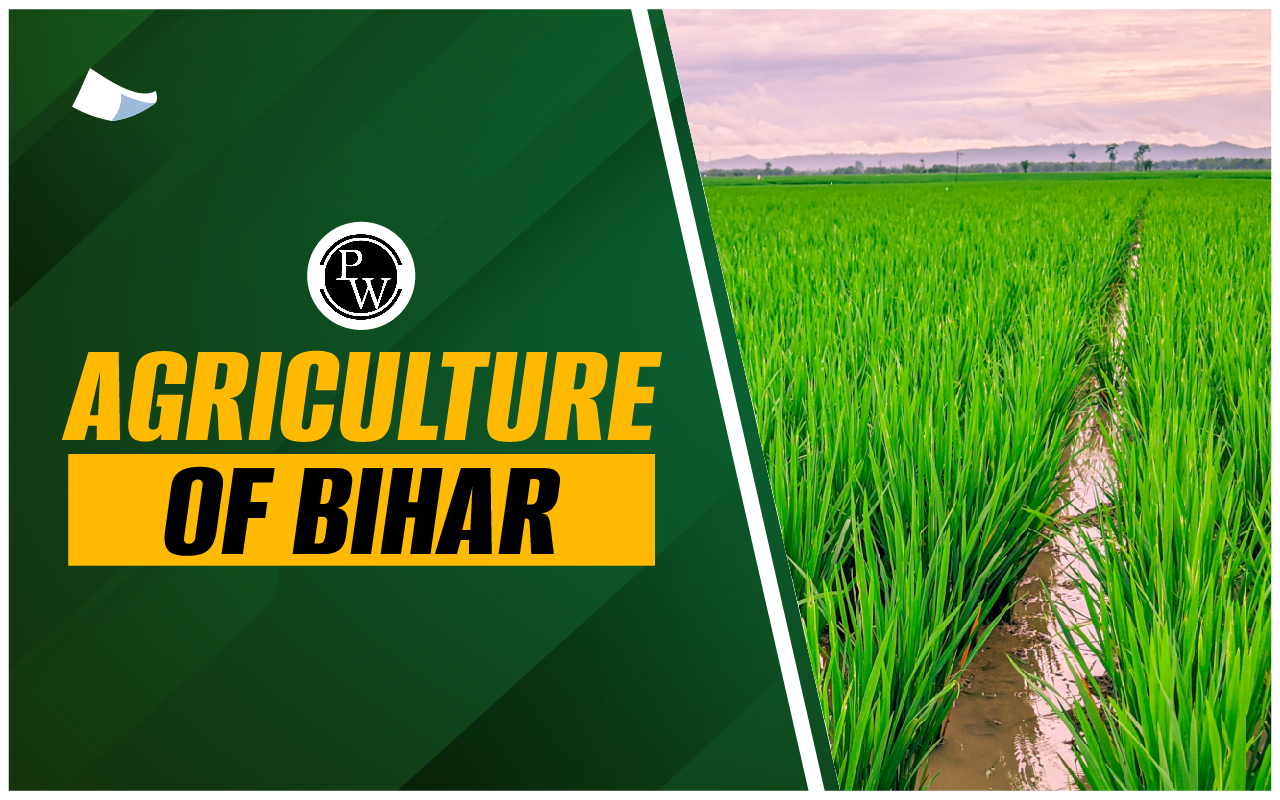
Agriculture of Bihar: This sector is ready for expansion, as India is currently among the greatest agricultural producers in the world in terms of value. Bihar is one of India's leading agricultural states, employing over 60% of the workforce and contributing over 17% of the country's GDP.
But on the eve of independence, Bihar's agricultural sector was in a very sorry condition of affairs in terms of the Indian economy. Agriculture, the most important industry, was facing stagnation and economic deterioration. In terms of GDP contribution and as a source of employment for the majority of the population, agriculture plays a major role in the Indian economy.Agriculture of Bihar
Agriculture of Bihar: Bihar is situated in the river lowlands of the Ganges River basin. It boasts a wealth of groundwater resources and productive alluvial soil. Bihar's agriculture is therefore rich and varied. Rice, wheat, and corn are the three principal cereal crops. Bihar is the home of pulses such arhar, urad, moong, gram, pea, lentils, and khesari. Bihar is a major producer of potatoes, onions, eggplants, and cauliflower. Regarding fruit production, it ranks third in the world for pineapple, first for lychee, and significantly higher for mango, banana, and guava. Two additional significant revenue crops in Bihar are jute and sugarcane.Agriculture of Bihar Cropping System
Sixty percent of Bihar's land area is under cultivation. This percentage is far higher than India's national average of 42%. There are two reasons why such a large percentage of land might be under cultivation. First off, Bihar is mostly a plain area with good agricultural potential. Second, the woodland had been mostly cleared for agriculture during the preceding two millennia. Presently, woods cover about 6 percent of the land. Although South Bihar is a thriving agricultural center, North Bihar is limited by its physical susceptibility to floods and droughts. In the south, the Ahar-Pyne Agriculture of Bihar System has been used for crop production for a very long time.Agriculture of Bihar Food Grains
Rice is farmed in every district in Bihar. Autumn rice, Aghani rice, and summer rice are the three varieties of rice that are grown at different times of the year. The average yearly production of rice is about 5 million tonnes. Fifty years ago, most of western Bihar was home to wheat agriculture. Due to the success of the "green revolution," Bihari farmers expanded the amount of wheat they planted, and today it's the primary crop of the rabi season. The yearly production of wheat is between 4 and 4.5 million metric tons. In addition, maize is farmed, with an output trend that is consistently increasing and an average yearly production level of about 1.5 million metric tons. The primary producing regions are Saharsa and Khagaria.Agriculture of Bihar Horticulture
Bihar is one of India's leading producers of fruits and vegetables, with 9.8 and 6.7 percent of the country's total production, respectively. It ranks third among other states in terms of producing fruits and vegetables, and sixth overall.Agriculture of Bihar Fruticulture
Bihar is one of the major producers of fruits and vegetables in the country. Bihar produces 71% of all litchi produced annually in India. Makhana, which is grown on about 5000 hectares across the country, produces 90% of the fox nuts used worldwide. It scores well for mango, banana, and guava production, and it ranks third for pineapple output. Due to the higher financial returns, few farmers in Bihar are moving to strawberry growing. Growing kamalam (dragon fruit) has also been encouraged by a higher economic return for farmers. Nowadays, only a few of farmers in Bihar grow corrigendum, one of the most costly crops in the world.Agriculture of Bihar Animal Husbandry
- The Dairy Co-operative was founded in 1983 to supervise the operations of multiple local milk unions.
- The government formally opened Nalanda, the largest automation-based dairy plant in eastern India, in 2013.
- Sudha came into being as a result of the White Revolution. By the end of the following three to four months, the organization planned to establish two more dairy factories in the districts of Bhagalpur and Purnea, with a combined capacity of 2 lakh liters per day. This agreement was made in January 2021.
- The construction of new plants would increase the income of the milk producers in the area.
- In 2020, the Bihar government started running a 300 MT animal feed mill and a 5 lakh liter dairy facility per day in Bihian.
- The government had granted Comfed the first installment of Rs 53 crore, out of a total of Rs 234 crore, for the building of dairy facilities and animal feed plants around the state.
- In 2018, Bihar State Milk Cooperative Federation, also known as Sudha, aimed to consolidate its market in Guwahati before expanding to other Northeastern states.
Problems of Agriculture in Bihar
Despite being one of the top producers of fruits and vegetables, the state of Bihar nevertheless faces a variety of challenges related to agriculture. The following problems keep the state from realizing its full potential:- Inconsistent Monsoon
- Lack of marketing and food processing facilities forces farmers to sell their products for less than their true value.
- Because seeds are so expensive, most farmers—especially small and marginal farmers—do not have access to high-quality seeds.
- Weeds Because of the high risk and unpredictability of the agro-climatic zones, prices, productivity, etc., investing in the agricultural sector has become difficult.
Agriculture of Bihar FAQs
Q1. What is Bihar’s contribution to Makhana production?
Ans. Bihar contributes 85% of national Makhana production.
Q2. When was the dairy cooperative of Bihar established?
Ans. The Dairy Co-operative was established in 1983.
Q3. What percentage of Bihar’s sown area is covered by vegetable farming?
Ans. Approximately 11% of the state's gross sown area is currently covered by vegetable farming.
Q4. What percent of India’s litchi is produced in Bihar?
Ans. 71% of India's annual litchi production is produced in Bihar.
🔥 Trending Blogs


Talk to a counsellorHave doubts? Our support team will be happy to assist you!


Check out these Related Articles









Join 15 Million students on the app today!
 Live & recorded classes available at easeDashboard for progress trackingMillions of practice questions at your fingertips


Free Learning Resources
PW Books
Notes (Class 10-12)
PW Study Materials
Notes (Class 6-9)
Ncert Solutions
Govt Exams
Our Other Websites
Class 6th to 12th Online Courses
Govt Job Exams Courses
UPSC Coaching
Defence Exam Coaching
Gate Exam Coaching
Other Exams
Know about Physics Wallah
Physics Wallah is an Indian edtech platform that provides accessible & comprehensive learning experiences to students from Class 6th to postgraduate level. We also provide extensive NCERT solutions, sample paper, NEET, JEE Mains, BITSAT previous year papers & more such resources to students. Physics Wallah also caters to over 3.5 million registered students and over 78 lakh+ Youtube subscribers with 4.8 rating on its app.
We Stand Out because
We provide students with intensive courses with India’s qualified & experienced faculties & mentors. PW strives to make the learning experience comprehensive and accessible for students of all sections of society. We believe in empowering every single student who couldn't dream of a good career in engineering and medical field earlier.
Our Key Focus Areas
Physics Wallah's main focus is to make the learning experience as economical as possible for all students. With our affordable courses like Lakshya, Udaan and Arjuna and many others, we have been able to provide a platform for lakhs of aspirants. From providing Chemistry, Maths, Physics formula to giving e-books of eminent authors like RD Sharma, RS Aggarwal and Lakhmir Singh, PW focuses on every single student's need for preparation.
What Makes Us Different
Physics Wallah strives to develop a comprehensive pedagogical structure for students, where they get a state-of-the-art learning experience with study material and resources. Apart from catering students preparing for JEE Mains and NEET, PW also provides study material for each state board like Uttar Pradesh, Bihar, and others
Copyright © 2026 Physicswallah Limited All rights reserved.