






Forests in Bihar, List, Types, Percentage of Area, Map
 Bhavya Upadhyay10 Sept, 2024
Forests in Bihar: Bihar, one of India’s most historically rich states, is specifically known for its fertile grassland, yet it also stands as an example of significant forested areas that play a vital role in its ecological balance. While Bihar is specifically recognized for its agricultural output, the forests in Bihar are equally important for the conservation of biodiversity, supporting livelihoods, and mitigating climate change. We have prepared this guide, to provide an overview of the forests in Bihar , from their types to their district-wise distribution, sanctuaries, and their importance in the region's overall ecology.
Forests in Bihar
The forests in Bihar cover around 7.76% of the state's geographical area. While the percentage may seem average, Bihar’s forests are highly diverse and play a crucial role in supporting both wildlife and human communities. Forests in Bihar provide resources like timber, fuelwood, and medicinal plants, and also help in regulating the water cycle, preventing soil erosion, and maintaining air quality.
In recent years, there has been an increasing awareness of the need to expand forest cover through afforestation programs, considering the environmental challenges that are duly raised by deforestation, soil degradation, and climate change.
| Forests in Bihar | |
|---|---|
| Aspect | Details |
| Total Forest Cover in Bihar | Approximately 7.76% of the state's total geographical area (around 7,300 sq km). |
| Types of Forests | Tropical dry deciduous, riverine, and mixed forests. |
| Major Forested Districts | West Champaran, Gaya, Rohtas, Munger, and Kaimur. |
| Key Wildlife Sanctuaries | Valmiki National Park, Bhimbandh Wildlife Sanctuary, Kaimur Wildlife Sanctuary, Udaypur Wildlife Sanctuary, Rajgir Wildlife Sanctuary. |
| Percentage of Forest Area | The forest area in Bihar is around 7.76% of the state's total area. |
| Primary Forest Resources | Timber, fuelwood, bamboo, medicinal plants, honey. |
| Conservation Efforts | "Hariyali Mission," afforestation and reforestation programs to increase forest cover. |
| Protected Areas | Valmiki National Park, Bhimbandh Wildlife Sanctuary, Kaimur Wildlife Sanctuary, Udaypur Wildlife Sanctuary, Rajgir Wildlife Sanctuary, and others. |
Forest Area in Bihar in Percentage
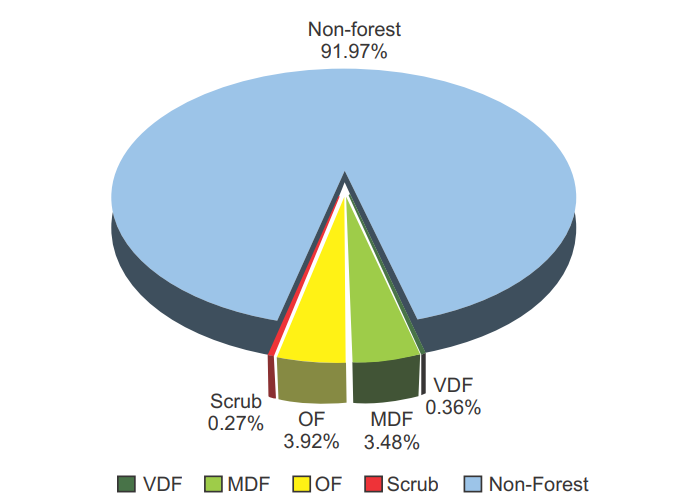
The area of Forest in Bihar is approximately 7.76% of the state's total land area, which is about 7,300 square kilometres . Though it falls short of the national average forest cover, Bihar has been focusing on increasing its forested area through reforestation and afforestation initiatives. The state's forest department continues to play an active role in conserving and regenerating forested areas.
| Forest Area in Bihar in Percentage | ||
| Class | Area | % of GA |
| Very Dense Forest | 333.13 | 0.36 |
| Moderately Dense Forest | 3,280.32 | 3.48 |
| Open Forest | 3,692.54 | 3.92 |
| Total | 7,305.99 | 7.76 |
| Scrub | 249.88 | 0.27 |
How Many Forests in Bihar?
It is necessary to understand that Bihar’s forest cover is spread across various districts with a variety of forest types and sanctuaries. The forests in Bihar can be categorized into- Reserved Forest
- Protected Forest
- Unclassified Forest
Types of Forest in Bihar
The types of forest in Bihar are largely classified into tropical dry deciduous forests, riverine forests, and mixed forests. The tropical dry deciduous forests are the most dominant, found in areas where rainfall is moderate. These forests shed their leaves during dry periods to conserve moisture.- Tropical Dry Deciduous Forests : Dominant in areas like Gaya and Rohtas, these forests are characterized by species such as Sal, Teak, and Sheesham.
- Riverine Forests : Found along the banks of rivers such as the Ganges and its tributaries, these forests consist of a mix of trees that thrive in moist conditions, including bamboo groves.
- Mixed Forests : These include both deciduous and evergreen species, providing a unique habitat for various wildlife species.
List of Forests in Bihar
Here is a list of forests in Bihar that are important for conservation and biodiversity, this list of forests in Bihar is categorized under these types of forest which we have discussed above.| Types of Forest in Bihar | |||||||
| SI.No. | Forest Type | % of Forest cover | |||||
| 1. | Cane Brakes | 0.03 | |||||
| 2. | Moist Teak Forest | 0.06 | |||||
| 3. | Bhabar-Dun Sal Forest | 3.66 | |||||
| 4. | West Gangatic Moist Mixed Deciduous Forest | 2.30 | |||||
| 5. | Eastern Wet Alluvial Grassland | 0.22 | |||||
| 6. | Barringtonia Swamp Forest | 0.03 | |||||
| 7. | Khair-Sissu Forest | 0.06 | |||||
| 8. | Dry Deciduous Scrub | 2.48 | |||||
| 9. | Boswellia Forest | 4.52 | |||||
| 10. | Dry Bamboo Brake | 0.97 | |||||
| 11. | Dry Siwalik Sal Forest | 5.14 | |||||
| 12. | Dry Peninsular Sal Forest | 21.13 | |||||
| 13. | Northern Dry Mixed Deciduous Forest | 30.70 | |||||
| 14. | Plantation/TOF | 28.70 | |||||
| Total | 100.00 | ||||||
Forests in Bihar Sanctuaries
Forests in Bihar sanctuaries play a significant role in protecting endangered species and preserving biodiversity. The state is home to several wildlife sanctuaries that not only conserve wildlife but also attract eco-tourism.
- Valmiki National Park : Located in the West Champaran district, this is the most prominent forest in Bihar and is known for being a tiger reserve and is home to tigers, deer, and an array of bird species. It is an integral part of the forests in Bihar that contribute to tiger conservation.
- Bhimbandh Wildlife Sanctuary : Situated in the Munger district, Bhimbandh is one of the oldest wildlife reserves in Bihar and is home to various wildlife, including leopards, elephants, and numerous bird species.
- Kaimur Wildlife Sanctuary : Located in the Kaimur district, spread over 1,342 square kilometres, this is one of the largest sanctuaries in Bihar, known for its rugged landscape and diverse species of flora and fauna.
- Udaypur Wildlife Sanctuary : Situated in the West Champaran district, it offers a habitat for birds and reptiles, making it an important ecological zone.
- Rajgir Wildlife Sanctuary : Located in the Nalanda district, this forest sanctuary is rich in biodiversity and is known for its scenic beauty.
Protected Areas of Bihar
Bihar has several protected areas that are essential for conserving wildlife and forest ecosystems. These include national parks, wildlife sanctuaries, and reserved forests. The most significant of these areas include:| Protected Areas of Bihar | |||
| Name | Districts of Bihar | Type | Size in km 2 |
| Gautam Budha Wildlife Sanctuary | Gaya | Wildlife Sanctuary | 259.48 |
| Bhimbandh Wildlife Sanctuary | Munger | Wildlife Sanctuary | 681.99 |
| Pant Wildlife Sanctuary | Rajgir | Wildlife Sanctuary | 35.84 |
| Kaimur Wildlife Sanctuary | Kaimur and Rohtas | Wildlife Sanctuary | 1504.96 |
| Kanwar Lake Bird Sanctuary | Begusarai | Wildlife Sanctuary | 67.5 |
| Nakti Dam Bird Sanctuary | Jamui | Wildlife Sanctuary | 3.32 |
| Nagi Dam Bird Sanctuary | Jamui | Wildlife Sanctuary | 7.91 |
| Valmiki National Park | West Champaran | National Park | 335.65 |
| Vikramshila Gangetic Dolphin Sanctuary | Bhagalpur | Wildlife Sanctuary | 50 |
| Barela Jheel Salim Ali Bird Sanctuary | Vaishali | Wildlife Sanctuary | 1.96 |
| Sanjay Gandhi Biological Park | Patna | Zoo and Botanic Garden | 0.619 |
| Udaypur Wildlife Sanctuary | Champaran | Wildlife Sanctuary | 8.74 |
| Valmiki Wildlife Sanctuary | West Champaran | Wildlife Sanctuary | 880.78 |
Forests in Bihar Map
When looking at the Forests in Bihar map , you can see that there is more forest area present in the northern and southern regions of the state, with large patches of green areas spread across the districts of West Champaran, Rohtas, Gaya, and Munger. The forests outline the hilly regions of Bihar, particularly in the southern districts where the terrain is more rugged.District-wise Forest Cover in Bihar
The district-wise forest cover in Bihar showcases how unevenly distributed the forest areas are. Some districts have significantly higher forest cover compared to others. Here is an overview of districts with notable forest cover:| District-wise Forest Cover in Bihar | |||||||
| District | Geographical Area (GA) | 2019 Assessment |
%
of GA |
Scrub | |||
| Very Dense Forest | Mod. Dense Forest | Open Forest | Total | ||||
| Araria | 2,830 | 0.00 | 8.10 | 142.91 | 151.01 | 5.34 | 0.38 |
| Arwal | 638 | 0.00 | 1.63 | 2.37 | 4.00 | 0.63 | 0.00 |
| Aurangabad | 3,305 | 0.00 | 62.26 | 94.50 | 156.76 | 4.74 | 16.70 |
| Banka | 3,020 | 0.00 | 103.34 | 157.39 | 260.73 | 8.63 | 34.55 |
| Begusarai | 1,918 | 0.00 | 28.64 | 53.31 | 81.95 | 4.27 | 0.00 |
| Bhagalpur | 2,569 | 0.00 | 46.21 | 23.52 | 69.73 | 2.91 | 0.00 |
| Bhojpur | 2,395 | 0.00 | 19.44 | 12.81 | 32.25 | 1.89 | 0.00 |
| Buxar | 1,703 | 0.00 | 2.94 | 2.95 | 5.89 | 0.26 | 0.00 |
| Darbhanga | 2,279 | 0.00 | 43.54 | 94.12 | 137.66 | 2.77 | 0.00 |
| Gaya | 4,976 | 0.00 | 134.40 | 455.91 | 590.31 | 29.04 | 62.34 |
| Gopalganj | 2,033 | 0.00 | 1.98 | 2.93 | 4.91 | 0.16 | 0.00 |
| Jamui | 3,098 | 28.97 | 351.69 | 267.29 | 647.95 | 69.60 | 15.74 |
| Jehanabad | 931 | 0.00 | 0.00 | 0.00 | 0.00 | 0.00 | 5.00 |
| Kaimur(Bhabua) | 3,332 | 0.00 | 525.14 | 531.25 | 1,056.39 | 41.12 | 19.43 |
| Katihar | 3,057 | 0.00 | 6.03 | 55.95 | 61.98 | 2.03 | 0.00 |
| Khagaria | 1,486 | 0.00 | 3.18 | 15.27 | 18.45 | 1.24 | 0.00 |
| Kishanganj | 1,884 | 0.00 | 16.33 | 87.37 | 103.70 | 5.50 | 0.00 |
| Lakhisarai | 1,228 | 17.00 | 144.42 | 18.99 | 180.41 | 14.69 | 5.49 |
| Madhepura | 1,788 | 0.00 | 0.93 | 51.95 | 52.88 | 2.96 | 0.40 |
| Madhubani | 3,501 | 0.00 | 40.34 | 163.73 | 204.07 | 5.83 | 0.00 |
| Munger | 1,419 | 37.97 | 223.67 | 21.96 | 283.60 | 19.99 | 9.98 |
| Muzaffarpur | 3,172 | 0.00 | 52.17 | 109.65 | 161.82 | 5.10 | 0.00 |
| Nalanda | 2,355 | 0.00 | 6.86 | 24.99 | 31.85 | 1.35 | 9.17 |
| Nawada | 2,494 | 0.00 | 200.98 | 312.52 | 513.50 | 20.59 | 20.46 |
| Pashchim Champaran | 5,228 | 249.19 | 550.24 | 105.23 | 904.66 | 17.30 | 8.10 |
| Patna | 3,202 | 0.00 | 18.78 | 4.76 | 23.54 | 0.74 | 0.00 |
| Purbi Champaran | 3,968 | 0.00 | 65.04 | 98.82 | 163.86 | 4.13 | 0.00 |
| Purnia | 3,229 | 0.00 | 5.00 | 50.67 | 55.67 | 1.72 | 0.00 |
| Rohtas | 3,881 | 0.00 | 352.52 | 319.71 | 672.23 | 17.32 | 42.14 |
| Saharsa | 1,687 | 0.00 | 4.17 | 30.45 | 34.62 | 2.05 | 0.00 |
| Samastipur | 2,904 | 0.00 | 105.30 | 48.06 | 153.36 | 5.28 | 0.00 |
| Saran | 2,641 | 0.00 | 26.30 | 32.83 | 59.13 | 2.24 | 0.00 |
| Sheikhpura | 689 | 0.00 | 1.00 | 0.00 | 1.00 | 0.15 | 0.00 |
| Sheohar | 349 | 0.00 | 2.00 | 18.58 | 20.58 | 5.90 | 0.00 |
| Sitamarhi | 2,294 | 0.00 | 37.38 | 110.40 | 147.78 | 6.44 | 0.00 |
| Siwan | 2,219 | 0.00 | 1.99 | 5.17 | 7.16 | 0.32 | 0.00 |
| Supaul | 2,425 | 0.00 | 3.89 | 134.89 | 138.78 | 5.72 | 0.00 |
| Vaishali | 2,036 | 0.00 | 82.49 | 29.33 | 111.82 | 5.49 | 0.00 |
| Grand Total | 94,163 | 333.13 | 3,280.32 | 3,692.54 | 7,305.99 | 7.76 | 249.88 |
Importance of Forests in Bihar
The forests in Bihar are not just important for ecological reasons but also provide livelihoods for many local communities. Non-timber forest products such as bamboo, medicinal plants, and honey are sources of income for many tribal and rural populations. Additionally, the forests play a crucial role in conserving water, protecting soil, and maintaining the regional climate. With increasing urbanization and agricultural expansion, it is important to focus on reforestation efforts to sustain the forested areas. The Bihar government has taken several initiatives to promote afforestation through programs like "Hariyali Mission" which aims to increase the green cover of the state.forests in Bihar FAQs
Q.1 How many forests are there in Bihar?
Q.2 Which is the famous jungle in Bihar?
Q.3 Which is the most dense forest in Bihar?
Q.4 What is the forest area in Bihar in percentage?
Q.5 What are the types of forest in Bihar?












 Live & recorded classes available at easeDashboard for progress trackingMillions of practice questions at your fingertips

