






Forests in Maharashtra, Top 10, List, Types, Famous Forests
 Bhavya Upadhyay11 Sept, 2024
Forests in Maharashtra: Maharashtra is a state which is located in the western part of India, and it is also home to a wide range of forest ecosystems, offering a rich biodiversity. Forests in Maharashtra play a significant role in maintaining the ecological balance, supporting wildlife, and providing livelihood opportunities for many communities. We have created this guide, to provide a detailed overview of Forests in Maharashtra, including their types, sanctuaries, and district-wise forest cover.
Neighbouring States of Maharashtra
Forests in Maharashtra Overview
Maharashtra spans a total forest cover of 61,579 square kilometres, which makes up around 20% of the state's total geographical area. The Forest area in Maharashtra in percentage might seem relatively low as compared to the national average forest cover, but Maharashtra's forests are extremely enriched with a wide range of flora and fauna. The Forests in Maharashtra map shows that the dense and open forests are mostly concentrated in the Sahyadri ranges, the Vidarbha region, and parts of the Konkan coastal belt.
Forests in Maharashtra are not only important for environmental reasons but they also act as tourist attractions, securing wildlife through various sanctuaries and national parks. Many rural communities depend on these forests for fuel, fodder, and minor forest products. Maharashtra also undertakes afforestation programs to enhance its green cover and improve the health of its forests.
| Forests in Maharashtra Overview | |
|---|---|
| Category | Details |
| Total Forest Area | 61,579 sq. km |
| Forest Area in Maharashtra (Percentage) | 20% |
| Major Forest Regions | Sahyadri ranges, Vidarbha, Konkan |
| Types of Forests | Tropical Moist Deciduous, Dry Deciduous, Montane |
| Famous Forest | Tadoba Andhari Tiger Reserve |
| Wildlife Sanctuaries | Bhima Shankar, Tansa, Nagzira, Phansad, Radhanagari |
| Highest Forest Cover District | Gadchiroli (77% forest cover) |
| Notable Flora and Fauna |
|
| Number of Forest Areas | Approximately 50 |
Forest Area in Maharashtra in Percentage
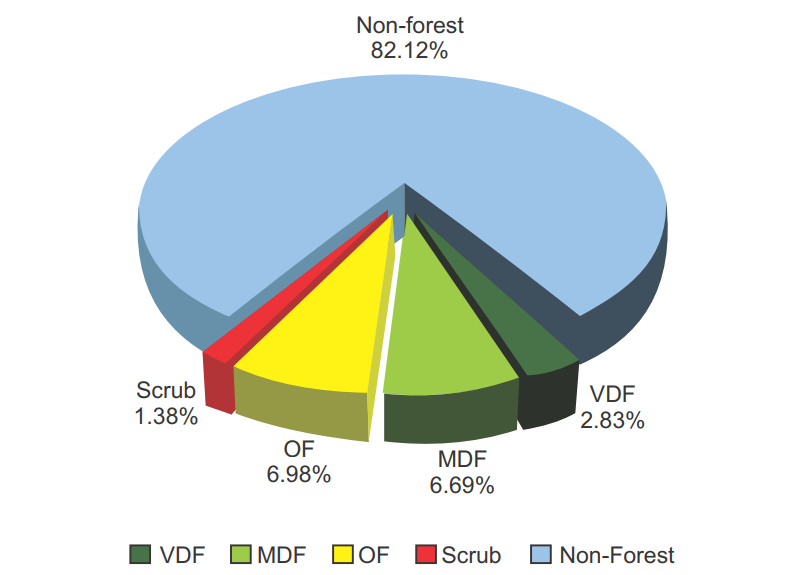
The forest area in Maharashtra in percentage stands at approximately around 20% of Maharashtra's total land. This percentage might be lower than the national average, but these forests are essential for the state's ecological balance. Forests in Maharashtra are spread across various landscapes, from the Western Ghats to the Vidarbha region, which makes the best suitable habitat for various wildlife species and supports local communities.
| Forest Area in Maharashtra in Percentage | ||
| Class | Area | % of GA |
| Very Dense Forest | 8,720.53 | 2.83 |
| Moderately Dense Forest | 20,572.35 | 6.69 |
| Open Forest | 21,484.68 | 6.98 |
| Total | 50,777.56 | 16.50 |
| Scrub | 4,256.49 | 1.38 |
How Many Forests in Maharashtra?
The state of Maharashtra is known for its variety of forests. There are approximately 50 recognized forests in Maharashtra , including national parks, wildlife sanctuaries, and forest reserves. These forests not only protect wildlife but also act as vital watersheds that feed the rivers and water bodies of the state.
Types of Forest in Maharashtra
Forests in Maharashtra can be classified into three broad categories based on climate and vegetation:
- Tropical Moist Deciduous Forests : Found in regions with moderate rainfall, such as the Konkan belt, these forests have a mix of hardwood trees like teak, bamboo, and sal.
- Tropical Dry Deciduous Forests : Mostly found in the Vidarbha and parts of Marathwada regions, these forests consist of species such as teak, tendu, and palas.
- Montane Subtropical Forests : Located in the higher altitudes of the Sahyadri ranges, these forests are rich in evergreen species and act as a necessary habitat for many rare species of plants and animals.
List of Forests in Maharashtra
Maharashtra has many renowned forests, and each of these forests contributes to the state's biodiversity. Here's a List of forests in Maharashtra that are extremely famous:
| List of Forests in Maharashtra | |||||||
| SI.No. | Forest Type | % of Forest cover | |||||
| 1 | West Coast Semi-Evergreen Forest | 11.87 | |||||
| 2 | Southern Moist Mixed Deciduous Forest | 21.01 | |||||
| 3 | Moist Teak Forest | 10.71 | |||||
| 4 | Mangrove Forest | 0.50 | |||||
| 5 | Mangrove Scrub | 0.05 | |||||
| 6 | Littoral Forest | 0.01 | |||||
| 7 | Riparian Fringing Forest | 0.00 | |||||
| 8 | Southern Dry Mixed Deciduous Forest | 26.30 | |||||
| 9 | Dry Teak Forest | 17.40 | |||||
| 10 | Dry Deciduous Scrub | 7.53 | |||||
| 11 | Dry Bamboo Brake | 0.46 | |||||
| 12 | Boswellia Forest | 0.12 | |||||
| 13 | Hardwickia Forest | 0.11 | |||||
| 14 | Babul Forest | 0.03 | |||||
| 15 | Butea Forest | 0.02 | |||||
| 16 | Southern Thorn Forest | 0.41 | |||||
| 17 | Western Sub Tropical Hill Forest | 1.19 | |||||
| 18 | Plantation/ TOF | 2.28 | |||||
| Total | 100.00 | ||||||
Famous Forest in Maharashtra
Many people often wonder, Which is the Famous forest in Maharashtra? , it would undoubtedly be the Tadoba Andhari Tiger Reserve, which is spread over an area of 625 square kilometres, Tadoba is often referred to as the 'Jewel of Vidarbha.' It is one of the best places in India to spot tigers in their natural habitat. The reserve is also home to a variety of other species like leopards, sloth bears, gaur, and various reptiles.
Forests in Maharashtra Sanctuaries
Maharashtra has many wildlife sanctuaries, which act as conservation sites for endangered species and protect the state's natural heritage. Some of the prominent Forests in Maharashtra Sanctuaries are:
- Tansa Wildlife Sanctuary : Located near Tansa Lake, this sanctuary is home to leopards, sambar, and various bird species.
- Nagzira Wildlife Sanctuary : Known for its dense forest cover, Nagzira is an important passage for tigers moving between forests.
- Phansad Wildlife Sanctuary : Established in the Western Ghats, Phansad is rich in biodiversity and a sanctuary for birdwatchers.
- Radhanagari Wildlife Sanctuary : Famous for its population of Indian bison (gaur), Radhanagari is a critical conservation area in the Kolhapur district.
- Tadoba Andhari Tiger Reserve : The largest and oldest national park in Maharashtra, known for its tiger population.
- Sanjay Gandhi National Park : Located in the city of Mumbai, this park offers a unique opportunity to experience nature within an urban area.
- Melghat Tiger Reserve : Situated in the Satpura range, Melghat is famous for its tigers and a variety of other wildlife species.
- Bhima Shankar Wildlife Sanctuary : Famous for its dense forests and the endangered giant squirrel, the state animal of Maharashtra.
- Koyna Wildlife Sanctuary : Known for its scenic beauty, Koyna is part of the UNESCO World Network of Biosphere Reserves.
Protected Areas of Maharashtra
Maharashtra has various protected areas , including national parks, wildlife sanctuaries, and tiger reserves that protect the state's unique biodiversity. These protected regions are important for the conservation of endangered species like the Bengal tiger, leopards, and Indian bison. The state's efforts toward maintaining these areas contribute significantly to wildlife conservation and ecological balance. Some of the well-known protected regions include:
| Protected Areas of Maharashtra | |||
|---|---|---|---|
| Protected Area | District | Type | Size |
| Himayat Bagh | Aurangabad | Historical Garden | 1.214 square kilometres |
| Jnaneshwar Udyan | Ahmednagar | Botanical Garden | 1.25 square kilometres |
| Mapro Garden | Satara | Tourist Attraction (Garden) | N/A (Commercial Plantation) |
| Yawal Wildlife Sanctuary | Jalgaon | Wildlife Sanctuary | 178.63 square kilometres |
Forests in Maharashtra Map
The Forests in Maharashtra map highlights the distribution of forest areas across the state, with dense forests mainly focused in the Sahyadri ranges, Vidarbha region, and parts of the Konkan coastal belt. The map also shows the locations of major national parks and wildlife sanctuaries, which attract tourists. Understanding the geographical spread of forests in Maharashtra helps in planning conservation efforts and sustainable forest management practices.
Highest Mountain Peak in Maharashtra
District-wise Forest Cover in Maharashtra
Understanding the distribution of forests in different parts of Maharashtra is key to learning the ecological diversity of the state. Here is a brief District wise Forest Cover in Maharashtra :
| District-wise Forest Cover in Maharashtra | |||||||
| District | Geographical Area (GA) | 2019 Assessment |
%
of GA |
Scrub | |||
| Very Dense Forest | Mod. Dense Forest | Open Forest | Total | ||||
| Ahmadnagar | 17.048 | 0.00 | 68.82 | 198.07 | 266.89 | 1.57 | 557.39 |
| Akola | 5.673 | 11.00 | 108.44 | 220.93 | 340.37 | 6.00 | 16.00 |
| Amravati | 12.210 | 618.89 | 1,461.53 | 1,087.35 | 3,167.77 | 25.94 | 112.76 |
| Aurangabad | 10.131 | 20.00 | 106.26 | 441.67 | 567.93 | 5.61 | 171.29 |
| Bhandara | 4.087 | 170.86 | 563.13 | 264.93 | 998.92 | 24.44 | 18.57 |
| Bid | 10.693 | 0.00 | 13.00 | 151.03 | 164.03 | 1.53 | 362.79 |
| Buldana | 9.661 | 25.00 | 143.95 | 422.65 | 591.60 | 6.12 | 162.00 |
| Chandrapur | 11.443 | 1,323.03 | 1,559.44 | 1,171.99 | 4,054.46 | 35.43 | 44.23 |
| Dhule | 7.195 | 0.00 | 68.57 | 232.70 | 301.27 | 4.19 | 111.37 |
| Gadchiroli | 14.412 | 4,699.29 | 3,307.73 | 1,909.92 | 9,916.94 | 68.81 | 24.58 |
| Gondiya | 5.234 | 888.61 | 732.23 | 317.75 | 1,938.59 | 37.04 | 32.25 |
| Hingoli | 4.827 | 0.00 | 9.00 | 101.01 | 110.01 | 2.28 | 49.23 |
| Jalgaon | 11.765 | 51.00 | 347.94 | 747.90 | 1,146.84 | 9.75 | 94.51 |
| Jalna | 7.694 | 0.00 | 9.65 | 26.83 | 36.48 | 0.47 | 51.21 |
| Kolhapur | 7.685 | 64.00 | 1,020.44 | 701.88 | 1,786.32 | 23.24 | 102.83 |
| Latur | 7.157 | 0.00 | 0.04 | 12.98 | 13.02 | 0.18 | 19.67 |
| Mumbai | 157 | 0.00 | 0.00 | 3.00 | 3.00 | 1.91 | 0.00 |
| Mumbai Suburban | 446 | 0.00 | 67.00 | 72.86 | 139.86 | 31.36 | 0.43 |
| Nagpur | 9.892 | 401.06 | 902.56 | 696.76 | 2,000.38 | 20.22 | 73.68 |
| Nanded | 10.528 | 58.00 | 442.91 | 435.85 | 936.76 | 8.90 | 123.08 |
| Nandurbar | 5.955 | 0.00 | 404.15 | 791.84 | 1,195.99 | 20.08 | 30.00 |
| Nashik | 15.530 | 0.00 | 346.34 | 730.21 | 1,076.55 | 6.93 | 337.66 |
| Osmanabad | 7.569 | 0.00 | 2.08 | 47.58 | 49.66 | 0.66 | 47.43 |
| Parbhani | 6.214 | 0.00 | 3.57 | 36.86 | 40.43 | 0.65 | 47.78 |
| Pune | 15.643 | 0.00 | 760.93 | 949.93 | 1,710.86 | 10.94 | 508.03 |
| Raigarh | 7.152 | 13.00 | 1,250.34 | 1,676.12 | 2,939.46 | 41.10 | 77.60 |
| Ratnagiri | 8.208 | 33.00 | 1,892.01 | 2,287.89 | 4,212.90 | 51.33 | 3.36 |
| Sangli | 8.572 | 0.00 | 95.00 | 55.13 | 150.13 | 1.75 | 171.03 |
| Satara | 10.480 | 117.00 | 569.68 | 591.69 | 1,278.37 | 12.20 | 365.70 |
| Sindhudurg | 5.207 | 88.82 | 1,391.73 | 1,347.43 | 2,827.98 | 54.31 | 32.27 |
| Solapur | 14.895 | 0.00 | 5.50 | 44.17 | 49.67 | 0.33 | 60.72 |
| Thane | 9.558 | 0.00 | 1,300.11 | 1,697.98 | 2,998.09 | 31.37 | 261.07 |
| Wardha | 6.309 | 9.97 | 410.03 | 441.95 | 861.95 | 13.66 | 55.93 |
| Washim | 4.901 | 5.00 | 101.89 | 189.87 | 296.76 | 6.06 | 31.65 |
| Yavatmal | 13.582 | 123.00 | 1,106.35 | 1,377.97 | 2,607.32 | 19.20 | 98.39 |
| Total | 3,07,713 | 8,720.53 | 20,572.35 | 21,484.68 | 50,777.56 | 16.50 | 4,256.49 |
Conservation and Challenges
While the forests in Maharashtra are rich in biodiversity, they face several challenges. Deforestation, illegal logging, forest fires, and encroachment are some of the major threats. The state government has implemented various conservation initiatives, such as the Joint Forest Management Program and extensive afforestation projects, to oppose these challenges.
Maharashtra is also working on increasing the forest cover in urban areas, particularly through initiatives like tree plantation drives in Mumbai and Pune. Efforts are also being made to educate local communities on sustainable practices to protect and manage the forests.
forests in Maharashtra FAQs
Q.1 How many forests are there in Maharashtra?
Q.2 Which is the famous forest in Maharashtra?
Q.3 Which is the most forested region in Maharashtra?
Q.4 What is the forest area in Maharashtra in percentage?
Q.5 Which district has the highest forest cover in Maharashtra?












 Live & recorded classes available at easeDashboard for progress trackingMillions of practice questions at your fingertips

