






History of Maharashtra, Ancient History, In English, Notes
 Bhavya Upadhyay4 Jul, 2024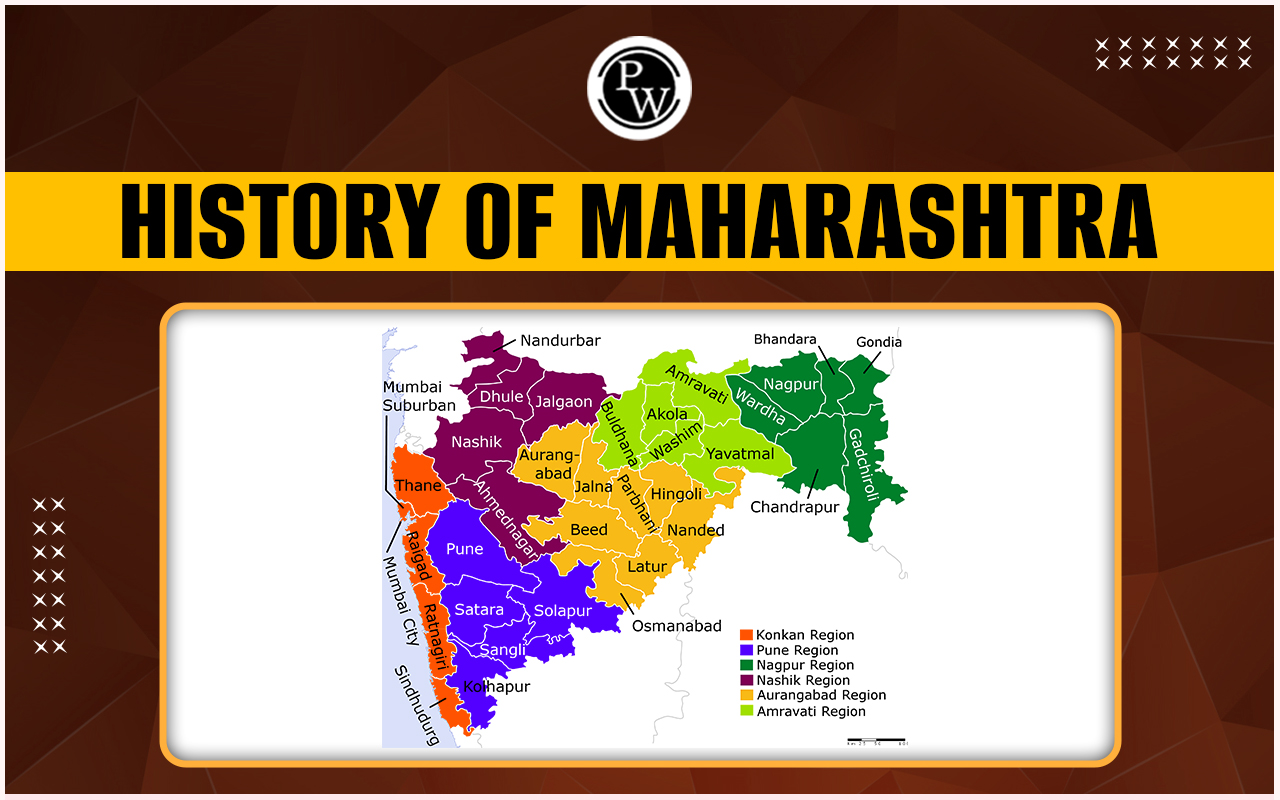
History of Maharashtra: Maharashtra, a land of vibrant culture and historical significance, has a storied past that spans millennia. From ancient civilizations and powerful empires to the rise of the Maratha Empire and the impact of British colonialism, the history of Maharashtra is a rich tapestry of cultural, social, and political developments. This blog delves into the captivating journey of Maharashtra, exploring its ancient roots, medieval glories, and modern transformations.
History of Maharashtra
Maharashtra, a state in the western peninsular region of India, boasts a rich and diverse history. From ancient civilizations and powerful empires to colonial rule and modern-day governance, Maharashtra's past is a tapestry of cultural, social, and political developments. This blog explores the history of Maharashtra, tracing its evolution from ancient times to the present.
History of Maharashtra Overview
The history of Maharashtra is a fascinating journey through time, beginning with ancient civilizations and early Vedic influences, progressing through the era of powerful dynasties like the Satavahanas and the Marathas, and enduring the transformative impact of British colonial rule. Post-independence, Maharashtra has emerged as a leading state in India's economic and cultural landscape.
| History of Maharashtra Overview | |
|---|---|
| Period | Key Events and Dynasties |
| Ancient Period | Early settlements, Indus Valley Civilization influences |
| Early Historic Period | Maurya Empire, Satavahana Dynasty |
| Medieval Period | Rashtrakutas, Yadavas, Bahmani Sultanate |
| Maratha Empire | Rise of Shivaji Maharaj, Expansion under Peshwas |
| Colonial Period | British East India Company rule, Anglo-Maratha Wars |
| Post-Independence | Formation of Maharashtra state, economic and cultural growth |
Ancient Period of the History of Maharashtra
Early Settlements and Indus Valley Civilization
The history of Maharashtra dates back to the prehistoric era. Evidence of human habitation in the region during the Stone Age has been found in places like the Konkan coast and the Sahyadri hills. The region was also influenced by the Indus Valley Civilization (3300-1300 BCE), particularly through trade and cultural exchanges.
Vedic Period
During the Vedic period (1500-500 BCE), the Aryans migrated to the Deccan plateau, bringing with them their language, culture, and traditions. The region saw the rise of various Janapadas (small kingdoms) and was mentioned in ancient texts such as the Mahabharata and Ramayana.
Early Historic Period of the History of Maharashtra
Maurya and Satavahana Empires
The Maurya Empire (322-185 BCE), under the rule of Emperor Ashoka, extended its influence over Maharashtra, introducing Buddhism and Jainism to the region. The subsequent decline of the Mauryas led to the rise of the Satavahana Dynasty (230 BCE-220 CE), which played a crucial role in the cultural and economic development of Maharashtra. The Satavahanas promoted trade, built infrastructure like roads and ports, and were known for their patronage of art and literature.
Vakataka and Western Chalukyas
After the fall of the Satavahanas, the Vakataka Dynasty (250-500 CE) emerged as a significant power, particularly in the Vidarbha region. They were known for their contributions to art, architecture, and literature, evident in the Ajanta Caves. The Western Chalukyas (543-753 CE) followed, contributing to the region's architectural heritage, including the construction of temples and fortifications.
Medieval Period of the History of Maharashtra
Rashtrakutas and Yadavas
The Rashtrakuta Dynasty (753-982 CE) rose to prominence, with their capital at Manyakheta (present-day Malkhed). They were known for their patronage of art and architecture, including the rock-cut Kailasa temple at Ellora. The Yadava Dynasty (1187-1317 CE) followed, with their capital at Devagiri (modern-day Daulatabad). They played a significant role in the cultural and political landscape of Maharashtra until the advent of the Delhi Sultanate.
Bahmani and Deccan Sultanates
In the late medieval period, the Bahmani Sultanate (1347-1527 CE) and its successor states, the Deccan Sultanates, controlled parts of Maharashtra. These Muslim dynasties influenced the region's culture, architecture, and administration, introducing Persian and Islamic elements into the local traditions.
Maratha Empire of the History of Maharashtra
Shivaji Maharaj and the Foundation of the Maratha Empire
The most significant period in Maharashtra's history began with the rise of Shivaji Maharaj (1630-1680 CE). He established the Maratha Empire, challenging the dominance of the Mughal Empire and other regional powers. Shivaji's administration was marked by efficient governance, military innovations, and the promotion of Marathi culture and language.
Expansion and Consolidation
After Shivaji's death, the Maratha Empire expanded under the leadership of the Peshwas (prime ministers). The Peshwa era (1713-1818 CE) saw the Marathas becoming a formidable force in India, with their influence extending across the subcontinent. The Battle of Panipat in 1761 was a significant event, marking a temporary setback but not the end of Maratha power.
Colonial Period of the History of Maharashtra
British East India Company and the Anglo-Maratha Wars
The British East India Company began to exert its influence over Maharashtra in the late 18th century. The Anglo-Maratha Wars (1775-1818) ultimately led to the downfall of the Maratha Empire, and by 1818, Maharashtra came under British control.
Social Reforms and Independence Movement
The colonial period saw significant social and cultural changes in Maharashtra. Leaders like Jyotirao Phule, Savitribai Phule, and Dr. B.R. Ambedkar spearheaded social reform movements, advocating for education, women's rights, and the abolition of caste discrimination. Maharashtra also played a crucial role in India's struggle for independence, with prominent leaders like Bal Gangadhar Tilak and Vinayak Damodar Savarkar contributing to the national movement.
Post-Independence Era of the History of Maharashtra
Formation of Maharashtra State
After India gained independence in 1947, the reorganization of states along linguistic lines led to the formation of Maharashtra on May 1, 1960. The new state, with Mumbai as its capital, was carved out of the bilingual Bombay State.
Economic and Cultural Development
Since its formation, Maharashtra has emerged as one of India's most economically developed and industrialized states. Mumbai, the financial capital of India, has become a global city, while Pune has grown into an educational and IT hub. The state has also maintained its rich cultural heritage, with contributions to literature, music, theater, and cinema.
Conclusion to the History of Maharashtra
Maharashtra's history is a remarkable saga of resilience, cultural synthesis, and political evolution. From ancient civilizations and powerful dynasties to the rise of the Maratha Empire and the impact of colonial rule, the state's past is a testament to its enduring spirit and adaptability. Today, Maharashtra continues to be a vibrant and dynamic state, contributing significantly to India's growth and development while preserving its rich historical legacy.
History of Maharashtra <span style=
Q.1 What is the older name of Maharashtra?
Q.2 What is the history of modern Maharashtra?
Q.3 Who is the king of history Maharashtra?








 Live & recorded classes available at easeDashboard for progress trackingMillions of practice questions at your fingertips

