






United Nations Security Council (UNSC), History, Members, Headquarters
The United Nations Security Council (UNSC) is a principal organ of the United Nations, responsible for maintaining international peace and security. Read about UNSC Members, History, Functions & more.
 Nigam Sharma18 Jul, 2024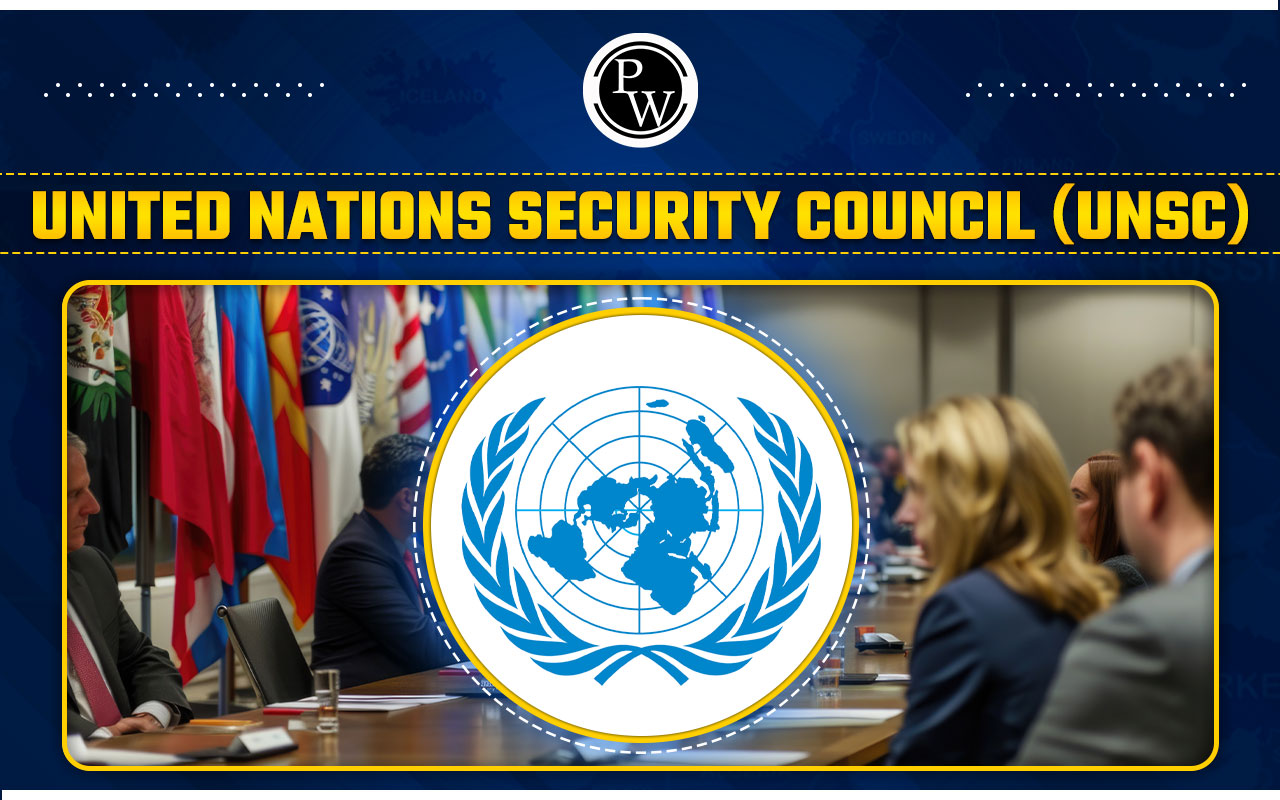
United Nations Security Council (UNSC): The United Nations Security Council (UNSC) is one of the six principal organs of the United Nations (UN), entrusted with maintaining international peace and security. It is a powerful entity within the UN system, capable of making binding decisions that member states are obligated to implement. This article delves into the intricacies of the UNSC, covering its history, members, functions, and related aspects.
Headquarters of United Nations Security Council
The headquarters of the United Nations Security Council (UNSC) is located at the United Nations Headquarters in New York City, United States. The iconic UN building, situated along the East River, serves as the central hub for the Security Council's meetings and activities. The UNSC convenes in the Security Council Chamber, a distinct room within the UN Headquarters designed specifically for its sessions and deliberations.History of the United Nations Security Council (UNSC)
The UNSC was established on October 24, 1945, following the conclusion of World War II, with the ratification of the United Nations Charter. Its creation was driven by the desire to prevent future conflicts and ensure collective security through a unified international body. The structure and functions of the UNSC were heavily influenced by the lessons learned from the failures of the League of Nations.-
Formation and Foundation (1945)
- The United Nations Security Council (UNSC) was established on October 24, 1945, with the ratification of the United Nations Charter.
- It was created in response to the failures of the League of Nations and the desire to prevent future global conflicts following World War II.
-
First Session (1946)
- The UNSC held its inaugural session on January 17, 1946, in Westminster, London.
- During this first meeting, the council set the groundwork for its operational procedures and initial objectives.
-
Early Peacekeeping Missions (1948-1956)
- The UNSC authorized its first peacekeeping missions in response to conflicts in the Middle East and Kashmir.
- Notable missions included the UN Truce Supervision Organization (UNTSO) in 1948 and the United Nations Emergency Force (UNEF) during the Suez Crisis in 1956.
-
Cold War Era (1947-1991)
- The UNSC's effectiveness was often hindered by the geopolitical tensions between the United States and the Soviet Union, leading to frequent vetoes.
- Despite this, the council managed to address several conflicts, including the Korean War (1950-1953) and the Cuban Missile Crisis (1962).
-
Post-Cold War Expansion and Reform Efforts (1990s)
- The end of the Cold War in 1991 led to increased cooperation among UNSC members.
- The 1990s saw a significant expansion of peacekeeping operations, including missions in the former Yugoslavia, Somalia, and Rwanda.
-
Contemporary Challenges and Criticisms (2000s-Present)
- The UNSC has faced criticism for its structure, particularly the veto power held by the five permanent members (China, France, Russia, the United Kingdom, and the United States).
- Calls for reform have grown, with proposals to expand the number of permanent and non-permanent members and address the veto issue.
-
Significant Resolutions and Actions
- The UNSC has passed numerous significant resolutions, including those related to sanctions against North Korea, the establishment of international tribunals, and interventions in Libya and Syria.
- The council's role in combating terrorism and nuclear proliferation has also been prominent in recent decades.
-
Reform Proposals and Ongoing Debates
- Various reform proposals have been put forward, including expanding membership to include countries like India, Germany, Japan, and Brazil.
- Debates continue on how to make the UNSC more representative and effective in addressing global security challenges.
Members of the United Nations Security Council (UNSC)
The UNSC is composed of 15 members, divided into two categories:-
Permanent Members (P5)
: These are five powerful countries with veto power over substantive resolutions:
- China
- France
- Russia
- United Kingdom
- United States
- Non-Permanent Members : Ten members elected by the General Assembly for two-year terms, with five replaced each year. These members are selected based on regional representation to ensure a balanced geographical distribution.
Functions of the United Nations Security Council (UNSC)
The UNSC's primary responsibility is to maintain international peace and security. Its key functions include:- Conflict Resolution : The UNSC investigates disputes and situations that may lead to international tension. It can recommend peaceful settlement methods or mediate negotiations.
- Sanctions : It can impose economic, diplomatic, or military sanctions to enforce its decisions and maintain peace.
- Military Action : The UNSC can authorize the use of force to maintain or restore international peace and security.
- Peacekeeping Operations : It establishes and oversees UN peacekeeping missions to conflict areas to ensure stability and support post-conflict recovery.
- International Cooperation : The UNSC fosters cooperation among states to address global issues like terrorism, nuclear proliferation, and humanitarian crises.
What is Veto Power of the UNSC?
The veto power of the United Nations Security Council (UNSC) refers to the authority granted to each of the five permanent members (China, France, Russia, the United Kingdom, and the United States) to block any substantive resolution or decision. This means that if any one of these five members votes against a proposed resolution, it cannot be adopted, regardless of the number of votes in favor from the other members. The veto power is a significant aspect of the UNSC's decision-making process, giving the permanent members substantial influence over the council's actions.Other Key Aspects of UNSC
Some of other Key Aspects of UNSC are as follows :-Decision-Making Process
The UNSC makes decisions through resolutions. For a resolution to pass, it requires at least nine votes in favor and no vetoes from any of the permanent members. This structure ensures that major powers have a significant influence on international security matters.Challenges and Criticisms
The UNSC has faced criticism for its structure and functioning. Critics argue that the veto power of the permanent members can lead to inaction in the face of global crises. Additionally, calls for reform have been made to make the UNSC more representative and reflective of the current geopolitical landscape.Reform Proposals
Several reform proposals have been suggested to enhance the UNSC's effectiveness and legitimacy. These include expanding the number of permanent and non-permanent members, limiting the use of the veto, and improving the transparency of its decision-making processes. The United Nations Security Council (UNSC) remains a cornerstone of the international peace and security architecture. Despite facing challenges and criticisms, it plays a crucial role in addressing global conflicts, fostering international cooperation, and upholding the principles of the United Nations. As the world evolves, so too must the UNSC, to better reflect contemporary realities and continue its mission of maintaining global peace and security.United Nations Security Council (UNSC) FAQs
Q1: What is the United Nations Security Council (UNSC)?
A1: The UNSC is a principal organ of the United Nations responsible for maintaining international peace and security.
Q2: How many members are in the UNSC?
A2: The UNSC has 15 members: 5 permanent members with veto power and 10 non-permanent members elected for two-year terms.
Q3: Who are the permanent members of the UNSC?
A3: The permanent members are China, France, Russia, the United Kingdom, and the United States.
Q4: What are the main functions of the UNSC?
A4: The main functions include conflict resolution, imposing sanctions, authorizing military action, overseeing peacekeeping operations, and promoting international cooperation.
Q5: How does the UNSC make decisions?
A5: Decisions require at least 9 votes in favor and no veto from any permanent member.
🔥 Trending Blogs


Talk to a counsellorHave doubts? Our support team will be happy to assist you!


Check out these Related Articles




Join 15 Million students on the app today!
 Live & recorded classes available at easeDashboard for progress trackingMillions of practice questions at your fingertips


Free Learning Resources
PW Books
Notes (Class 10-12)
PW Study Materials
Notes (Class 6-9)
Ncert Solutions
Govt Exams
Our Other Websites
Class 6th to 12th Online Courses
Govt Job Exams Courses
UPSC Coaching
Defence Exam Coaching
Gate Exam Coaching
Other Exams
Know about Physics Wallah
Physics Wallah is an Indian edtech platform that provides accessible & comprehensive learning experiences to students from Class 6th to postgraduate level. We also provide extensive NCERT solutions, sample paper, NEET, JEE Mains, BITSAT previous year papers & more such resources to students. Physics Wallah also caters to over 3.5 million registered students and over 78 lakh+ Youtube subscribers with 4.8 rating on its app.
We Stand Out because
We provide students with intensive courses with India’s qualified & experienced faculties & mentors. PW strives to make the learning experience comprehensive and accessible for students of all sections of society. We believe in empowering every single student who couldn't dream of a good career in engineering and medical field earlier.
Our Key Focus Areas
Physics Wallah's main focus is to make the learning experience as economical as possible for all students. With our affordable courses like Lakshya, Udaan and Arjuna and many others, we have been able to provide a platform for lakhs of aspirants. From providing Chemistry, Maths, Physics formula to giving e-books of eminent authors like RD Sharma, RS Aggarwal and Lakhmir Singh, PW focuses on every single student's need for preparation.
What Makes Us Different
Physics Wallah strives to develop a comprehensive pedagogical structure for students, where they get a state-of-the-art learning experience with study material and resources. Apart from catering students preparing for JEE Mains and NEET, PW also provides study material for each state board like Uttar Pradesh, Bihar, and others
Copyright © 2026 Physicswallah Limited All rights reserved.