








Indefinite Integration for JEE Main Paper 2A 2027: Formulas and Methods
 Mishika Gupta21 Oct, 2026


Indefinite Integration can be challenging when you need to remember formulas and choose the right method for a question. Expressions involving algebraic, exponential and trigonometric functions may require different approaches, making it important to understand the basics before attempting complex problems.
For JEE Main Paper 2A (B.Arch) 2027, focus on learning standard integration formulas, substitution, partial fractions and integration by parts to solve questions accurately. PW provides online batches with live and recorded classes aligning with the Paper 2 syllabus to help you revise these concepts, understand the role of the arbitrary constant (C) and practise different question types.
1. What Is Indefinite Integration?
Indefinite Integration is the reverse process of differentiation. If differentiating a function gives its derivative, integrating that derivative helps you recover the original function, along with an arbitrary constant.
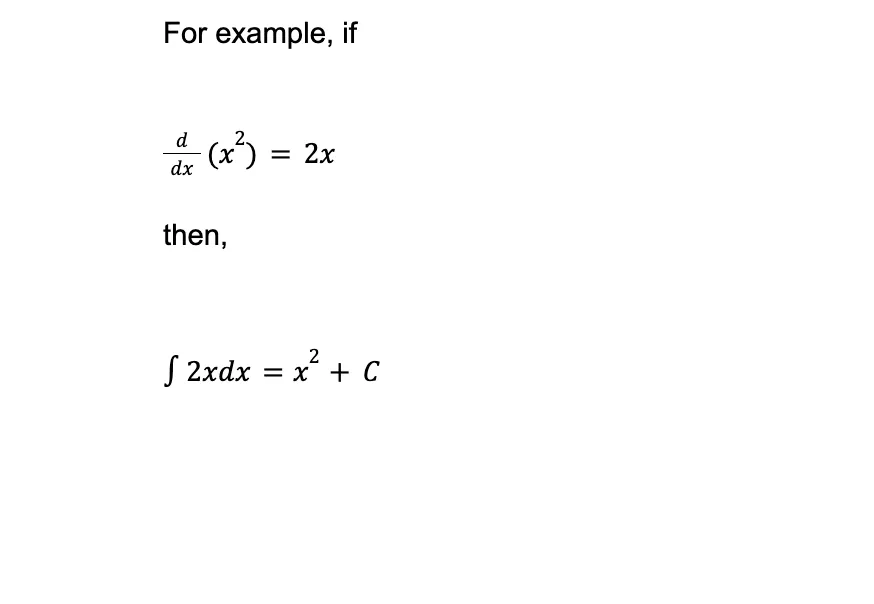
Here, C represents the arbitrary constant. Since the derivative of any constant is zero, differentiation cannot identify the constant in the original function. Therefore, you add C when evaluating an indefinite integral.
Why Is the Arbitrary Constant Important?
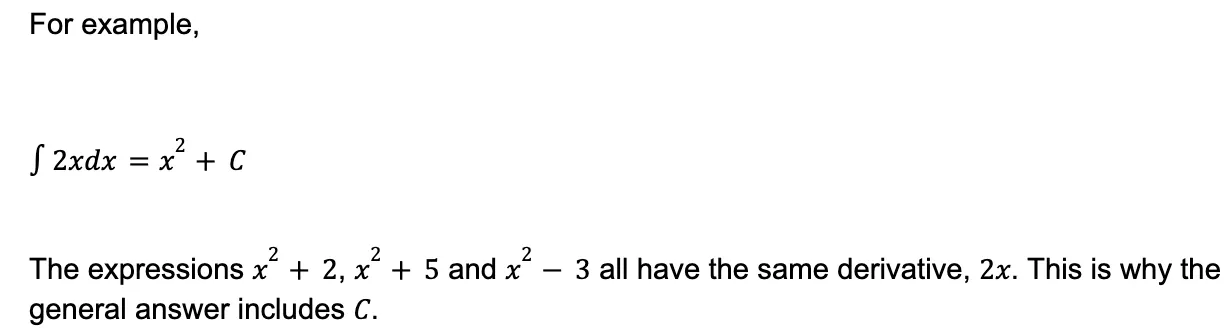
The arbitrary constant accounts for all functions that differ only by a constant but have the same derivative.
2. Basic Indefinite Integration Formulas for JEE Paper 2A
Memorising standard integration formulas can help you solve direct questions and recognise patterns in more complex expressions. Revise the following formulas regularly.
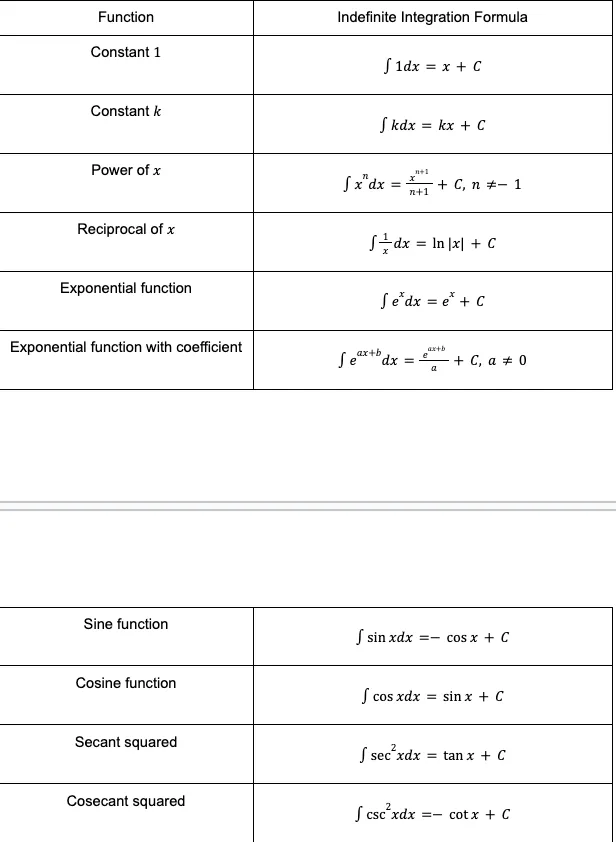
You should also revise the standard inverse trigonometric integration formulas:
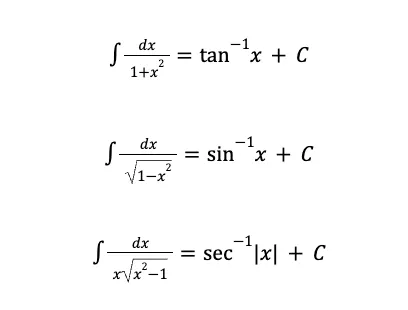
These formulas are useful when an integrand matches a standard form or can be simplified to one.
3. Algebra of Integration
Integration follows certain algebraic rules that allow you to split expressions, take constants outside integrals and simplify calculations.
Sum and Difference Rule
The integral of a sum or difference equals the sum or difference of the individual integrals.

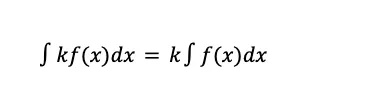
Constant Multiplication Rule
A constant multiplied by a function can be taken outside the integral.
Integration of a Linear Expression
For an expression involving ax+b, substitution can simplify the calculation.
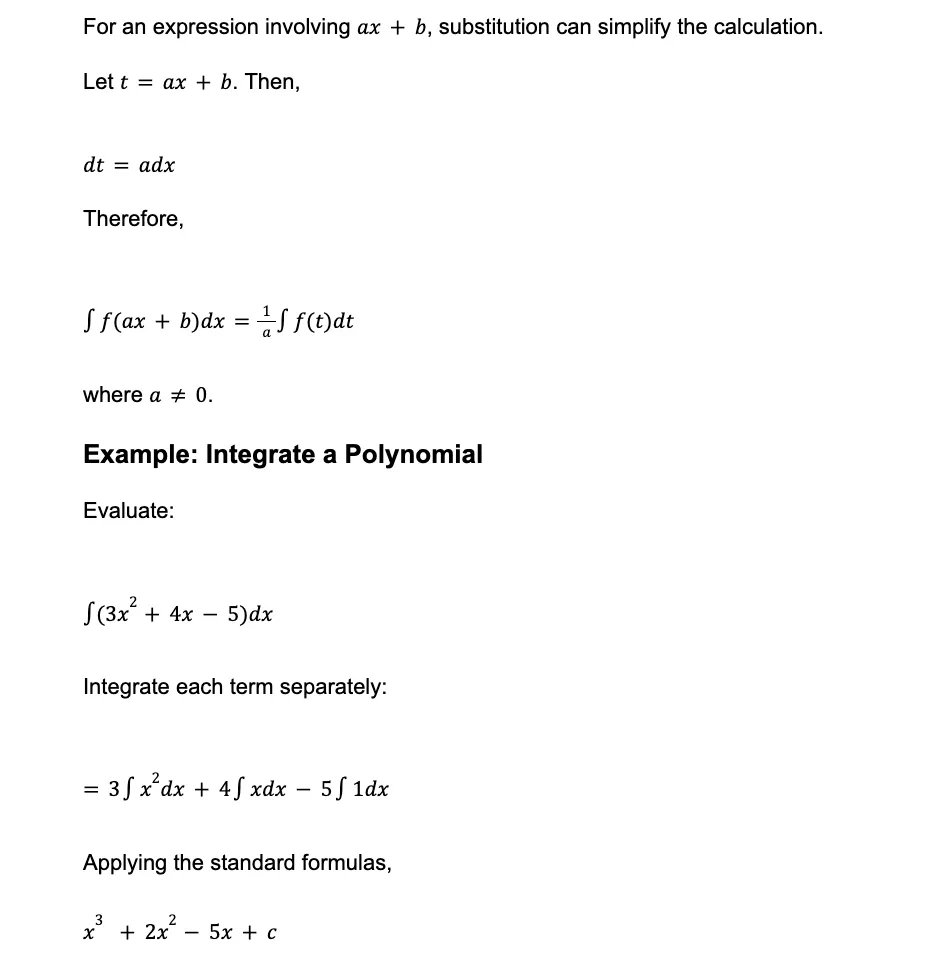
Splitting an expression into simpler terms is often the easiest approach when the integrand contains a polynomial.
4. Integration by Substitution
The substitution method is useful when an integrand contains a function and its derivative. It replaces a complicated expression with a simpler variable, making the integral easier to evaluate.
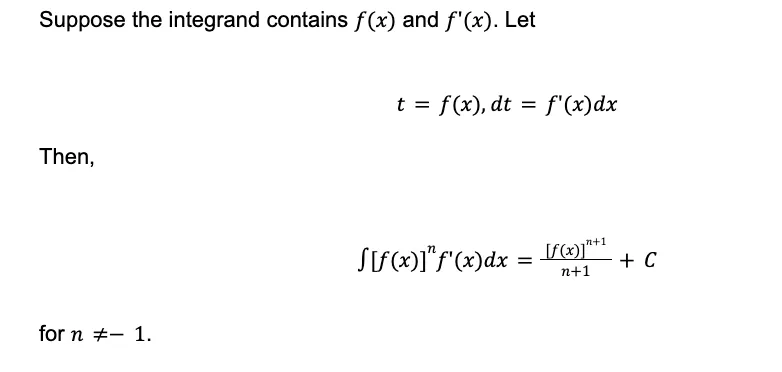
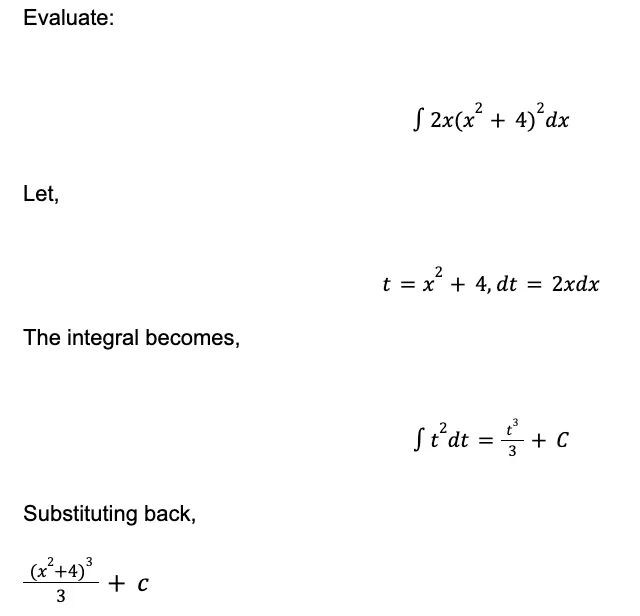
Example: Integrate Using Substitution
Logarithmic Integration Formula
A common substitution pattern occurs when the derivative of a function appears in the numerator and the function itself appears in the denominator.
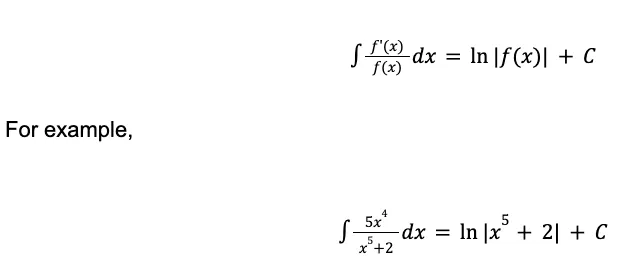
Recognising this pattern can save time in direct integration questions.
Integration of Trigonometric Functions
Trigonometric integration questions often require standard formulas, algebraic manipulation or the use of trigonometric identities. Learn the basic results first, then practise expressions that require simplification.
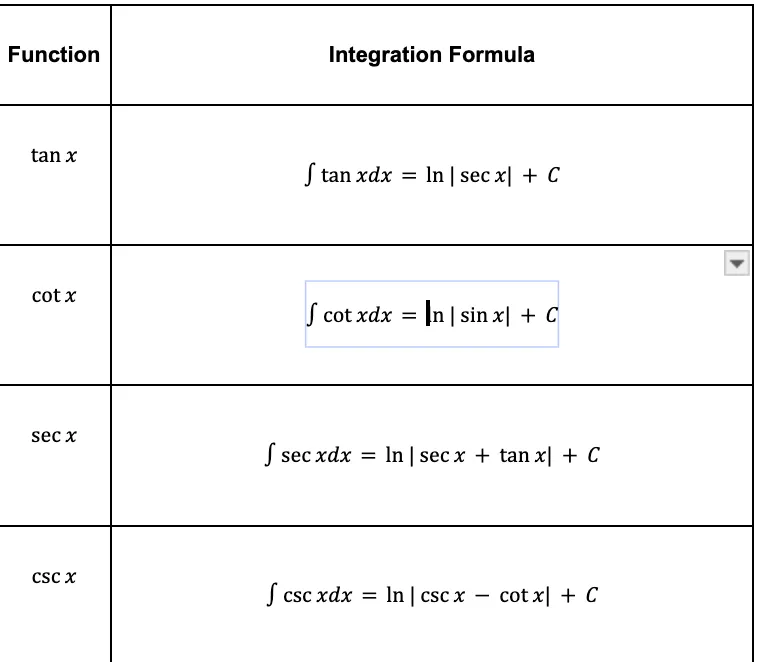
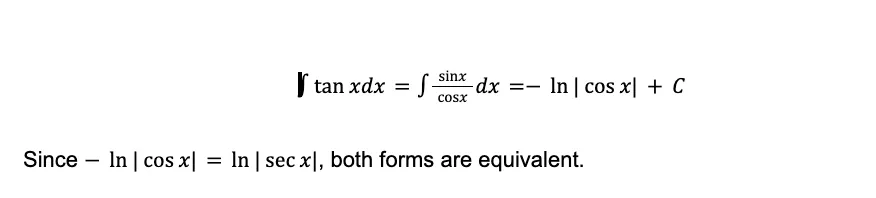
For example, the integral of x can be derived by writing it as xx and applying substitution.
Partial Fractions in Indefinite Integration
Partial fractions help simplify certain rational functions by expressing them as a sum of simpler fractions. This method is useful when the numerator and denominator are polynomials and the denominator can be factorised appropriately.
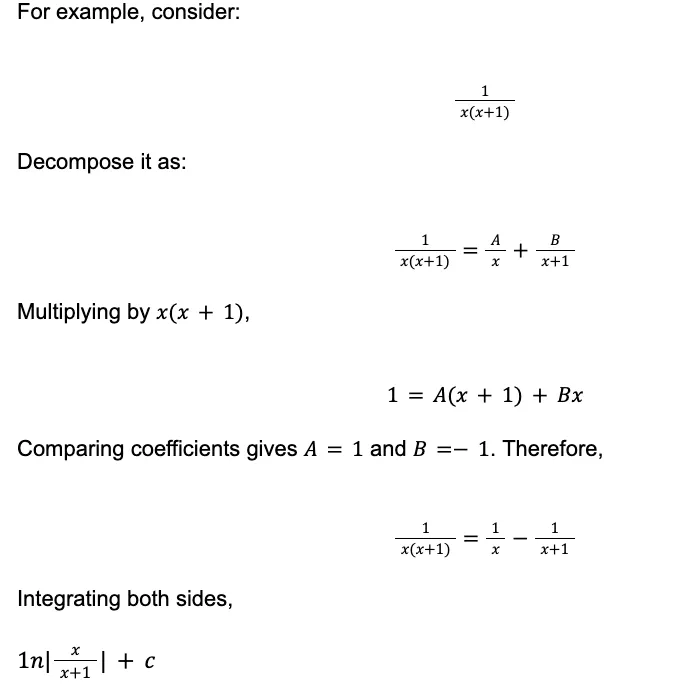
Before applying partial fractions, check whether the rational function is proper. If the numerator's degree is greater than or equal to the denominator's degree, polynomial division may be required first.
Integration by Parts and the ILATE Rule
Integration by parts is useful when the integrand is a product of two functions and direct integration or substitution is not convenient.
The formula is:

Here, u is the function you differentiate, while dv is the part you integrate to obtain v.
What Is the ILATE Rule?
The ILATE rule is a guideline for choosing u in integration by parts. It gives the following general order of preference:
-
I – Inverse trigonometric functions
-
L – Logarithmic functions
-
A – Algebraic functions
-
T – Trigonometric functions
-
E – Exponential functions
When an integrand contains different types of functions, the function that appears earlier in this order is generally selected as u. However, ILATE is a guideline rather than a universal rule; choose the function that makes the remaining integral simpler.
For further preparation, review the JEE B.Arch Mathematics syllabus and check how the topic fits into your overall Mathematics revision plan.
Common Mistakes to Avoid
While solving Indefinite Integration questions, watch out for these errors:
-
Forgetting +C: Include the arbitrary constant in the final answer.
-
Applying the power rule incorrectly: Remember that the formula xn+1n+1+C does not apply when n=-1.
-
Ignoring the derivative during substitution: Ensure that the differential matches the substitution you choose.
-
Choosing u without considering the remaining integral: Use ILATE as a guideline and check whether integration by parts simplifies the problem.
-
Dropping absolute value signs: Use absolute values in logarithmic results such as |x|, where required.
-
Skipping verification: Differentiate your final expression to confirm that it matches the original integrand.
Mastering Indefinite Integration requires more than memorising formulas; you need to recognise patterns and apply the right method with confidence. Practise substitution, partial fractions, trigonometric integrals and integration by parts, and verify your solutions through differentiation. Consistent practice with varied questions can improve your accuracy and problem-solving skills for JEE Main Paper 2A 2027. Keep the official syllabus as your reference and focus on building a strong foundation for the Mathematics section.
Indefinite Integration JEE Paper 2A FAQs
Which methods are used to solve Indefinite Integration questions?
What is the ILATE rule in integration?
How can you check an Indefinite Integration answer?
Why is +C added to an indefinite integral?





 Live & recorded classes available at easeDashboard for progress trackingLakhs of practice questions


