ICSE Class 10 Maths Selina Solutions Chapter 7 – Ratio and Proportion provides a clear understanding of ratios, proportions, and their important properties. This chapter explains how quantities are compared using ratios and how proportions establish relationships between them.
Students learn key properties such as invertendo, alternendo, componendo, and dividendo, which help in solving algebraic and word problems effectively. The step-by-step solutions improve conceptual clarity, accuracy, and confidence. Since the ICSE Board exams have started from 17 February, it is important for students to revise this chapter thoroughly to score well and strengthen their fundamental mathematical concepts.
ICSE Class 10 Maths Selina Solutions Chapter 7 Ratio and Proportion
ICSE Class 10 Maths Selina Solutions for Chapter 7, Ratio and Proportion (Including Properties and Uses), are prepared by the subject teachers. With simple, step-by-step explanations, these solutions make it easy for students to understand and master ratio and proportion, building a strong foundation in these important math concepts.
ICSE Class 10 Maths Selina Solutions Chapter 7 PDF
ICSE Class 10 Maths Selina Solutions for Chapter 7 Ratio and Proportion (Including Properties and Uses) are available in PDF format. This PDF contains detailed solutions to all the problems in the chapter, helping students understand and master the concepts of ratio and proportion. You can download the PDF using the link provided below to enhance your study and improve your problem-solving skills.
ICSE Class 10 Maths Selina Solutions Chapter 7 PDF
ICSE Class 10 Maths Selina Solutions Chapter 7 Exercise 7(A) Page No: 87
Below we have provided ICSE Class 10 Maths Selina Solutions Chapter 7 for the ease of the students –
1. If a: b = 5: 3, find: 5a – 3b/ 5a + 3b
Solution:
Given, a: b = 5: 3 So, a/b = 5/3 Now, 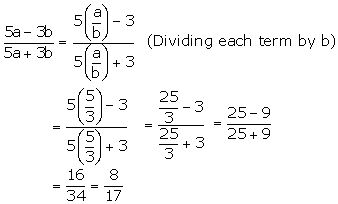
2. If x: y = 4: 7, find the value of (3x + 2y): (5x + y).
Solution:
Given, x: y = 4: 7 So, x/y = 4/7 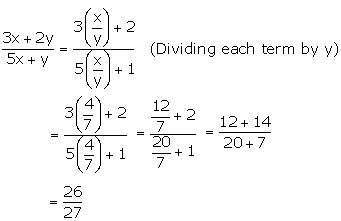
3. If a: b = 3: 8, find the value of 4a + 3b/ 6a – b.
Solution:
Given, a: b = 3: 8 So, a/b = 3/8 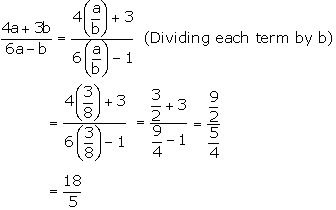
4. If (a – b): (a + b) = 1: 11, find the ratio (5a + 4b + 15): (5a – 4b + 3).
Solution:
Given, (a – b)/ (a + b) = 1/ 11 11a – 11b = a + b 10a = 12b a/b = 12/10 = 6/5 Now, lets take a = 6k and b = 5k So, 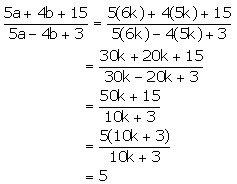 Therefore, (5a + 4b + 15): (5a – 4b + 3 = 5: 1
5. Find the number which bears the same ratio to 7/33 that 8/21 does to 4/9.
Solution:
Let consider the required number to be x/y Now, given that Ratio of 8/21 to 4/9 = (8/21)/ (4/9) = (8/21) x (9/4) = 6/7 Hence, we have (x/y)/ (7/33) = 6/7 x/y = (6/7)/ (7/33) = (6/7) x (7/33) = 2/11 Therefore, the required number is 2/11.
6. 
Solution:
Given, 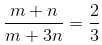 3(m + n) = 2(m + 3n) 3m + 3n = 2m + 6n m = 3n m/n = 3/1 Now,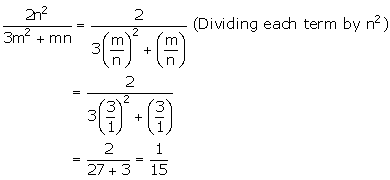
7. Find x/y; when x 2 + 6y 2 = 5xy
Solution:
Given, x 2 + 6y 2 = 5xy Dividing by y 2 both side, we have 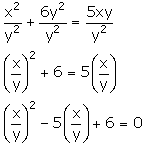 Let x/y = a So, a 2 – 5a + 6 = 0 (a – 2) (a – 3) = 0 a = 2 or a = 3 Therefore, x/y = 2 or 3
8. If the ratio between 8 and 11 is the same as the ratio of 2x – y to x + 2y, find the value of 7x/ 9y.
Solution:
Given, (2x – y)/ (x + 2y) = 8/11 On cross multiplying, we get 11(2x – y) = 8(x + 2y) 22x – 11y = 8x + 16y 14x = 27y x/y = 27/14 So, 7x / 9y = (7 x 27)/ (9 x 14) = 3/2
9. Divide Rs 1290 into A, B and C such that A is 2/5 of B and B: C = 4: 3.
Solution:
Given, B: C = 4: 3 so, B/C = 4/3 ⇒ C = (3/4) B And, A = (2/5) B We know that, A + B + C = Rs 1290 (2/5) B + B + (3/4) B = 1290 Taking L.C.M, (8B + 20B + 15B)/ 20 = 1290 43B = 1290 x 20 B = 1290 x 20/ 43 = 600 So, A = (2/5) x 600 = 240 And, C = (3/4) x 600 = 450 Therefore, A gets Rs 600, B gets Rs 240 and C gets Rs 450
10. A school has 630 students. The ratio of the number of boys to the number of girls is 3: 2. This ratio changes to 7: 5 after the admission of 90 new students. Find the number of newly admitted boys.
Solution:
Let’s consider the number of boys be 3x. Then, the number of girls = 2x ⇒ 3x + 2x = 630 5x = 630 x = 126 So, the number of boys = 3x = 3 x 126 = 378 And, number of girls = 2x = 2 x 126 = 252 After admission of 90 new students, Total number of students = 630 + 90 = 720 Here, let take the number of boys to be 7x And, the number of girls = 5x ⇒ 7x + 5x = 720 12x = 720 x = 720/12 x = 60 So, the number of boys = 7x = 7 x 60 = 420 And, the number of girls = 5x = 5 x 60 = 300 Therefore, the number of newly admitted boys = 420 – 378 = 42
11. What quantity must be subtracted from each term of the ratio 9: 17 to make it equal to 1: 3?
Solution:
Let x be subtracted from each term of the ratio 9: 17.  27 – 3x = 17 – x 10 = 2x x = 5 Therefore, the required number which should be subtracted is 5.
12. The monthly pocket money of Ravi and Sanjeev are in the ratio 5: 7. Their expenditures are in the ratio 3: 5. If each saves Rs. 80 every month, find their monthly pocket money.
Solution:
Given, The pocket money of Ravi and Sanjeev are in the ratio 5: 7 So, we can assume the pocket money of Ravi as 5k and that of Sanjeev as 7k. Also, give that The expenditure of Ravi and Snajeev are in the ratio 3: 5 So, it can be taken as the expenditure of Ravi as 3m and that of Sanjeev as 5m. And, each of them saves Rs 80 This can be expressed as below: 5k – 3m = 80 ….. (a) 7k – 5m = 80 …… (b) Solving equations (a) and (b), we have k = 40 and m = 40 Therefore, the monthly pocket money of Ravi is Rs 5k = Rs 5 x 40 = Rs 200 and that of Sanjeev is Rs 7k = Rs 7 x 40 = Rs 280.
13. The work done by (x – 2) men in (4x + 1) days and the work done by (4x + 1) men in (2x – 3) days are in the ratio 3: 8. Find the value of x.
Solution:
On assuming that the same amount of work is done one day by all the men and one day work of each man = 1 units, we have Amount of work done by (x – 2) men in (4x + 1) days = Amount of work done by (x – 2)*(4x + 1) men in one day = (x – 2)(4x + 1) units of work Similarly, we have Amount of work done by (4x + 1) men in (2x – 3) days = (4x + 1)*(2x – 3) units of work Then according to the question, we have  8x – 16 = 6x – 9 2x = 7 x = 7/2
14. The bus fare between two cities is increased in the ratio 7: 9. Find the increase in the fare, if:
(i) the original fare is Rs 245;
(ii) the increased fare is Rs 207.
Solution:
From the question we have, Increased (new) bus fare = (9/7) x original bus fare (i) We have, Increased (new) bus fare = 9/7 x Rs 245 = Rs 315 Thus, the increase in fare = Rs 315 – Rs 245 = Rs 70 (ii) Here we have, Rs 207 = (9/7) x original bus fare Original bus fare = Rs 207 x 7/9 = Rs 161 Thus, the increase in fare = Rs 207 – Rs 161 = Rs 46
15. By increasing the cost of entry ticket to a fair in the ratio 10: 13, the number of visitors to the fair has decreased in the ratio 6: 5. In what ratio has the total collection increased or decreased?
Solution:
Let’s take the cost of the entry ticket initially and at present to be 10x and 13x respectively. And let the number of visitors initially and at present be 6y and 5y respectively. So, Initially, the total collection = 10x x 6y = 60 xy And at present, the total collection = 13x x 5y = 65 xy Hence, The ratio of total collection = 60 xy: 65 xy = 12: 13 Therefore, it’s seen that the total collection has been increased in the ratio 12: 13.
ICSE Class 10 Maths Selina Solutions Chapter 7 Exercise 7(B) Page No: 94
1. Find the fourth proportional to:
(i) 1.5, 4.5 and 3.5 (ii) 3a, 6a 2 and 2ab 2
Solution:
(i) Let’s assume the fourth proportional to 1.5, 4.5 and 3.5 be x. 1.5: 4.5 = 3.5: x 1.5 × x = 3.5 × 4.5 x = (3.5 x 4.5)/ 1.5 x = 10.5 (ii) Let’s assume the fourth proportional to 3a, 6a 2 and 2ab 2 be x. 3a: 6a 2 = 2ab 2 : x 3a × x = 2ab 2 x 6a 2 3a × x = 12a 3 b 2 x = 4a 2 b 2
2. Find the third proportional to:
(i)  and 4 (ii) a – b and a 2 – b 2
Solution:
(i) Let’s take the third proportional to  and 4 be x. So,
  , 4, x are in continued proportion. 8/3: 4 = 4: x (8/3)/ 4 = 4/x x = 16 x 3/8 = 6 (ii) Let’s take the third proportional to a – b and a 2 – b 2 be x. So, a – b, a 2 – b 2 , x are in continued proportion. a – b: a 2 – b 2 = a 2 – b 2 : x
3. Find the mean proportional between:
(i) 6 + 3√3 and 8 – 4√3
(ii) a – b and a 3 – a 2 b
Solution:
(i) Let the mean proportional between 6 + 3√3 and 8 – 4√3 be x. So, 6 + 3√3, x and 8 – 4√3 are in continued proportion. 6 + 3√3 : x = x : 8 – 4√3 x × x = (6 + 3√3) (8 – 4√3) x 2 = 48 + 24√3 – 24√3 – 36 x 2 = 12 x= 2√3 (ii) Let the mean proportional between a – b and a 3 – a 2 b be x. a – b, x, a 3 – a 2 b are in continued proportion. a – b: x = x: a 3 – a 2 b x x x = (a – b) (a 3 – a 2 b) x 2 = (a – b) a 2 (a – b) = [a(a – b)] 2 x = a(a – b)
4. If x + 5 is the mean proportional between x + 2 and x + 9; find the value of x.
Solution:
Given, x + 5 is the mean proportional between x + 2 and x + 9. So, (x + 2), (x + 5) and (x + 9) are in continued proportion. (x + 2): (x + 5) = (x + 5): (x + 9) (x + 2)/ (x + 5) = (x + 5)/ (x + 9) (x + 5) 2 = (x + 2)(x + 9) x 2 + 25 + 10x = x 2 + 2x + 9x + 18 25 – 18 = 11x – 10x x = 7
5. If x 2 , 4 and 9 are in continued proportion, find x.
Solution:
Given, x 2 , 4 and 9 are in continued proportion So, we have x 2 /4 = 4/9 x 2 = 16/9 Thus, x = 4/3
6. What least number must be added to each of the numbers 6, 15, 20 and 43 to make them proportional?
Solution:
Let assume the number added to be x. So, (6 + x): (15 + x) :: (20 + x): (43 + x) (6 + x)/ (15 + x) = (20 + x)/ (43 + x) (6 + x) (43 + x) = (20 + x) (43 + x) 258 + 6x + 43x + x 2 = 300 + 20x = 15x + x 2 49x – 35x = 300 – 258 14x = 42 x = 3 Therefore, the required number which should be added is 3.
7. (i) If a, b, c are in continued proportion,
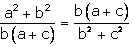 Show that:
Solution:
Given, a, b, c are in continued proportion. So, we have a/b = b/c ⇒ b 2 = ac Now, (a 2 + b 2 ) (b 2 + c 2 ) = (a 2 + ac) (ac + c 2 ) [As b 2 = ac] = a(a + c) c(a + c) = ac(a + c) 2 = b 2 (a + c) 2 (a 2 + b 2 ) (b 2 + c 2 ) = [b(a + c)][b(a + c)] Thus, L.H.S = R.H.S 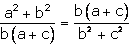 – Hence Proved
(ii) If a, b, c are in continued proportion and a(b – c) = 2b, prove that: a – c = 2(a + b)/ a
Solution:
Given, a, b, c are in continued proportion. So, we have a/b = b/c ⇒ b 2 = ac And, given a(b – c) = 2b ab – ac = 2b ab – b 2 = 2b ab = 2b + b 2 ab = b(2 + b) a = b + 2 a – b = 2 Now, taking the L.H.S we have L.H.S = a – c = a(a – c)/ a [Multiply and divide by a] = a 2 – ac/ a = a 2 – b 2 / a = (a – b) (a + b)/a = 2(a + b)/a = R.H.S – Hence Proved 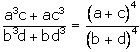 (iii) If a/b = c/d, show that:
Solution:
Let’s take a/b = c/d = k So, a = bk and c = dk Taking L.H.S,
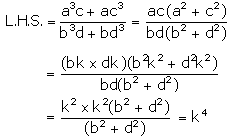
Now, taking the R.H.S  Thus, L.H.S = R.H.S – Hence Proved
8. What least number must be subtracted from each of the numbers 7, 17 and 47 so that the remainders are in continued proportion?
Solution:
Let’s assume the number subtracted to be x. So, we have (7 – x): (17 – x):: (17 – x): (47 – x)  (7 – x)(17 – x) = (17 – x) 2 329 – 47x – 7x + x 2 = 289 – 34x + x 2 329 – 289 = -34x + 54x 20x = 40 x = 2 Therefore, the required number which must be subtracted is 2.
ICSE Class 10 Maths Selina Solutions Chapter 7 Exercise 7(C) Page No: 101
1. If a : b = c : d, prove that:
(i) 5a + 7b : 5a – 7b = 5c + 7d : 5c – 7d.
(ii) (9a + 13b) (9c – 13d) = (9c + 13d) (9a – 13b).
(iii) xa + yb : xc + yd = b : d.
Solution:
(i) Given, a/b = c/d 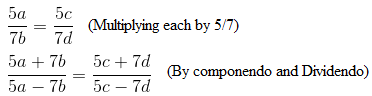 (ii) Given, a/b = c/d
  On cross-multiplication we have, (9a + 13b)(9c – 13d) = (9c + 13d)(9a – 13b) (iii) Given, a/b = c/d
 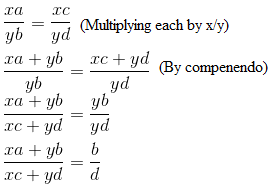 – Hence Proved
2. If a : b = c : d, prove that:
(6a + 7b) (3c – 4d) = (6c + 7d) (3a – 4b).
Solution:
Given, a/b = c/d 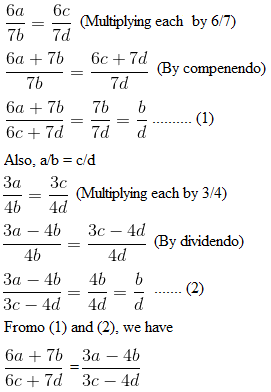 (6a + 7b)(3c – 4d) = (3a – 4b)(6c + 7d) – Hence Proved
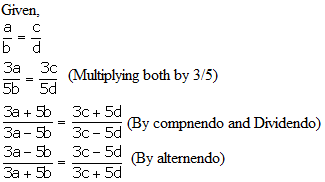
3. Given, a/b = c/d, prove that:
(3a – 5b)/ (3a + 5b) = (3c – 5d)(3c + 5d)
Solution:
4. If 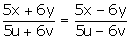 ;
;
Then prove that x: y = u: v
Solution:
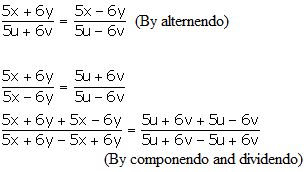 10x/ 12y = 10u/ 12v Thus, x/y = u/v ⇒ x: y = u: v
5. If (7a + 8b) (7c – 8d) = (7a – 8b) (7c + 8d);
Prove that a: b = c: d
Solution:
The given can the rewritten as, 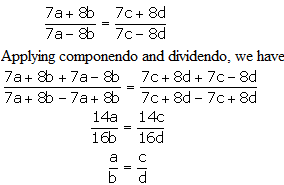
6. (i) If x = 6ab/ (a + b), find the value of:
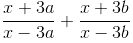
Solution:
Given, x = 6ab/ (a + b) ⇒ x/3a = 2b/ a + b Now, applying componendo and dividendo we have 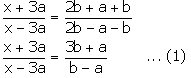 Again, x = 6ab/ (a + b) ⇒ x/3b = 2a/ a + b Now, applying componendo and dividendo we have
 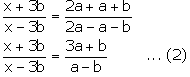 From (1) and (2), we get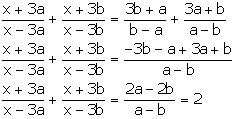
(ii) If a = 4√6/ (√2 + √3), find the value of:
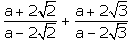
Solution:
Given, a = 4√6/ (√2 + √3) a/2√2 = 2√3/ (√2 + √3) Now, applying componendo and dividendo we have 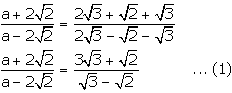 Again, a = 4√6/ (√2 + √3) a/2√3 = 2√2/ (√2 + √3) Now, applying componendo and dividendo we have
 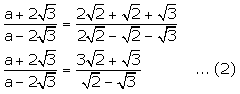 From (1) and (2), we have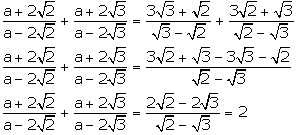
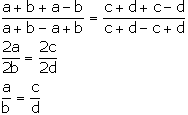
7. If (a + b + c + d) (a – b – c + d) = (a + b – c – d) (a – b + c – d), prove that a: b = c: d.
Solution:
Rewriting the given, we have 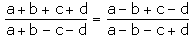 Now, applying componendo and dividendo
 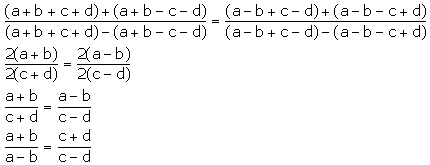 Applying componendo and dividendo again, we get
  – Hence Proved
ICSE Class 10 Maths Selina Solutions Chapter 7 Exercise 7(D) Page No: 102
1. If a: b = 3: 5, find:
(10a + 3b): (5a + 2b)
Solution:
Given, a/b = 3/5 (10a + 3b)/ (5a + 2b) 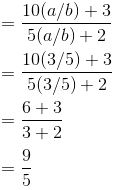
2. If 5x + 6y: 8x + 5y = 8: 9, find x: y.
Solution:
 Given, On cross multiplying, we get 45x + 54y = 64x + 40y 14y = 19x Thus, x/y = 14/19
3. If (3x – 4y): (2x – 3y) = (5x – 6y): (4x – 5y), find x: y.
Solution:
Given, (3x – 4y): (2x – 3y) = (5x – 6y): (4x – 5y) This can be rewritten as, 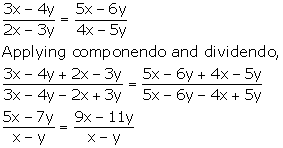 5x – 7y = 9x – 11y 4y = 4x x/y = 1/1 Thus, x: y = 1: 1
4. Find the:
(i) duplicate ratio of 2√2: 3√5
(ii) triplicate ratio of 2a: 3b
(iii) sub-duplicate ratio of 9x 2 a 4 : 25y 6 b 2
(iv) sub-triplicate ratio of 216: 343
(v) reciprocal ratio of 3: 5
(vi) ratio compounded of the duplicate ratio of 5: 6, the reciprocal ratio of 25: 42 and the sub-duplicate ratio of 36: 49.
Solution:
(i) Duplicate ratio of 2√2: 3√5 = (2√2) 2 : (3√5) 2 = 8: 45 (ii) Triplicate ratio of 2a: 3b = (2a) 3 : (3b) 3 = 8a 3 : 27b 3 (iii) Sub-duplicate ratio of 9x 2 a 4 : 25y 6 b 2 = √(9x 2 a 4 ): √(25y 6 b 2 ) = 3xa 2 : 5y 3 b (iv) Sub-triplicate ratio of 216: 343 = (216) 1/3 : (343) 1/3 = 6: 7 (v) Reciprocal ratio of 3: 5 = 5: 3 (vi) Duplicate ratio of 5: 6 = 25: 36 Reciprocal ratio of 25: 42 = 42: 25 Sub-duplicate ratio of 36: 49 = 6: 7 Required compound ratio = 
5. Find the value of x, if:
(i) (2x + 3): (5x – 38) is the duplicate ratio of √5: √6.
(ii) (2x + 1): (3x + 13) is the sub-duplicate ratio of 9: 25.
(iii) (3x – 7): (4x + 3) is the sub-triplicate ratio of 8: 27.
Solution:
(i) (2x + 3): (5x – 38) is the duplicate ratio of √5: √6 And, the duplicate ratio of √5: √6 = 5: 6 So, (2x + 3)/ (5x – 38) = 5/6 12x + 18 = 25x – 190 25x – 12x = 190 + 18 13x = 208 x = 208/13 = 16 (ii) (2x + 1): (3x + 13) is the sub-duplicate ratio of 9: 25 Then the sub-duplicate ratio of 9: 25 = 3: 5 (2x + 1)/ (3x + 13) = 3/5 10x + 5 = 9x + 39 x = 34 (iii) (3x – 7): (4x + 3) is the sub-triplicate ratio of 8: 27 And the sub-triplicate ratio of 8: 27 = 2: 3 (3x – 7)/ (4x + 3) = 2/3 9x – 8x = 6 + 21 x = 27
6. What quantity must be added to each term of the ratio x: y so that it may become equal to c: d?
Solution:
Let’s assume the required quantity which has to be added be p. So, we have  dx + pd = cy + cp pd – cp = cy – dx p(d – c) = cy – dx p = cy –dx/ (d – c)
7. A woman reduces her weight in the ratio 7: 5. What does her weight become if originally it was 84 kg?
Solution:
Let’s consider the woman’s reduced weight as x. Given, the original weight = 84 kg So, we have 84: x = 7: 5 84/x = 7/5 84 x 5 = 7x x = (84 x 5)/ 7 x = 60 Therefore, the reduced weight of the woman is 60 kg.
8. If 15(2x 2 – y 2 ) = 7xy, find x: y; if x and y both are positive.
Solution:
15(2x 2 – y 2 ) = 7xy  Let’s take the substitution as x/y = a 2a – 1/a = 7/15 (2a 2 – 1)/ a = 7/15 30a 2 – 15 = 7a 30a 2 – 7a – 15 = 0 30a 2 – 25a + 18a – 15 = 0 5a(6a – 5) + 3(6a – 5) = 0 (6a – 5) (5a + 3) = 0 So, 6a – 5 = 0 or 5a + 3 = 0 a = 5/6 or a = -3/5 As, a cannot be taken negative (ratio) Thus, a = 5/6 x/y = 5/6 Hence, x: y = 5: 6
9. Find the:
(i) fourth proportional to 2xy, x 2 and y 2 .
(ii) third proportional to a 2 – b 2 and a + b.
(iii) mean proportional to (x – y) and (x 3 – x 2 y).
Solution:
(i) Let the fourth proportional to 2xy, x 2 and y 2 be n. 2xy: x 2 = y 2 : n 2xy × n = x 2 × y 2  n = (ii) Let the third proportional to a 2 – b 2 and a + b be n. a 2 – b 2 , a + b and n are in continued proportion. a 2 – b 2 : a + b = a + b: n n =
  (iii) Let the mean proportional to (x – y) and (x 3 – x 2 y) be n. (x – y), n, (x 3 – x 2 y) are in continued proportion (x – y): n = n: (x 3 – x 2 y) n 2 = (x -y) (x 3 – x 2 y) n 2 = (x -y) x 2 (x – y) n 2 = x 2 (x – y) 2 n = x(x – y)
10. Find two numbers such that the mean proportional between them is 14 and third proportional to them is 112.
Solution:
Let’s assume the required numbers be a and b. Given, 14 is the mean proportional between a and b. a: 14 = 14: b ab = 196 a = 196/b …. (1) Also, given, third proportional to a and b is 112. a: b = b: 112 b 2 = 112a …. (2) Using (1), we have: b 2 = 112 × (196/b) b 3 = 14 3 x 2 3 b = 28 From (1), a = 196/ 28 = 7 Therefore, the two numbers are 7 and 28.
11. If x and y be unequal and x: y is the duplicate ratio of x + z and y + z, prove that z is mean proportional between x and y.
Solution:
Given,  x(y 2 + z 2 + 2yz) = y(x 2 + z 2 + 2xz) xy 2 + xz 2 + 2yzx = x 2 y + z 2 y + 2xzy xy 2 + xz 2 = x 2 y + z 2 y xy(y – x) = z 2 (y – x) xy = z 2 Therefore, z is mean proportional between x and y.
12. If  , find the value of
  .
.
Solution:
x = 2ab/ (a + b) x/a = 2b/(a + b) Applying componendo and dividendo, 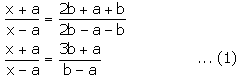 Also, x = 2ab/ (a + b) x/b = 2a/ (a + b) Applying componendo and dividendo, we have
 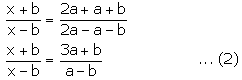 Now, comparing (1) and (2) we have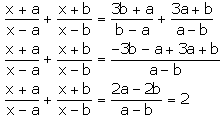
13. If (4a + 9b) (4c – 9d) = (4a – 9b) (4c + 9d), prove that:
a: b = c: d.
Solution:
Given, 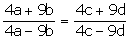 Applying componendo and dividendo, we get
  8a/18b = 8c/18d a/b = c/d – Hence Proved
Last Minute Preparation Tips for ICSE Class 10 Maths Selina Solutions Chapter 7
With the ICSE Board exams already started from 17 February, this is the right time to focus on quick revision strategies. Ratio and Proportion is a scoring chapter if revised smartly and systematically.
1. Revise Key Definitions Clearly
Go through the basic definitions of ratio and proportion once again. Understanding the core concept helps you solve application-based questions confidently.
2. Memorize Important Properties
Revise properties like invertendo, alternendo, componendo, and dividendo carefully. Make sure you know when and how to apply them in algebraic problems.
3. Practice Standard Question Types
Solve important examples and 4–5 representative questions from each exercise. Focus more on word problems and proportional equations.
4. Avoid Calculation Errors
Be careful during cross multiplication and simplification. Most mistakes in this chapter happen due to small arithmetic errors.
5. Follow Proper Stepwise Method
Write all steps clearly in the exam. Even if the final answer is wrong, proper steps can help you secure partial marks.
6. Manage Time Smartly
Ratio and proportion questions are generally direct and scoring. Attempt them early to build confidence and save time.
7. Recheck Final Answers
Substitute values back wherever possible. This ensures your proportion or equation is correctly solved.