ICSE Class 10 Maths Selina Solutions Chapter 8 Remainder and Factor Theorems provides a detailed and student-friendly guide to understanding and applying these important algebraic concepts. Here, we have provided ICSE Class 10 Maths Selina Solutions Chapter 8 prepared by our teachers to help students prepare effectively for their examinations.
With clear step-by-step explanations and solved examples, these solutions simplify complex polynomial problems and improve accuracy. Since the ICSE Board exams have started from 17 February, timely revision and practice of this chapter will help students strengthen their algebraic foundation and score confidently in the examination.
ICSE Class 10 Maths Selina Solutions Chapter 8 Remainder and Factor Theorems Overview
These solutions are prepared by subject teachers for ICSE Class 10 Maths Selina Solutions Chapter 8 Remainder and Factor Theorems. They give clear and detailed explanations, showing step-by-step how to solve problems about remainders and factors of polynomial expressions. This helps students learn these important math concepts well. By using these solutions, students can improve their problem-solving skills and gain confidence in solving algebra problems.
ICSE Class 10 Maths Selina Solutions Chapter 8 PDF
The PDF link for the ICSE Class 10 Maths Selina Solutions Chapter 8 Remainder and Factor Theorems is available below. By accessing this PDF, students can enhance their learning experience and effectively prepare for their exams.
ICSE Class 10 Maths Selina Solutions Chapter 8 PDF
ICSE Class 10 Maths Selina Solutions Chapter 8 Remainder and Factor Theorems
Below we have provided ICSE Class 10 Maths Selina Solutions Chapter 8 for the ease of the students –
1. Show that (x – 1) is a factor of x 3 – 7x 2 + 14x – 8. Hence, completely factorise the given expression.
Solution:
Let f(x) = x 3 – 7x 2 + 14x – 8 Then, for x = 1 f(1) = (1) 3 – 7(1) 2 + 14(1) – 8 = 1 – 7 + 14 – 8 = 0 Thus, (x – 1) is a factor of f(x). Now, performing long division we have 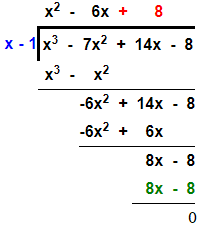 Hence, f(x) = (x – 1) (x 2 – 6x + 8) = (x – 1) (x 2 – 4x – 2x + 8) = (x – 1) [x(x – 4) -2(x – 4)] = (x – 1) (x – 4) (x – 2)
2. Using Remainder Theorem, factorise:
x 3 + 10x 2 – 37x + 26 completely.
Solution:
Let f(x) = x 3 + 10x 2 – 37x + 26 From remainder theorem, we know that For x = 1, the value of f(x) is the remainder f(1) = (1) 3 + 10(1) 2 – 37(1) + 26 = 1 + 10 – 37 + 26 = 0 As f(1) = 0, x – 1 is a factor of f(x). Now, performing long division we have 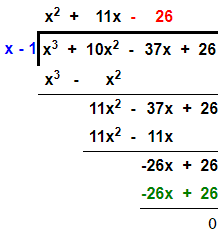 Thus, f(x) = (x – 1) (x 2 + 11x – 26) = (x – 1) (x 2 + 13x – 2x – 26) = (x – 1) [x(x + 13) – 2(x + 13)] = (x – 1) (x + 13) (x – 2)
3. When x 3 + 3x 2 – mx + 4 is divided by x – 2, the remainder is m + 3. Find the value of m.
Solution:
Let f(x) = x 3 + 3x 2 – mx + 4 From the question, we have f(2) = m + 3 (2) 3 + 3(2) 2 – m(2) + 4 = m + 3 8 + 12 – 2m + 4 = m + 3 24 – 3 = m + 2m 3m = 21 Thus, m = 7
4. What should be subtracted from 3x 3 – 8x 2 + 4x – 3, so that the resulting expression has x + 2 as a factor?
Solution:
Let’s assume the required number to be k. And let f(x) = 3x 3 – 8x 2 + 4x – 3 – k From the question, we have f(-2) = 0 3(-2) 3 – 8(-2) 2 + 4(-2) – 3 – k = 0 -24 – 32 – 8 – 3 – k = 0 -67 – k = 0 k = -67 Therefore, the required number is -67.
5. If (x + 1) and (x – 2) are factors of x 3 + (a + 1)x 2 – (b – 2)x – 6, find the values of a and b. And then, factorise the given expression completely.
Solution:
Let’s take f(x) = x 3 + (a + 1)x 2 – (b – 2)x – 6 As, (x + 1) is a factor of f(x). Then, remainder = f(-1) = 0 (-1) 3 + (a + 1)(-1) 2 – (b – 2) (-1) – 6 = 0 -1 + (a + 1) + (b – 2) – 6 = 0 a + b – 8 = 0 … (1) And as, (x – 2) is a factor of f(x). Then, remainder = f(2) = 0 (2) 3 + (a + 1) (2) 2 – (b – 2) (2) – 6 = 0 8 + 4a + 4 – 2b + 4 – 6 = 0 4a – 2b + 10 = 0 2a – b + 5 = 0 … (2) Adding (1) and (2), we get 3a – 3 = 0 Thus, a = 1 Substituting the value of a in (i), we get, 1 + b – 8 = 0 Thus, b = 7 Hence, f(x) = x 3 + 2x 2 – 5x – 6 Now as (x + 1) and (x – 2) are factors of f(x). So, (x + 1) (x – 2) = x 2 – x – 2 is also a factor of f(x). 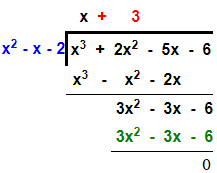 Therefore, f(x) = x 3 + 2x 2 – 5x – 6 = (x + 1) (x – 2) (x + 3)
6. If x – 2 is a factor of x 2 + ax + b and a + b = 1, find the values of a and b.
Solution:
Let f(x) = x 2 + ax + b Given, (x – 2) is a factor of f(x). Then, remainder = f(2) = 0 (2) 2 + a(2) + b = 0 4 + 2a + b = 0 2a + b = -4 … (1) And also given that, a + b = 1 … (2) Subtracting (2) from (1), we have a = -5 On substituting the value of a in (2), we have b = 1 – (-5) = 6
7. Factorise x 3 + 6x 2 + 11x + 6 completely using factor theorem.
Solution:
Let f(x) = x 3 + 6x 2 + 11x + 6 For x = -1, the value of f(x) is f(-1) = (-1) 3 + 6(-1) 2 + 11(-1) + 6 = -1 + 6 – 11 + 6 = 12 – 12 = 0 Thus, (x + 1) is a factor of f(x). 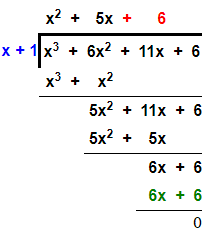 Therefore, f(x) = (x + 1) (x 2 + 5x + 6) = (x + 1) (x 2 + 3x + 2x + 6) = (x + 1) [x(x + 3) + 2(x + 3)] = (x + 1) (x + 3) (x + 2)
8. Find the value of ‘m’, if mx 3 + 2x 2 – 3 and x 2 – mx + 4 leave the same remainder when each is divided by x – 2.
Solution:
Let f(x) = mx 3 + 2x 2 – 3 and g(x) = x 2 – mx + 4 From the question, it’s given that f(x) and g(x) leave the same remainder when divided by (x – 2). So, we have: f(2) = g(2) m(2) 3 + 2(2) 2 – 3 = (2) 2 – m(2) + 4 8m + 8 – 3 = 4 – 2m + 4 10m = 3 Thus, m = 3/10
Last Minute Preparation Tips for ICSE Class 10 Maths Selina Solutions Chapter 8
With the ICSE Board exams already started from 17 February, this is the perfect time for quick and focused revision. Remainder and Factor Theorems are scoring topics if concepts and steps are clear.
1. Revise the Statements of Both Theorems
Clearly understand the statements of the Remainder Theorem and Factor Theorem. Many mistakes happen when students confuse their applications.
2. Practice Substitution Carefully
When applying the Remainder Theorem, substitute the value correctly into the polynomial. Be careful with signs and powers to avoid calculation errors.
3. Focus on Factor Verification
For Factor Theorem questions, remember that if the remainder is zero, the given expression is a factor. Always show proper working steps.
4. Revise Polynomial Division Method
Go through long division or synthetic division once more. These methods are frequently used in factor-related problems.
5. Avoid Sign Errors
Most errors in this chapter happen due to incorrect handling of negative signs. Double-check each step while simplifying.
6. Solve Previous Year Questions
Practice 3–4 important board-level questions for better confidence. This helps in understanding the exam pattern and marking scheme.
7. Manage Time Smartly
These questions are generally direct and scoring. Attempt them carefully but efficiently to save time for lengthy alge