








JEE Capacitance Notes by Physics Wallah
 Mehjabeen Hussain16 Oct, 2026
Capacitance is a chapter where JEE tests your reasoning more than your memory. Problems rarely ask for a single formula. They ask what happens to charge, potential difference, field and energy when a slab slides in, a switch is flipped, or a second capacitor is connected. A wrong assumption about what stays constant can undo an otherwise correct solution, and in JEE Advanced, several of these steps are often combined in one question.
Physics Wallah’s Capacitance notes organise the chapter around that decision. They begin with the basic relation and the capacitance of standard geometries, then move through energy, combinations, dielectrics, charge sharing, breakdown limits and RC circuits. Identify the circuit condition before writing any equation, note the assumptions behind each formula and practise problems that mix two or more of these ideas.
Capacitance and Its Basic Formula
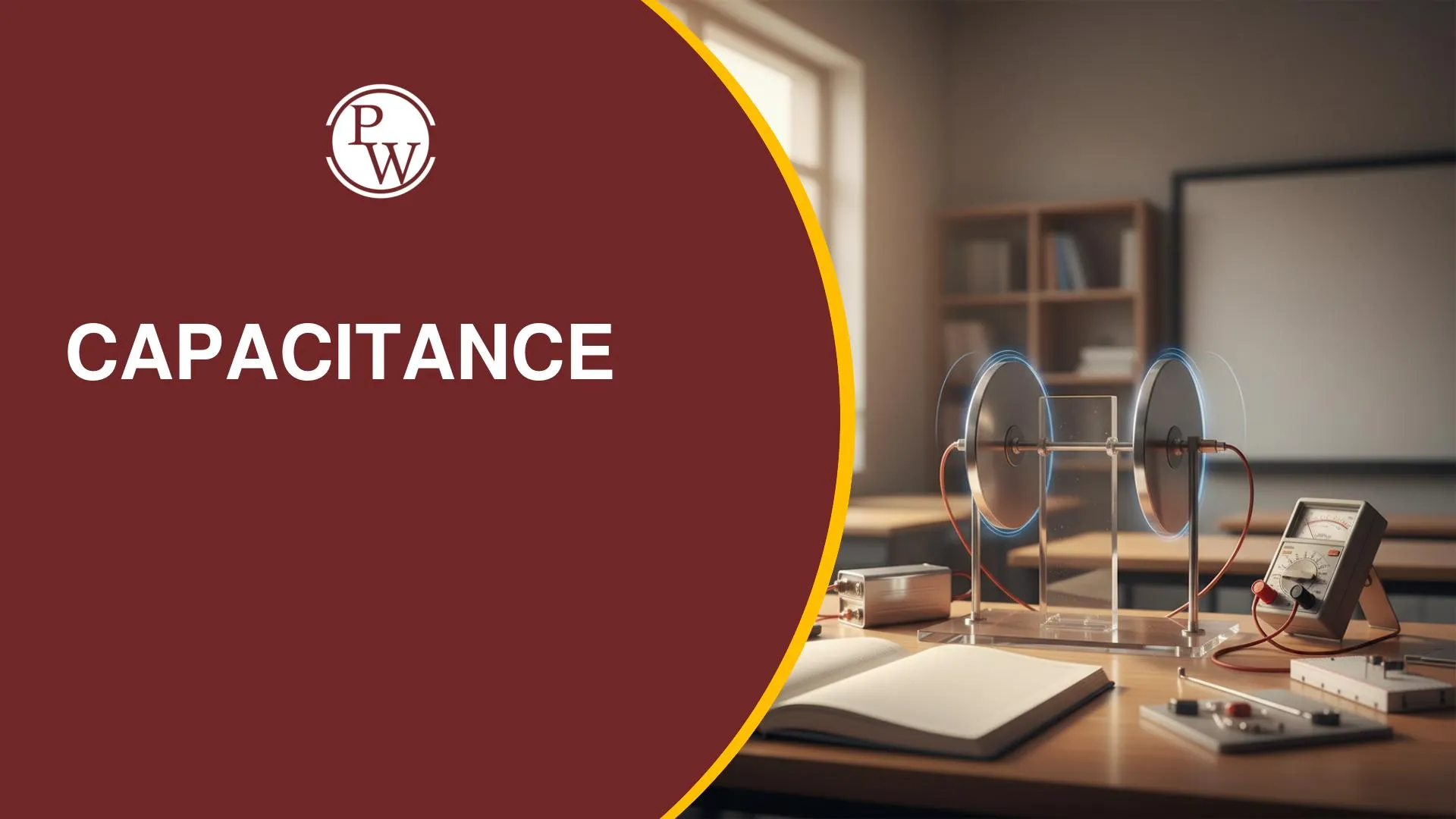
A capacitor consists of two conductors separated by an insulating medium called a dielectric. It stores electrical energy in the electric field between its conductors and can release that energy when required.
The charge stored is directly proportional to the potential difference across the plates:
-
Q = CV
-
C = Q / V
Here Q is the charge, V is the potential difference and C is the capacitance.
For two conductors at potentials V₁ and V₂: Q = C (V₁ − V₂)
Capacitance depends on the geometry of the conductors and the medium between them, not directly on the charge or potential difference.
Unit of Capacitance
The SI unit is the farad (F), where 1 F = 1 C/V.
-
1 mF = 10⁻³ F
-
1 μF = 10⁻⁶ F
-
1 nF = 10⁻⁹ F
-
1 pF = 10⁻¹² F
Capacitance of Different Capacitors
1. Parallel-Plate Capacitor
For plates of area A separated by distance d, in air or vacuum:
C = ε₀ A / d
If a dielectric of constant K completely fills the gap:
C = K ε₀ A / d = K C₀
Here ε₀ is the permittivity of free space and C₀ is the original capacitance.
-
Capacitance increases with plate area: C ∝ A.
-
Capacitance decreases with plate separation: C ∝ 1/d.
-
Only the overlapping area contributes in the ideal parallel-plate model.
2. Isolated Spherical Conductor
For a sphere of radius R:
-
In vacuum: C = 4π ε₀ R
-
In a dielectric medium: C = 4π ε₀ K R
3. Spherical Capacitor
For concentric spheres with inner radius R₁ and outer radius R₂ (R₂ > R₁):
-
C = 4π ε₀ R₁ R₂ / (R₂ − R₁)
-
With a dielectric filling the gap: C = 4π K ε₀ R₁ R₂ / (R₂ − R₁)
4. Cylindrical Capacitor
For coaxial cylinders of length l and radii r₁ and r₂:
-
C = 2π ε₀ l / ln(r₂ / r₁)
-
Capacitance per unit length: C / l = 2π ε₀ / ln(r₂ / r₁)
-
With a dielectric filling the gap: C = 2π K ε₀ l / ln(r₂ / r₁)
These expressions assume ideal geometries and neglect edge effects.
Energy Stored in a Capacitor
The work done in charging a capacitor is stored as electrostatic potential energy.
-
U = Q² / (2C)
-
U = ½ C V² = ½ Q V
Energy density of the electric field:
-
In a linear dielectric: u = ½ ε E², where ε = K ε₀
-
In vacuum: u = ½ ε₀ E²
For a parallel-plate capacitor, the magnitude of the attractive force between the plates is:
F = Q² / (2 ε₀ A)
In terms of voltage, this is F = ε₀ A V² / (2d²). The field of one plate is used to find the force on the other, because a plate does not exert a net force on itself.
Capacitors in Series and Parallel
Series Combination
Every capacitor carries the same magnitude of charge: Q₁ = Q₂ = … = Q.
-
1 / C(eq) = 1/C₁ + 1/C₂ + …
-
Two capacitors: C(eq) = C₁ C₂ / (C₁ + C₂)
-
Voltage divides inversely with capacitance: V₁ / V₂ = C₂ / C₁
The equivalent capacitance is smaller than the smallest individual capacitance.
Parallel Combination
Every capacitor has the same potential difference: V₁ = V₂ = … = V.
-
C(eq) = C₁ + C₂ + …
-
Charge divides in proportion to capacitance: Q₁ / Q₂ = C₁ / C₂
The equivalent capacitance is greater than the largest individual capacitance.
Memory tip: Series means same charge. Parallel means same potential difference.
Dielectric Effects
A dielectric is an insulating material that becomes polarised in an electric field. When it completely fills the space between the plates, capacitance increases by a factor of K:
C’ = K C₀
The effect on other quantities depends on whether the battery stays connected.
Battery Connected (Constant Potential Difference)
-
Capacitance becomes K C₀.
-
Charge becomes K Q₀.
-
The electric field is unchanged for a completely filled, uniform parallel-plate capacitor.
-
Stored energy becomes K U₀.
Battery Disconnected (Constant Charge)
-
Capacitance becomes K C₀.
-
Potential difference becomes V₀ / K.
-
The electric field becomes E₀ / K for a completely filled, uniform parallel-plate capacitor.
-
Stored energy becomes U₀ / K.
Partially Filled Capacitors
These cases are common in JEE problems. Treat the arrangement as a combination of simpler capacitors.
-
Dielectric slab of thickness t, full plate area: C = ε₀ A / [(d − t) + t/K]
-
Conducting slab of thickness t (the K → ∞ limit): C = ε₀ A / (d − t)
-
Slab covering part of the area (A₁ without, A₂ with dielectric): the two regions are in parallel, so C = ε₀ (A₁ + K A₂) / d
-
Two dielectric layers of thickness d₁ and d₂ across the full area: the layers are in series, so C = ε₀ A / (d₁/K₁ + d₂/K₂)
Effect of Changing Plate Separation
Suppose the plate separation is doubled. The result depends on the battery connection.
Battery connected (V constant):
-
Capacitance becomes half.
-
Charge becomes half.
-
Electric field becomes half.
-
Stored energy becomes half.
Battery disconnected (Q constant):
-
Capacitance becomes half.
-
Potential difference doubles.
-
Stored energy doubles.
-
Electric field and attractive force remain unchanged for an ideal parallel-plate capacitor.
Memory tip: Connected battery means constant voltage. Disconnected battery means constant charge.
Charge Sharing and Charging Energy
When charged capacitors are connected, charge redistributes until their potentials become equal, provided the system is isolated.
For two capacitors joined with like-polarity terminals together, the common potential is:
V(f) = (C₁V₁ + C₂V₂) / (C₁ + C₂)
The final charges are Q₁’ = C₁ V(f) and Q₂’ = C₂ V(f).
Some electrostatic energy is generally lost as heat during charge sharing:
ΔU(lost) = C₁ C₂ (V₁ − V₂)² / [2 (C₁ + C₂)]
This loss is zero only when V₁ = V₂.
When an uncharged capacitor is charged by a battery of voltage V:
-
Energy supplied by the battery: CV²
-
Energy stored in the capacitor: U = ½ C V²
-
The remaining half is dissipated as heat in the resistance of the circuit.
Dielectric Strength and Breakdown
Dielectric strength is the maximum electric field an insulating material can withstand before electrical breakdown occurs.
For a dielectric of thickness D:
V(max) = E(max) × D
where E(max) is the dielectric strength.
-
In a series combination, voltage divides according to the capacitances, so check the breakdown limit for each capacitor.
-
In a parallel combination, all capacitors have the same voltage, so the lowest individual breakdown voltage sets the limit.
RC Circuits: Charging and Discharging
An RC circuit contains a resistor R and a capacitor C. The capacitor’s charge changes gradually, not instantaneously.
Time constant: τ = RC
In the ideal DC model, an uncharged capacitor behaves like a short circuit at the instant of connection. After a long time under a constant DC supply, it behaves like an open circuit.
Charging
For an initially uncharged capacitor connected to a battery of emf V:
-
Q(t) = CV (1 − e^(−t/RC))
-
I(t) = (V/R) e^(−t/RC)
After one time constant, the capacitor reaches about 63% of its final charge, while the current falls to about 37% of its initial value.
Discharging
For a capacitor with initial charge Q₀:
-
Q(t) = Q₀ e^(−t/RC)
-
|I(t)| = I₀ e^(−t/RC)
The current direction during discharge is opposite to the charging direction. After one time constant, about 37% of the initial charge remains.
Heat Dissipated
-
Charging from a battery through a resistor: H = ½ C V²
-
Discharging an initially charged capacitor: H = Q₀² / (2C)
Important Points to Remember
-
C = Q/V, and the SI unit is the farad.
-
Parallel-plate capacitance increases with area and decreases with separation.
-
Series: same charge. Parallel: same potential difference.
-
A dielectric that fills the gap multiplies capacitance by K.
-
Battery connected means V constant. Battery disconnected means Q constant.
-
Energy stored: U = ½ C V².
-
Charge sharing between unequal potentials always loses energy as heat.
-
RC time constant: τ = RC, with 63% charge reached (or 37% remaining) after one τ.
Capacitance problems become easier once you fix the circuit condition first: is the battery attached, is the charge isolated, and are the capacitors in series or parallel? Only then choose the formula. Revise the partially filled arrangements, the energy lost in charge sharing, and the RC charging and discharging relations, and practise problems that change plate separation or insert a slab step by step. PW’s Capacitance notes can support your JEE Main and Advanced preparation with a clear, formula-focused revision of the chapter.
You may also like :
|
Resource Name |
Link |
|
JEE Syllabus |
|
|
JEE PYQs |
|
|
JEE Sample Paper |
|
|
JEE Main Formulas |
|
|
JEE Advanced Formulas |
|
|
JEE Advanced Sample Paper |
|
|
JEE Advanced PYQs |
FAQ's
What is the fundamental equation of capacitance?
What happens when a dielectric is inserted with the battery connected?
What other JEE resources does Physics Wallah provide?


Have questions about your prep?
Our experts can answer all your questions



 Live & recorded classes available at easeDashboard for progress trackingLakhs of practice questions

