







Physics Electrostatics and Capacitance JEE Syllabus

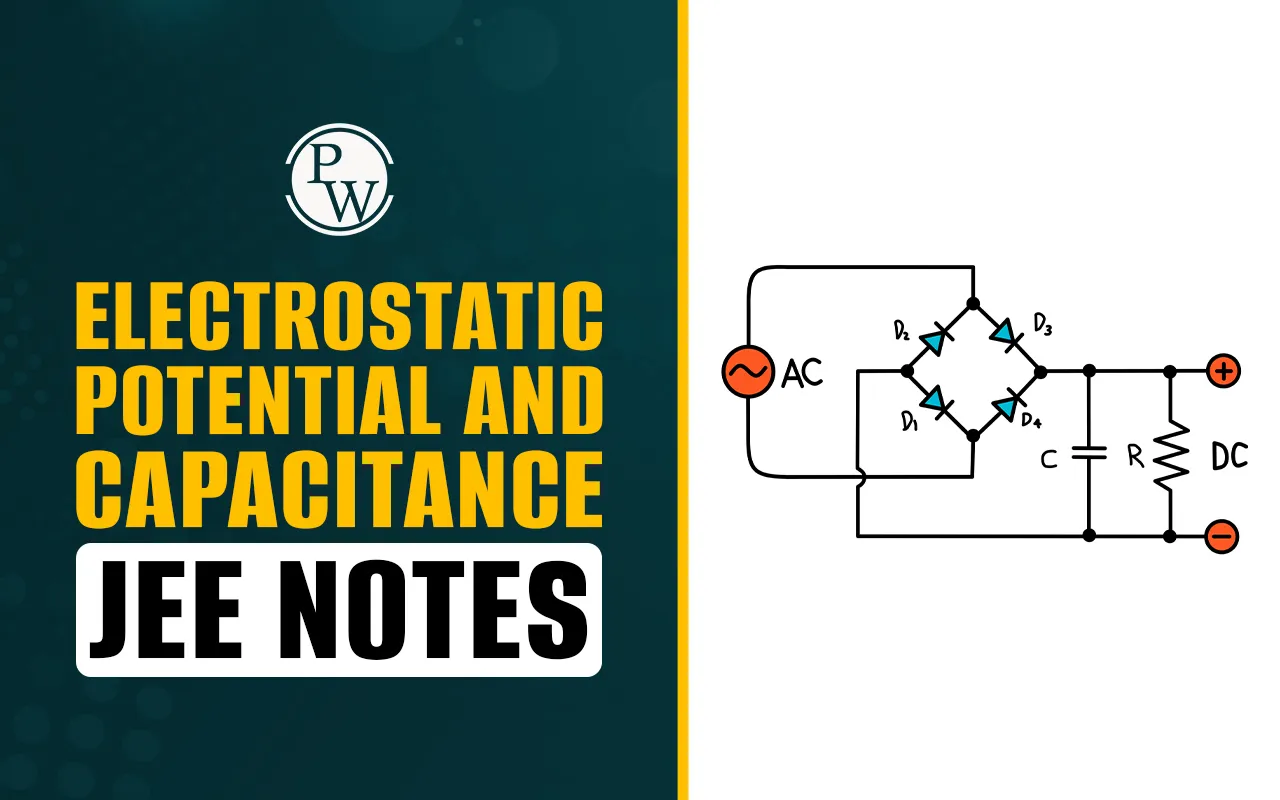
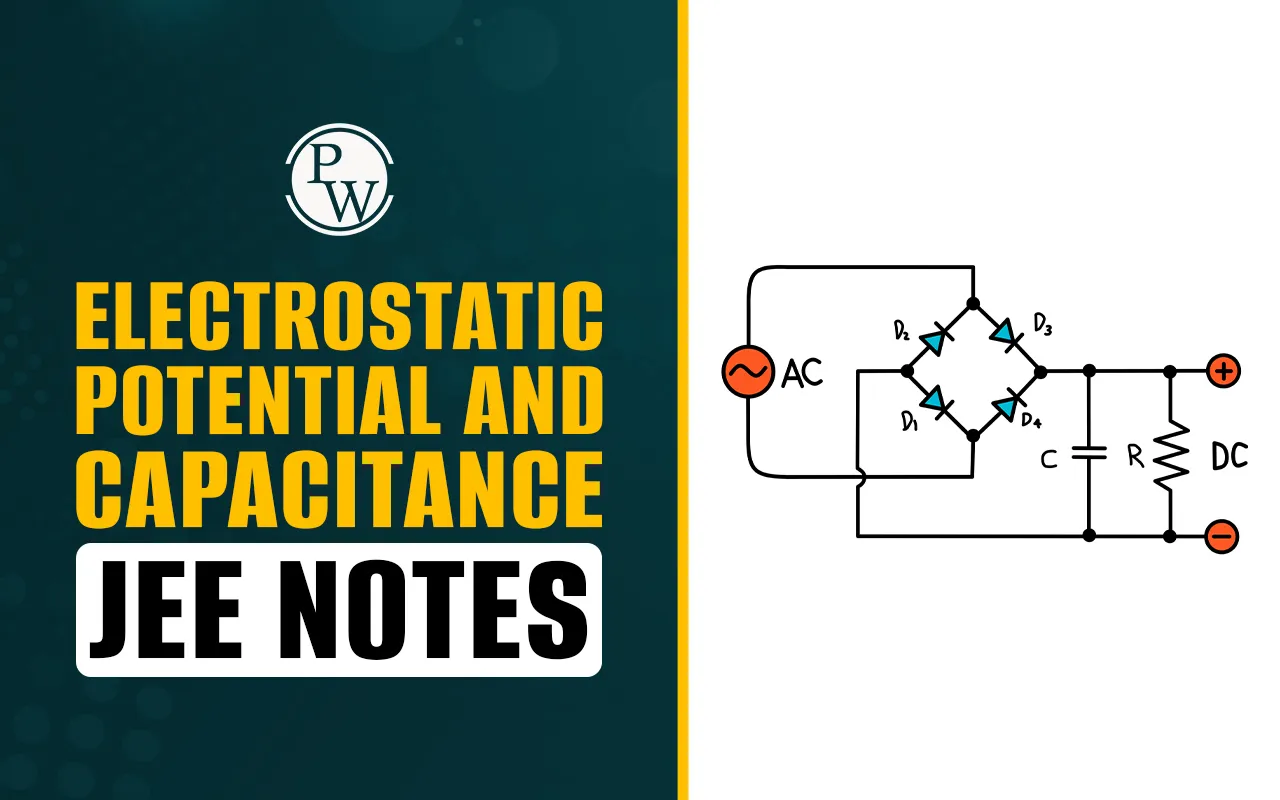
Electrostatics and capacitance form the foundation for several advanced topics in Physics, including current electricity and electromagnetism. Through this chapter, you learn how charged particles interact, how electric fields influence their surroundings, and how electrical energy can be stored.
Since the concepts are interconnected, developing a clear understanding of the basics can help you solve a wide variety of questions in competitive examinations. If you practise regularly and strengthen your fundamentals, this chapter can become one of the most rewarding topics of JEE Physics.
Understanding Electric Charges
The chapter begins with the basic properties of electric charges and the forces acting between them. Once these ideas become clear, solving advanced questions becomes much easier.
Conservation of Charge
Conservation of charge states that electric charge can neither be created nor destroyed. You should understand this principle because it forms the basis of many electrostatic phenomena.
Quantisation of Charge
Electric charge exists in discrete units and is always an integral multiple of the elementary charge. Questions based on quantisation often test conceptual understanding.
Superposition Principle
The superposition principle explains that the net force acting on a charge is equal to the vector sum of individual forces due to all surrounding charges.
Conductors and Insulators
Conductors allow charges to move freely, whereas insulators restrict their movement. Understanding their behaviour is important when studying charge distribution.
Coulomb's Inverse Square Law
Coulomb's law describes the electrostatic force between two charges and shows how force varies with distance. You should understand that electrostatic force is directly proportional to the product of charges and inversely proportional to the square of the distance between them.
Questions from this topic often involve multiple charges placed at different locations, requiring careful analysis.
Electric Field
The concept of an electric field explains how charges exert influence in the surrounding space. Instead of considering only force, you study the region in which another charge experiences an effect.
Electric Field Intensity
Electric field intensity represents the force experienced by a unit positive charge placed at a point in space. You should understand both its magnitude and direction.
Electric Field Due to a Point Charge
The electric field produced by a point charge decreases with increasing distance. This concept serves as the foundation for more advanced field calculations.
Electric Field Due to a Dipole
Electric dipoles produce characteristic field patterns along axial and equatorial positions. You should practise these configurations because they are commonly tested.
Electric Field Lines
Electric field lines help visualise the direction and strength of electric fields. Their properties are often included in conceptual questions.
Uniform Electric Field
A uniform electric field has a constant magnitude and direction throughout a region. Parallel plate capacitors provide a common example.
Gauss's Law
Gauss's law provides a convenient method for determining electric fields in systems with symmetry. It simplifies calculations that may otherwise become lengthy using Coulomb's law.
The applications generally involve:
Spherical Charge Distributions
Gauss's law simplifies electric field calculations for uniformly charged spheres because of spherical symmetry.
Infinite Line Charges
You should understand how cylindrical symmetry helps determine the electric field around infinitely long charged wires.
Charged Conducting Shells
Questions may involve electric fields both inside and outside conducting shells, making this an important application.
Plane Sheets of Charge
Infinite plane sheets produce a constant electric field independent of distance. This concept is frequently used in problem-solving.
Electric Field and Flux
An electric field represents the region around a charged object where another charge experiences a force. Instead of memorising formulas, you should try to visualise how field lines behave around different charge distributions.
Key areas to focus on are:
|
Topic |
What You Should Know |
|
Electric Field |
Magnitude and direction |
|
Field Lines |
Properties and patterns |
|
Electric Dipole |
Field along axial and equatorial positions |
|
Electric Flux |
Flux through different surfaces |
|
Gauss's Law |
Symmetry-based applications |
Gauss's law is particularly useful because it simplifies calculations for highly symmetrical systems.
Electric Potential and Potential Energy
Electric potential describes the amount of work required to move a unit positive charge from one point to another.
Electric Potential
Electric potential represents the work done in bringing a unit positive charge from infinity to a given point.
Potential Difference
Potential difference determines the amount of energy required to move a charge between two locations.
Potential Due to Point Charges
You should understand how individual potentials combine because the principle of superposition is applicable in potential calculations.
Potential Due to a Dipole
Electric dipoles generate varying potentials at different positions, particularly along axial and equatorial lines.
Potential Energy of Charge Systems
Potential energy explains the energy stored due to the arrangement of charges within a system.
Equipotential Surfaces
Equipotential surfaces connect points having the same electric potential. Electric field lines are always perpendicular to these surfaces.
Capacitance
Capacitance deals with the storage of electrical energy in electric fields. It is one of the most scoring topics within Electrostatics.
Important Capacitance Concepts
|
Area |
Why It Matters |
|
Dielectrics |
Improves conceptual understanding |
|
Capacitor Combination |
Frequently asked in JEE |
|
Stored Energy |
Useful for numerical questions |
|
Potential Difference |
Connected with charge distribution |
Electrostatics and Capacitance is a fundamental chapter in JEE Physics that helps you understand how electric charges interact and how electrical energy can be stored. By building a strong grasp of electric fields, potential, Gauss's law, and capacitors, you can tackle a wide range of conceptual and numerical questions with confidence. Regular practice, formula revision, and problem-solving can make this chapter a reliable scoring area in both JEE Main and JEE Advanced.
Electrostatics and Capacitance JEE FAQs
Is Electrostatics and Capacitance a high-weightage topic in JEE?
Which concepts need the most attention?
Are derivations necessary for JEE?
Is NCERT enough for this chapter?













 Live & recorded classes available at easeDashboard for progress trackingMillions of practice questions at your fingertips

