








IIM Rohtak IPMAT Syllabus 2027: Sectional Topics & Exam Pattern

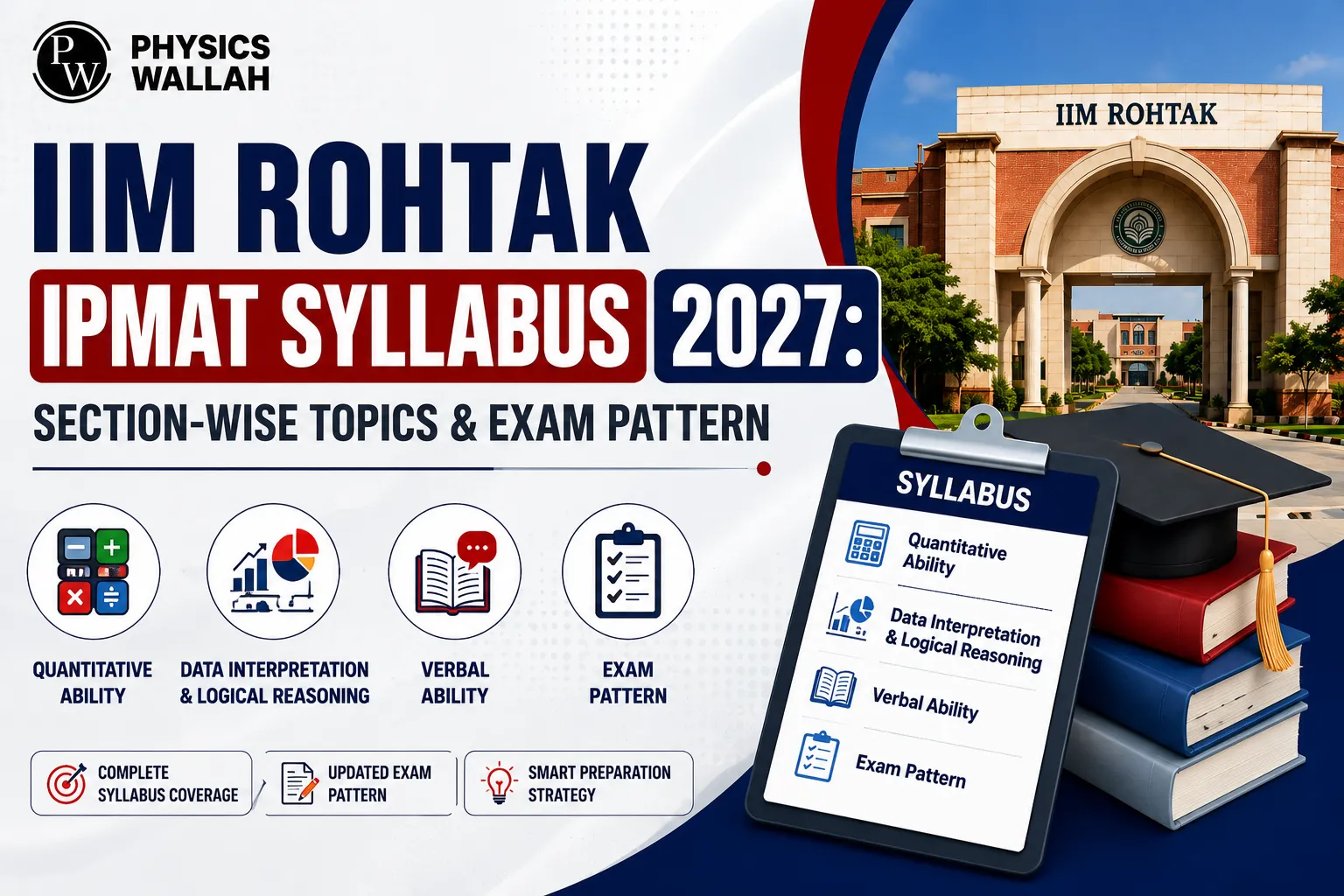
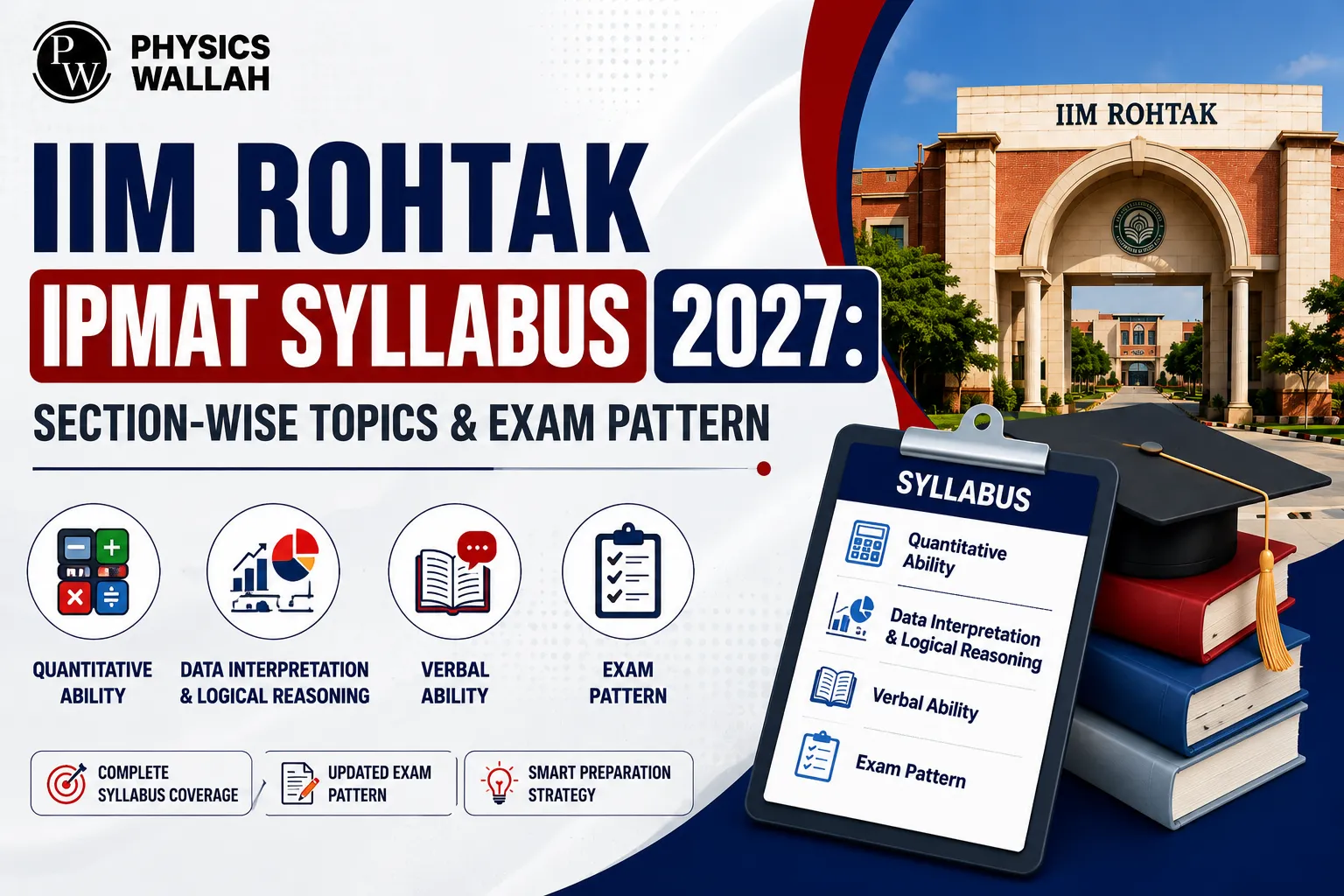
Securing a seat in the 5-year Integrated Programme in Management (IPM) at IIM Rohtak requires a clear understanding of its unique entrance structure. Unlike other aptitude tests, the IIM Rohtak IPMAT focuses heavily on speed and logic. With the 2027 cycle approaching, students must prepare for a test that gives equal weight to mathematical ability, reasoning skills, and language command.
The IIM Rohtak entrance exam stands out because it includes a dedicated Logical Reasoning section, which is absent as a separate section in the Indore pattern. This means your preparation must be balanced across all three modules to ensure a high overall percentile.
IIM Rohtak IPMAT Exam Pattern 2027 Overview
The exam is conducted as a computer-based test (CBT) with a strict sectional time limit. You cannot jump between sections: you must complete the assigned 40 minutes for one before the system moves you to the next.
| Feature | Details |
| Exam Mode | Computer-Based Test (CBT) |
| Total Questions | 120 Multiple Choice Questions (MCQs) |
| Duration | 120 Minutes (40 mins per section) |
| Marking Scheme | +4 for correct answer: -1 for incorrect answer |
| Sections | QA, LR, and VA (40 questions each) |
Also Read : IPMAT Rohtak Eligibility
Detailed Section-wise IIM Rohtak IPMAT Syllabus
The syllabus for 2027 is categorized into three core areas. While the topics generally cover Class 10 to 12 standards, the application of concepts is more competitive and time-sensitive.
1. Quantitative Ability (QA)
The Quantitative Ability section measures your comfort with numbers and your ability to solve mathematical problems under pressure. Arithmetic usually carries the highest weightage in this section.
-
Arithmetic: You must master Percentages, Profit and Loss, Simple and Compound Interest, and Ratio and Proportion. Topics like Time, Speed and Distance, and Averages are frequently tested.
-
Algebra: Focus on Linear and Quadratic Equations, Inequalities, Logarithms, and Progressions (AP/GP).
-
Number System: Study HCF and LCM, Divisibility Rules, Factors and Multiples, and the Remainder Theorem.
-
Modern Math: This includes Set Theory, Permutation and Combination, and Probability.
-
Geometry: Expect questions on Triangles, Circles, Polygons, and Coordinate Geometry.
-
Data Interpretation: Basics of Bar Graphs, Tables, and Pie Charts to test your analytical speed.
2. Logical Reasoning (LR)
The LR section is the "X-Factor" for IIM Rohtak aspirants. It tests your critical thinking and your ability to identify hidden patterns within data.
-
Analytical Reasoning: Linear and Circular Seating Arrangements, Blood Relations, and Direction Sense.
-
Logical Deductions: Syllogisms, Venn Diagrams, Analogies, and identifying the "Odd One Out."
-
Sequence and Series: Number and Letter Series, Coding-Decoding, and Missing Term problems.
-
Critical Reasoning: Evaluating Statement and Assumptions, Cause and Effect, and Course of Action.
-
Miscellaneous: Clocks, Calendars, Cubes, and Input-Output sequences.
Also Read : What is a good Score in IPMAT Rohtak ?
3. Verbal Ability (VA)
This section evaluates your proficiency in English, covering grammar, vocabulary, and reading speed. It is not about literary knowledge, but rather the practical use of the language.
-
Vocabulary: Focus on Synonyms, Antonyms, Idioms, and Phrases. Confusing words and spellings are also common.
-
Grammar: Mastery of Parts of Speech, Tenses, Subject-Verb Agreement, Articles, and Prepositions is mandatory.
-
Reading Comprehension: Expect passages followed by direct, factual questions and inference-based questions.
-
Verbal Logic: Para Jumbles, Sentence Completion, and Sentence Correction.
Key Differences: IPMAT Rohtak vs. IPMAT Indore
A common question for 2027 aspirants is how these two exams differ.
-
Logical Reasoning: Rohtak has a dedicated LR section: Indore does not.
-
Short Answers: Rohtak only uses Multiple Choice Questions (MCQs), while Indore includes a "Short Answer" (SA) math section where you must type the answer.
-
Difficulty vs. Speed: Indore is often cited as more mathematically challenging, while Rohtak tests your ability to solve 120 questions in a tight 120-minute window.
Effective Preparation Strategy for 2027
Success in the IIM Rohtak entrance depends on how you manage your 40-minute sectional blocks.
-
Arithmetic Mastery: Since arithmetic dominates the math section, ensure you can solve these without using a calculator.
-
Logic Practice: Spend time daily on puzzles and arrangements. These are the most time-consuming topics in the Logical Reasoning section.
-
Read Editorials: Regular reading helps in understanding complex Reading Comprehension passages quickly, saving you vital minutes during the exam.
-
Sectional Mocks: Take mock tests that specifically simulate the sectional timer. This prepares your brain for the switch from math to logic to verbal.
IIM Rohtak IPMAT Syllabus FAQs
What is the marking scheme for the IIM Rohtak IPMAT?
Does IIM Rohtak have a sectional cutoff?
Can science or humanities students apply for IIM Rohtak IPMAT?
How many seats are available at IIM Rohtak for the IPM program?
Is the IPMAT Rohtak syllabus difficult?


Have questions about your prep?
Our experts can answer all your questions

 Live & recorded classes available at easeDashboard for progress trackingLakhs of practice questions

