NCERT Solutions for Class 10 Social Science Civics Chapter 2 explains the concept of Federalism in a clear and exam-oriented manner as prescribed in the CBSE Class 10 syllabus.
Federalism Class 10 questions and answers help you understand how power is constitutionally divided between the Union government, State governments, and local bodies, ensuring efficient governance, balanced administration, and national unity. Understanding these key concepts is crucial for your Class 10 board exams, aiding in better preparation and performance.
Federalism Class 10 NCERT Solutions
Below are the NCERT Solutions for Class 10 Civics Chapter 2 question answers. These solutions cover all the exercises and questions provided in the chapter, and provide a comprehensive understanding of the concept of federalism.
By going through these NCERT Solutions, students can clarify their doubts and strengthen their knowledge of federalism and its significance in the political system.
Exercises
1. Locate the following States on a blank outline political map of India: Manipur, Sikkim, Chhattisgarh and Goa.
Answer.
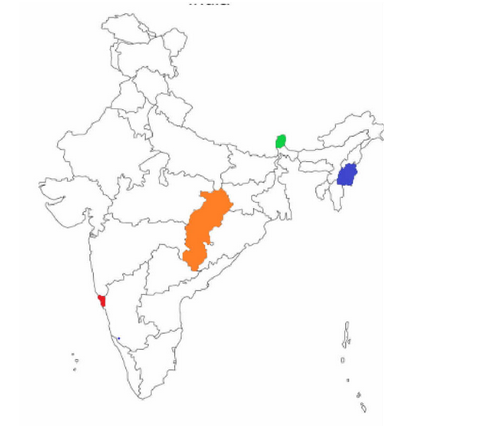
| Green – SikkimBlue – Manipur, Orange – Chhattisgarh, Red – Goa |
2. Identify and shade three federal countries (other than India) on a blank outline political map of the world.
Answer.
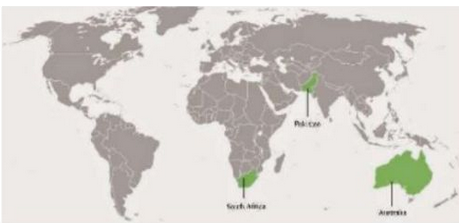
- South Africa
- Pakistan
- Australia
3. Point out one feature in the practice of federalism in India that is similar to and one feature that is different from that of Belgium.
Answer.
A similarity between the practice of federalism in India and Belgium is the aspect of power-sharing between the union government and state governments. However, a notable difference is that India lacks a community government in practice, whereas Belgium has one.
4. What is the main difference between a federal form of government and a unitary one? Explain with an example.
Answer.
| Federal Form |
Unitary Form |
| There is a sharing of power between the union and the state government. |
The power is centralised with the union government, and there is no role of state governments. |
| Example – India (India is a federal country with union government at the centre and state governments at the state level and Panchayati Raj at the local level.) |
Example – Sri Lanka (The national government has all the powers.) |
5. State any two differences between the local government before and after the constitutional amendment in 1992.
Answer.
| Local Government Pre-1992 |
Local Government Post Constitutional Amendment 1992 |
| Elections to these local governments were not held regularly |
Now, it is constitutionally mandated to hold regular elections to local government bodies |
| Local governments did not have any powers or resources of their own. |
The State governments are required to share some powers and revenue with local government bodies. The nature of sharing varies from state to state. |
6. Fill in the blanks:
Since the United States is a ___________________ type of federation, all the constituent States have equal powers and States are ______________vis-à-vis the federal government. But India is a _____________________ type of federation and some States have more power than others. In India, the ____________ government has more powers.
Answer.
In the United States, which follows a "coming together" type of federation, all constituent states possess equal powers, making them strong in relation to the federal government. However, in India, a "holding together" type of federation, some states wield more power than others. Here, the central government holds greater authority.
7. Here are three reactions to the language policy followed in India. Give an argument and an example to support any of these positions.
Sangeeta: The policy of accommodation has strengthened national unity.
Arman: the Language-based States have divided us by making everyone conscious of their language.
Harish: This policy has only helped to consolidate the dominance of English over all other languages.
Answer.
Sangeeta's advocacy for the policy of accommodation is a fitting response to India's language policy. This approach fosters unity among states with diverse linguistic backgrounds. Without such accommodation, there might have been demands for secession from several states, posing a threat to India's integrity.
8. The distinguishing feature of a federal government is:
- The national government gives some powers to the provincial governments.
- Power is distributed among the legislature, executive and judiciary.
- Elected officials exercise supreme power in the government.
- Governmental power is divided between different levels of government
Answer.
d. Governmental power is divided between different levels of government
9. A few subjects in various Lists of the Indian Constitution are given here. Group them under the Union, State and Concurrent Lists as provided in the table below.
- Defence
- Police
- Agriculture
- Education
- Banking
- Forests
- Communications
- Trade
- Marriages
Answer.
| Union List |
Defence |
Communications |
Banking |
| State List |
Police |
Agriculture |
Trade |
| Concurrent List |
Education |
Forests |
Marriages |
10. Examine the following pairs that give the level of government in India and the powers of the government at that level to make laws on the subjects mentioned against each. Which of the following pairs is not correctly matched?
| State government |
State List |
| Central government |
Union List |
| Central and State governments |
Concurrent List |
| Local governments |
Residuary powers |
Answer.
| Local governments |
Residuary powers |
11. Match List-I with List-II and select the correct answer using the codes given below the lists:
| List-I |
List-II |
| Union of India |
Prime Minister |
| State |
Sarpanch |
| Municipal Corporation |
Governor |
| Gram Panchayat |
Mayor |
Answer.
| List-I |
List-II |
| Union of India |
Prime Minister |
| State |
Governor |
| Municipal Corporation |
Mayor |
| Gram Panchayat |
Sarpanch |
12. Consider the following two statements.
- In a federation, the powers of the federal and provincial governments are clearly demarcated.
- India is a federation because the powers of the Union and State Governments are specified in the Constitution and they have exclusive jurisdiction on their respective subjects.
- Sri Lanka is a federation because the country is divided into provinces.
- India is no longer a federation because some powers of the States have been devolved to the local government bodies.
Which of the statements given above are correct?
- A, B and C
- A, C and D
- A and B only
- B and C only
Answer.
(c) A and B only
How NCERT Solutions for Class 10 Social Science Civics Chapter 2 are Helpful in Board Exams
NCERT Solutions for Class 10 Social Science Civics Chapter 2 are essential for board exam preparation. They provide clear concept explanations, structured answers, and exam-oriented practice, helping students effectively understand federalism and governance. These solutions ensure thorough revision for better performance.
-
Clear Concept Understanding: The solutions provide detailed explanations of key concepts like federalism, ensuring students fully understand the distribution of power, which is critical for board exam questions.
-
Well-structured Answers: NCERT solutions help students understand how to structure their answers, particularly for long-answer questions, ensuring that they are both precise and comprehensive.
-
Exam-oriented Practice: The solutions are designed in line with the CBSE Class 10 exam pattern, helping students practice questions that are likely to appear in the board exams, boosting their exam preparation.
-
Effective Revision Tool: These solutions serve as a quick and easy reference for revision, helping students retain important concepts and facts needed for their board exams.