Development of Female Gametophyte, Definition, Stages, and Functions
Development of Female Gametophyte, Learn about the development of the female gametophyte, its definition, and function. This topic is crucial for understanding plant reproduction.
 Krati Saraswat5 Jun, 2025
Development of female gametophyte is a vital topic in plant reproduction and has significant importance in biology. It helps explain key processes like fertilization and double fertilization. The female gametophyte, also called the embryo sac, is a critical structure in the reproduction of flowering plants. It is a haploid structure formed inside the ovule, located within the ovary of a flower. This topic is vital for understanding plant reproduction and is important for the NEET Exam .
Development of Female Gametophyte
The development of the female gametophyte is an essential process in the life cycle of flowering plants. It plays a significant role in sexual reproduction, ensuring the production of viable female gametes. The female gametophyte is also known as the embryo sac, and its formation takes place inside the ovule, which is located in the ovary of the flower.Definition of Gametophyte
A gametophyte is the haploid phase in the life cycle of plants that produces gametes—male and female reproductive cells. In flowering plants, the female gametophyte is formed through a specialized process called megasporogenesis and megagametogenesis.Stages in the Development of Female Gametophyte
The formation of the female gametophyte occurs in two primary stages:Megasporogenesis
Megasporogenesi s refers to the process of forming megaspores from the megaspore mother cell (MMC) through meiosis. The steps involved are:- Initiation in the Ovule : The development begins with the differentiation of a single cell in the nucellus called the megaspore mother cell (MMC). The MMC is diploid (2n) and undergoes meiosis.
- Formation of Megaspores : Meiosis in the MMC results in the production of four haploid (n) megaspores arranged in a linear tetrad. Out of these four, only one megaspore located at the chalazal end becomes functional. The other three degenerate and disintegrate.
Megagametogenesis
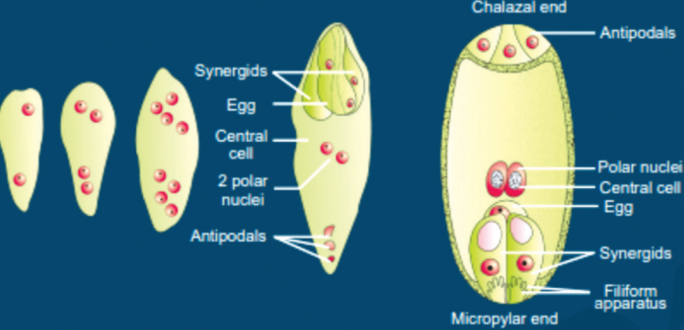
Megagametogenesis is the process by which the functional megaspore develops into the mature female gametophyte (embryo sac) through mitosis. The steps include:- Mitotic Divisions : The functional megaspore undergoes three rounds of mitotic division, resulting in an eight-nucleate structure.
- Organization into Cells : These eight nuclei are arranged in specific locations:
- Three nuclei move to the micropylar end to form the egg apparatus, consisting of one egg cell and two synergids.
- Three nuclei move to the chalazal end, forming antipodal cells.
- Two nuclei remain in the center of the embryo sac and form the polar nuclei, which later fuse to form a diploid secondary nucleus.
- Final Structure : The mature embryo sac has seven cells (three antipodal cells, two synergids, one egg cell, and one central cell) but contains eight nuclei.
Functions of Female Gametophyte
The female gametophyte performs several important functions during the plant's reproductive process:- The egg cell within the gametophyte acts as the female gamete.
- The synergids guide the pollen tube, ensuring successful fertilization by directing the male gamete to the egg cell.
- The central cell's secondary nucleus fuses with one male gamete to form the endosperm, which provides nourishment to the developing embryo.
- The female gametophyte provides the environment necessary for the initial stages of embryogenesis.
MCQs of Development of Female Gametophyte
Q1. An ovule generally has a single embryo sac formed from a megaspore through;
- reduction divisions.
- mitotic divisions.
- mitotic division followed by meiotic division.
- meiotic divisions followed by mitotic division.
Q2. Functional megaspore in an angiosperm develops into:
- Ovule
- Endosperm
- Embryo sac
- Embryo
Q3. The functional megaspore is referred to as;
- megasporangium
- female gamete
- ovule
- embryo sac
Answers of MCQs of Development of Female Gametophyte
Ans1. Mitotic Divisions.,| NEET Exam Important Links | |
|---|---|
| NEET Biology Syllabus | NEET Biology Diagrams |
| NEET Biology MCQ | NEET Biology Chapter wise Weightage |
| NEET Biology Notes | NEET Previous Year Question papers |
Development of Female Gametophyte FAQs
Q. What is the process of female gametophyte development?
Ans. The female gametophyte develops in two stages: megasporogenesis, where a megaspore is formed through meiosis, and megagametogenesis, where the functional megaspore undergoes mitosis to form the embryo sac.
Q. What is the sequence of development of female gametophytes?
Ans. The sequence includes (1) meiosis in the megaspore mother cell to form megaspores, (2) degeneration of three megaspores, and (3) mitosis of the functional megaspore to form the mature embryo sac.
Q. What is the development of female gametophytes without fertilization?
Ans. The development of the female gametophyte without fertilization is called apomixis, where the embryo sac forms directly from the diploid megaspore mother cell or nucellar cells.
Q. What is the development of the male gametophyte?
Ans. The male gametophyte develops in pollen grains through microsporogenesis, forming microspores, and micro gametogenesis, where the microspores undergo mitosis to produce sperm cells within the pollen tube.


🔥 Trending Blogs


Talk to a counsellorHave doubts? Our support team will be happy to assist you!


Join 15 Million students on the app today!
 Live & recorded classes available at easeDashboard for progress trackingMillions of practice questions at your fingertips


Free Learning Resources
PW Books
Notes (Class 10-12)
PW Study Materials
Notes (Class 6-9)
Ncert Solutions
Govt Exams
Our Other Websites
Class 6th to 12th Online Courses
Govt Job Exams Courses
UPSC Coaching
Defence Exam Coaching
Gate Exam Coaching
Other Exams
Know about Physics Wallah
Physics Wallah is an Indian edtech platform that provides accessible & comprehensive learning experiences to students from Class 6th to postgraduate level. We also provide extensive NCERT solutions, sample paper, NEET, JEE Mains, BITSAT previous year papers & more such resources to students. Physics Wallah also caters to over 3.5 million registered students and over 78 lakh+ Youtube subscribers with 4.8 rating on its app.
We Stand Out because
We provide students with intensive courses with India’s qualified & experienced faculties & mentors. PW strives to make the learning experience comprehensive and accessible for students of all sections of society. We believe in empowering every single student who couldn't dream of a good career in engineering and medical field earlier.
Our Key Focus Areas
Physics Wallah's main focus is to make the learning experience as economical as possible for all students. With our affordable courses like Lakshya, Udaan and Arjuna and many others, we have been able to provide a platform for lakhs of aspirants. From providing Chemistry, Maths, Physics formula to giving e-books of eminent authors like RD Sharma, RS Aggarwal and Lakhmir Singh, PW focuses on every single student's need for preparation.
What Makes Us Different
Physics Wallah strives to develop a comprehensive pedagogical structure for students, where they get a state-of-the-art learning experience with study material and resources. Apart from catering students preparing for JEE Mains and NEET, PW also provides study material for each state board like Uttar Pradesh, Bihar, and others
Copyright © 2026 Physicswallah Limited All rights reserved.